Thea Energy has announced a major collaboration to develop the first digital twin of a stellarator fusion power plant.
The company is working with NVIDIA, Synopsys, Argonne National Laboratory (ANL), and Princeton Plasma Physics Laboratory (PPPL) on the project. The goal is to speed up the design and deployment of commercial fusion energy systems.
The digital twin will serve as a detailed virtual version of Thea Energy’s planned Helios fusion power plant.
Engineers will use it to test designs, analyze performance, and simulate plant operations before construction begins. This approach aims to reduce costs, shorten development timelines, and improve decision-making.
The project aligns with the US Department of Energy’s Genesis Mission. The initiative focuses on applying artificial intelligence to solve scientific and engineering challenges. One of its priorities is accelerating the path toward commercial fusion energy.
Fusion energy works by combining light atomic nuclei to release large amounts of energy. It is the same process that powers the sun and stars. Scientists view fusion as a potential source of abundant, carbon-free electricity if it can be commercialized at large scale.
READ ALSO: Aerodata Completes AeroForce X Drone Prototype Assembly, First Flight Set for Germany
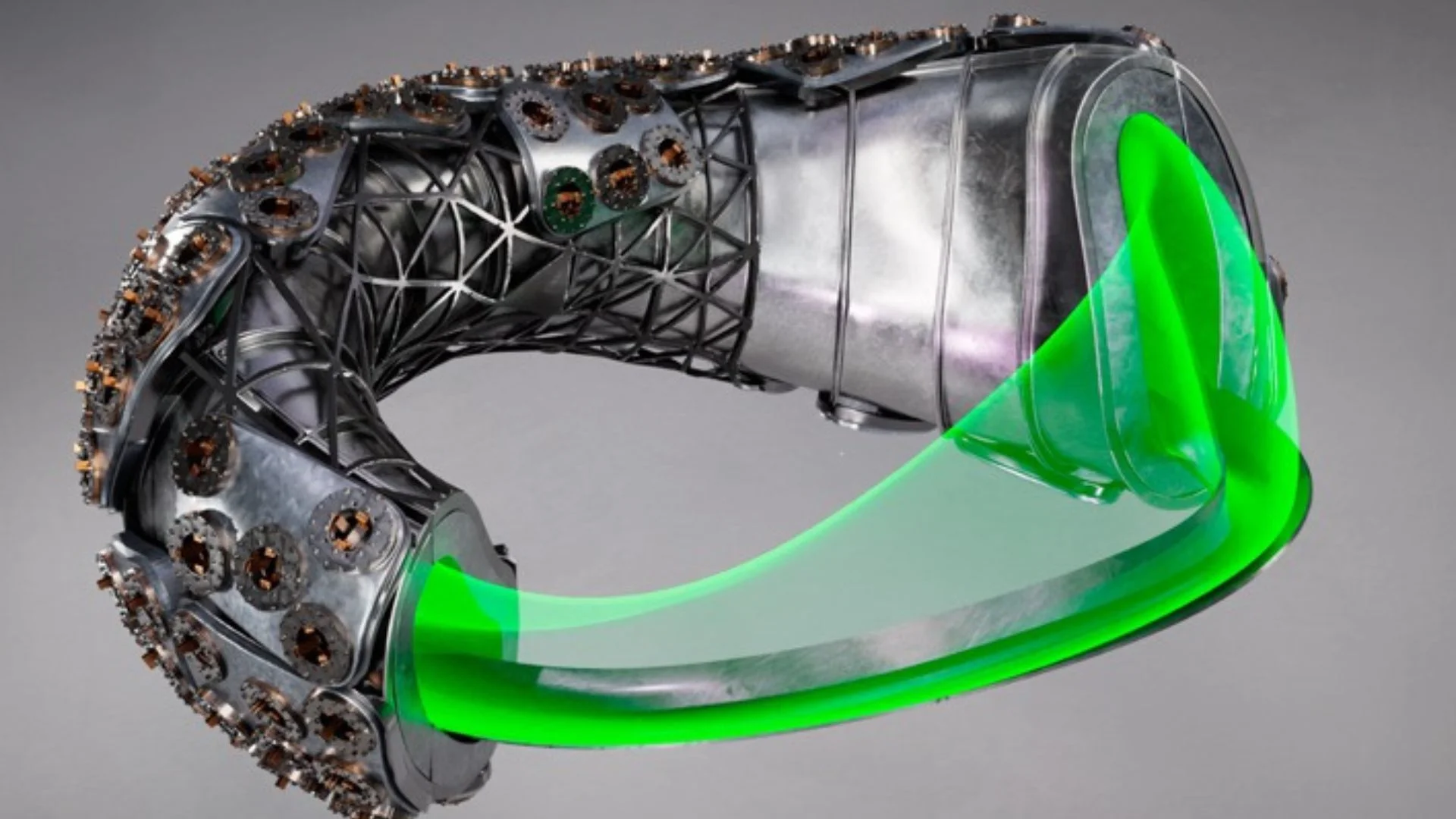
Thea Energy is developing a stellarator, a type of fusion device that uses magnetic fields to confine superheated plasma. Plasma is an extremely hot state of matter where electrons separate from atoms. Stellarators are designed to operate continuously and steadily, making them attractive for future power generation.
The company’s Helios power plant is based on a planar coil stellarator architecture. The design aims to simplify manufacturing and maintenance compared with traditional stellarator systems. Thea Energy believes this approach can help make fusion power plants more practical and scalable.
Artificial intelligence plays a central role in the company’s strategy. Thea Energy plans to use AI not only for plant design but also for operational control. AI systems can continuously analyze performance data and adjust operating conditions to maintain efficiency and compensate for equipment wear over time.
NVIDIA will contribute accelerated computing technologies and AI infrastructure to the project. The company will help integrate simulations, operational data, and engineering models into a unified digital twin platform. The system will use NVIDIA Omniverse libraries and OpenUSD technology to create an interactive environment for analysis and visualization.
By combining real-world data with advanced simulations, NVIDIA’s technology will allow engineers to evaluate plant performance much faster than traditional methods. Large datasets can be processed in real time using graphics processing units(GPUs). This provides quicker feedback during the design process.
Synopsys will contribute simulation expertise and software tools. The company will help integrate multiple engineering disciplines into a single modeling framework. This allows engineers to study how different parts of the fusion plant interact with each other.
READ ALSO: New Cryo-EM Tech Breaks Into the Elusive Realm of Tiny Protein Molecules
Digital Twin Accelerates Fusion Design
One key area of focus is the breeding blanket system. This component surrounds the fusion reaction and performs several important tasks. It captures energy from fusion reactions, helps produce fuel for the reactor, and protects critical magnet systems from intense radiation.
Argonne National Laboratory will provide expertise in neutronics and blanket design. Neutronics involves studying how neutrons behave inside nuclear systems. Understanding neutron interactions is essential for maximizing energy production and ensuring safe and efficient plant operation.
Argonne researchers will also provide simulation data that can be incorporated into the Helios digital twin. This information will help bridge existing knowledge gaps in commercial blanket system development. It will also support the creation of advanced AI models that can rapidly evaluate design changes.
Princeton Plasma Physics Laboratory will contribute plasma physics expertise and advanced computational tools. The laboratory has decades of experience studying plasma behavior in fusion systems. Its researchers will provide high-fidelity simulation codes and validated datasets.
These datasets will be used to train AI surrogate models. A surrogate model is a simplified AI representation of a complex simulation. Instead of running lengthy calculations, engineers can use these models to obtain fast and accurate predictions.
According to Thea Energy, the Helios digital twin will enable engineers to test countless operating scenarios before physical construction begins. This virtual testing environment can reveal potential issues early in the design process. Identifying problems sooner reduces risk and lowers development costs.
The collaboration also highlights a growing trend across the energy sector. Digital twins are being used in industries such as aerospace, manufacturing, and power generation. They allow companies to optimize designs and operations using virtual environments before deploying expensive physical systems.
WATCH ALSO: India recently tested carried out the successful launch of Intermediate Range Agni-Prime Missile
Thea Energy plans to operate Helios during the 2030s. Before that, the company intends to develop Eos, a large-scale demonstration system designed to achieve steady-state fusion under power-plant-relevant conditions. Lessons learned from Eos are expected to support the development of the commercial Helios facility.
The project represents another step in the broader effort to bring fusion energy closer to the electrical grid. While significant engineering challenges remain, AI-driven tools are becoming important in reducing development time and improving system design.