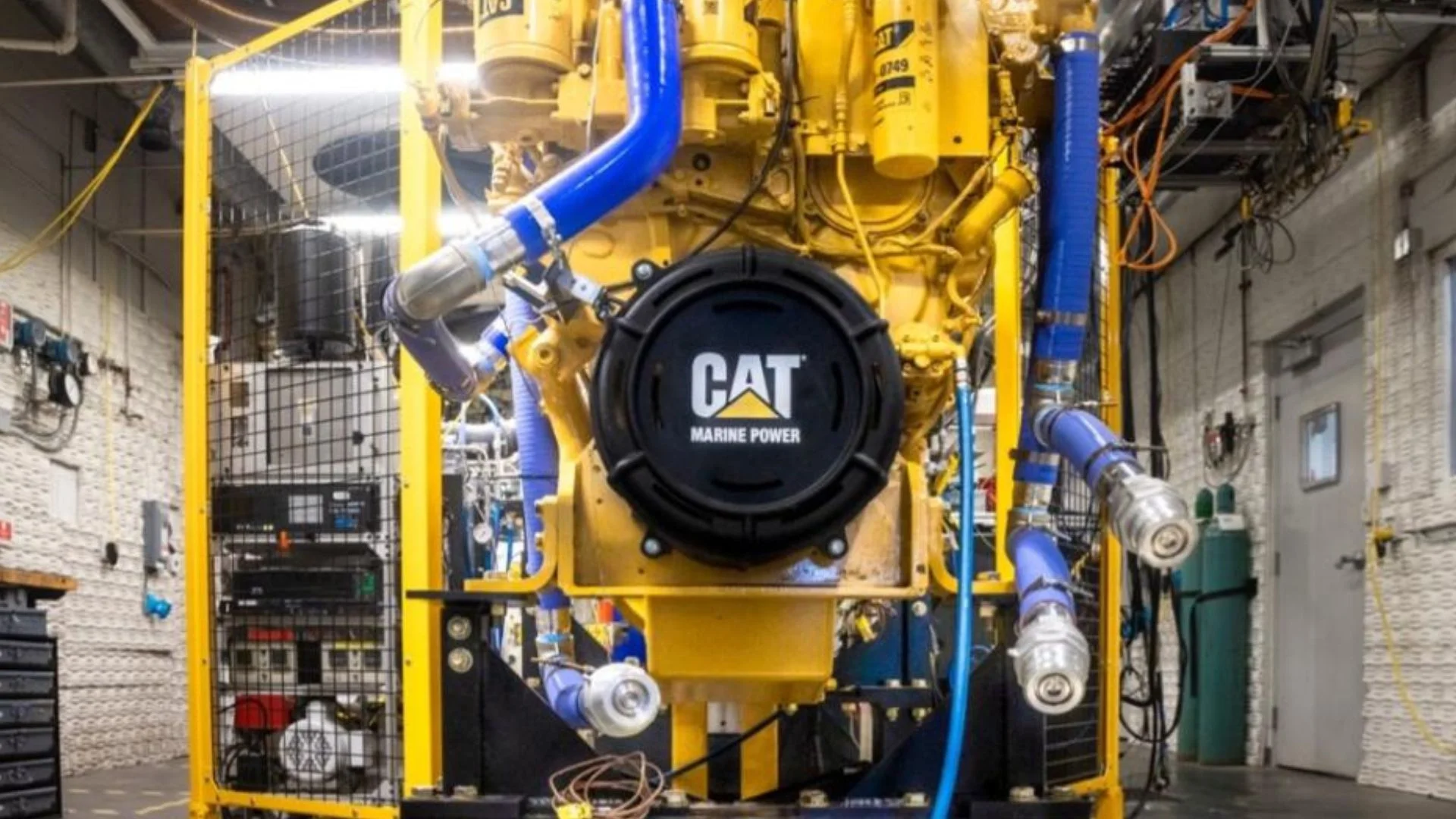
Oak Ridge National Laboratory and Caterpillar have developed a dual-fuel combustion system designed for marine diesel engines.
The technology enables vessels to use methanol alongside a small amount of diesel. It is particularly relevant for inland and coastal marine vessels seeking lower-emission fuel options.
Methanol has attracted growing interest in the shipping industry because it is easier to store and transport than many alternative fuels. It is commonly produced from natural gas, which remains widely available across global energy markets. As a liquid fuel, it can also fit more easily into existing fuel-handling systems.
The biggest challenge is that methanol does not ignite easily inside conventional compression-ignition diesel engines. Unlike diesel, methanol requires additional support to start combustion under normal operating conditions. This limitation has slowed wider adoption in marine applications.
How Methanol Dual-Fuel System Works
The new system uses a small quantity of diesel as a pilot fuel to initiate combustion. Once ignition begins, methanol provides most of the energy needed to power the engine. This approach enables stable operation across a broad range of engine loads and power settings.
According to ORNL project lead Derek Splitter, the technology allows marine engines to operate with more than 75 percent methanol without sacrificing performance. The system maintains engine capability while significantly increasing methanol use. This balance is important for vessel operators looking to reduce dependence on conventional diesel fuel.
READ ALSO: OCEANCO REVEALS BEYOND CUSTOM DESIGN: LILY
Another advantage is that the solution does not require a complete engine redesign. Existing engines would need modifications and updates, but operators would not have to replace entire propulsion systems. Engines can also continue running on diesel alone when required.
Why It Matters for Shipping Industry
Shipping companies are under immense pressure to reduce emissions and improve fuel flexibility. Methanol has emerged as one of the leading alternative marine fuels because it is easier to handle than hydrogen and requires less complex storage than some other low-carbon options. Several new ships are already being designed to operate on methanol-based fuel systems.
The ORNL-Caterpillar technology offers a practical route for existing vessels to adopt methanol without major operational compromises. By expanding the range of conditions where methanol can be used effectively, the system helps make alternative fuels more viable for everyday marine operations. This is especially important for regional shipping routes and inland waterways.
WATCH ALSO: American company’s next-generation ejection seat offers a 92% survivability rate
As the maritime sector seeks cleaner, more flexible energy solutions, technologies that simplify the transition away from conventional fuels are gaining attention.
The new dual-fuel system offers a realistic option to increase methanol use while maintaining reliable engine performance. Future deployment of similar technologies could accelerate the adoption of alternative fuels across the global shipping industry.