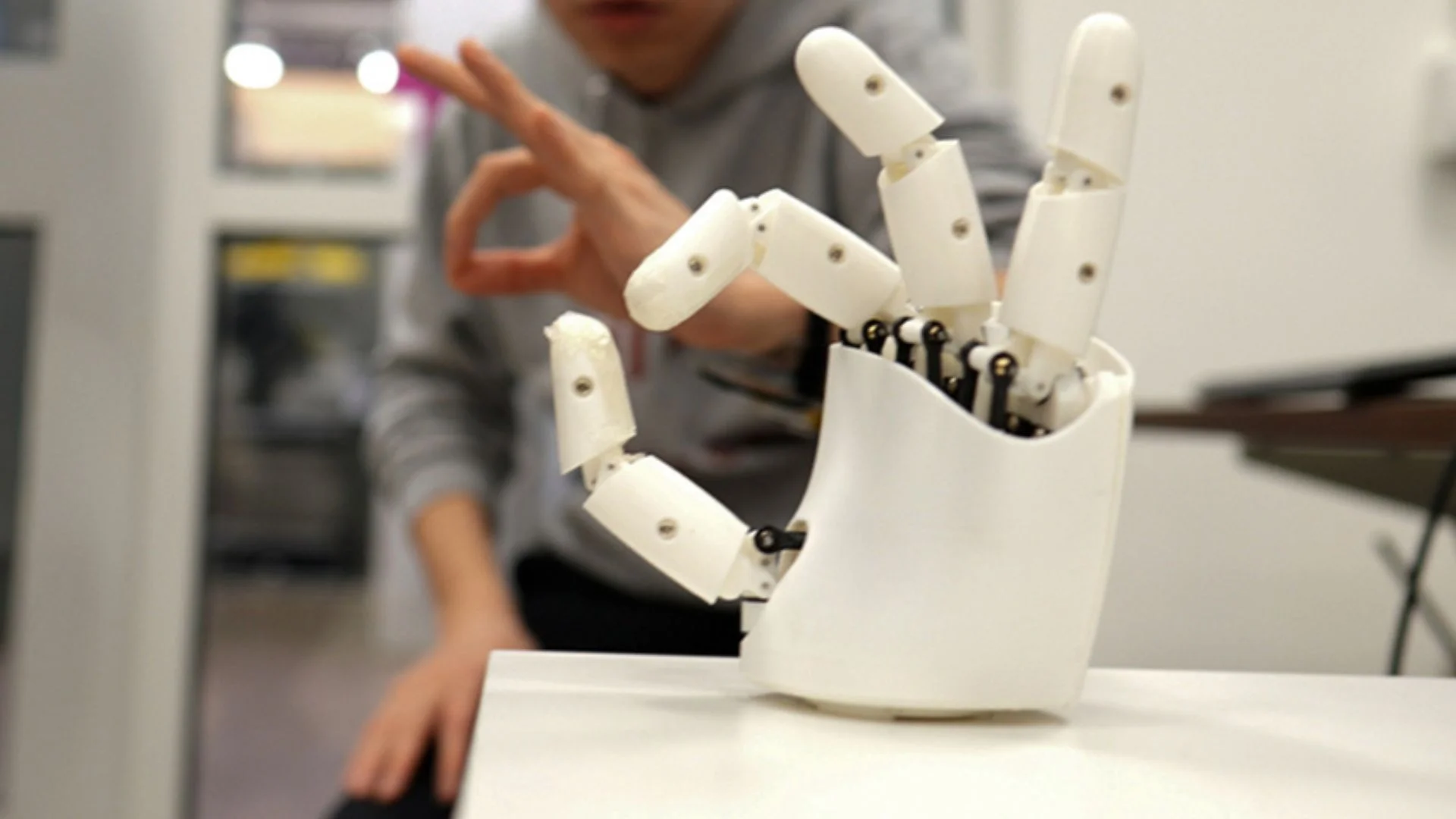
Researchers at MIT have developed a new AI-powered wristband that captures human hand movements and converts them into training data for robots.
The wearable device uses ultrasound technology to track muscles and tendons beneath the skin in real time. The system helps robotic hands replicate human actions with high accuracy.
AI and Ultrasound Combine for Better Robot Control
The wristband uses high-frequency sound waves to monitor movements inside the wrist and hand. These sound waves create images of moving muscles, tendons, and ligaments. A computer then analyzes the images and translates them into commands for a robotic hand.
The technology was developed by a team led by MIT mechanical engineering professor Xuanhe Zhao. He said the system can record how people perform everyday activities and use that information to teach robots. The goal is to help machines learn the same hand movements humans use for tasks at home and at work.
READ ALSO: Scientists discover genes to grow bigger tomatoes and eggplants
Capturing Complex Hand Movements
Human hands are highly flexible and contain 22 different degrees of freedom. These degrees of freedom describe the different ways joints can bend, rotate, and move. Replicating these movements has long been one of the biggest challenges in robotics.
MIT researchers created an AI model that decodes ultrasound images into detailed hand-motion data. This allows the system to recognize complex gestures with greater precision than many earlier approaches. Previous technologies often struggled to track even a small portion of hand movements accurately.
Wristband Captures Human Dexterity
During laboratory tests, eight volunteers used the wristband while performing different gestures. The system successfully mirrored all 26 letters of American Sign Language through a robotic hand. Researchers reported that the response occurred within about 120 milliseconds, making the interaction feel nearly instantaneous.
Building Smarter Humanoid Robots
The wristband can operate wirelessly, allowing the user and robot to remain in separate locations. This feature enables remote control of robotic systems without requiring a direct physical connection. It also opens opportunities for robots to assist in locations that are difficult or unsafe for people to access.
Researchers believe the technology can support fields that require precise hand control. Examples include household work, manufacturing, and medical procedures such as surgery. Detailed motion data collected from skilled human operators can help robots perform delicate tasks more effectively.
WATCH ALSO: Hyundai’s Atlas humanoid robot wins top honor for its advanced design and capabilities
The team also sees the wristband as a tool for creating large datasets of human hand movements. These datasets can be used to train future AI systems that power humanoid robots. As robotics companies race to build machines capable of working alongside people, technologies that teach robots human-level dexterity are becoming increasingly important.
The research highlights a growing effort to connect artificial intelligence with real-world physical skills. By translating natural human movements into robot training data, MIT’s system offers a practical path toward more capable and adaptable robotic assistants in the years ahead.