Manufacturers across the world are expanding the use of humanoids and AI-powered robotic systems as industries look for smarter ways to improve productivity and solve labor shortages.
Companies are now deploying these machines in factories, warehouses and industrial facilities where they work alongside people instead of replacing entire production lines. The latest projects also show how artificial intelligence is helping robots perform more complex tasks with greater accuracy.
Unlike traditional industrial robots that remain fixed in one position, humanoid robots are designed to move and work in spaces originally built for humans. Their human-like structure allows them to use existing equipment, walk through factory floors, and complete different jobs without major changes to workplace layouts. This flexibility makes them suitable for industries that require workers to perform varied and repetitive tasks every day.
AI Drives Manufacturing
The textile and apparel industry is among the sectors accelerating the adoption of intelligent automation. Manufacturers face growing pressure from shorter product cycles, customized customer demands and the need to control production costs while maintaining quality. As a result, many companies are investing in software, digital engineering and artificial intelligence to modernize their operations.
China-based industrial sewing machine manufacturer Jack Technology is one of the companies leading this transition. It has combined industrial AI with humanoid robotics while adopting Siemens software across product design, manufacturing, simulation and digital platform development. The company expects these technologies to improve production efficiency by at least 30 percent.
Jack Technology has also ordered 2,000 humanoid robots designed specifically for apparel manufacturing this year.
The order represents the first large-scale deployment of humanoid robots in the clothing manufacturing sector. The move highlights how AI-powered machines are becoming part of everyday factory operations rather than remaining limited to pilot projects.
READ ALSO: This Quantum Heat Engine Breaks the Rules of Heat And Cools While It Powers Up
Humanoids Handle Logistics
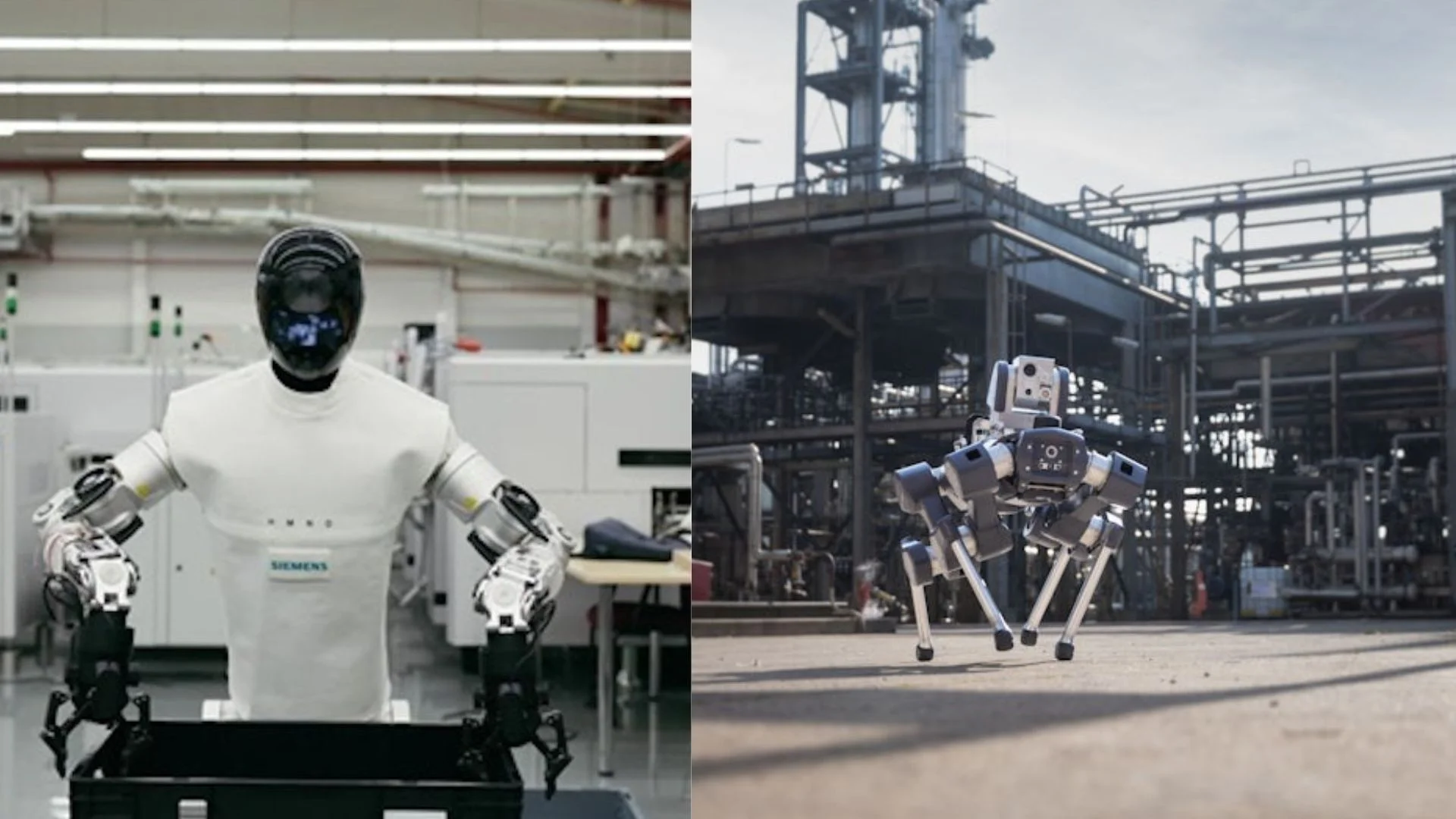
Humanoid robots are also proving their value in warehouse and logistics operations. British humanoid robotics startup Humanoid tested its wheeled Alpha robot, known as HMND 01, at Siemens’ electronics plant in Erlangen during a two-week trial. The robot used NVIDIA’s physical AI technology to move crates from one location to another before handing them over to human workers.
During the trial, HMND 01 handled two different crate sizes without requiring manual adjustments. It autonomously moved around 60 crates every hour while operating for more than eight hours each day. The robot also achieved a success rate of over 90 percent in grasping and placing crates independently.
These results demonstrate how humanoid robots can support warehouse teams by taking over repetitive physical work. Human employees can then focus on tasks that require judgment, quality checks, or problem-solving. This approach helps improve productivity while reducing physical strain on workers.
Robot Dogs Inspect
Automation is also expanding beyond factory production lines into industrial maintenance and safety inspections. Large chemical plants, refineries, and energy facilities cover vast areas where workers regularly inspect equipment operating under high temperatures and hazardous conditions. These inspections often expose personnel to dangerous environments and require significant time.
Swiss robotics company ANYbotics developed the quadruped robot ANYmal to address these challenges. Using Siemens technologies together with Roboverse Reply’s digital platform, the robot performs inspection tasks in locations that are difficult, dirty or dangerous for people to access. It collects data automatically from hundreds of inspection points during a single mission.
ANYmal builds detailed three-dimensional models of industrial facilities while moving through dark environments, staircases and multi-storey buildings without human guidance. Infrared cameras monitor the temperature of pumps and motors, while acoustic sensors detect sounds beyond human hearing. These sensors allow the robot to identify gas leaks and equipment problems before they become serious failures.
The robot sends important inspection data to plant operators in real time. Instead of waiting for equipment to fail, maintenance teams can repair problems earlier through predictive maintenance. This approach helps reduce downtime, improve safety and lower operating costs.
READ ALSO: Elbit’s Merchant Ship Drone Carrier Kit Redefines Naval Aviation With Hermes 650 Spark
Integrated Factory Systems
Experts say the effectiveness of humanoid robots depends on more than their physical design. These machines must communicate continuously with production equipment, factory software, automated guided vehicles and human workers to perform efficiently. Real-time coordination allows tasks to adjust automatically when production conditions change.
Siemens provides many of the technologies supporting this connected environment. Its portfolio includes digital twins, AI-enabled sensors, programmable logic controller interfaces, industrial communication systems, fleet management software, and drive technologies. Together, these systems create a digital infrastructure that allows multiple robots and machines to operate as part of one coordinated production network.
This integrated approach is becoming increasingly important as manufacturers adopt more autonomous equipment. Instead of deploying individual robots for isolated tasks, companies are building connected factories where machines exchange information instantly and support each other’s work. Such coordination improves efficiency across the entire production process.
The growing adoption of humanoid robots and robotic dogs reflects a broader shift towards intelligent industrial automation across multiple sectors. As AI, digital platforms, and connected factory systems continue to evolve, these technologies are expected to play a larger role in manufacturing, logistics, and industrial maintenance while helping businesses improve efficiency, safety, and operational reliability.