Scientists have developed a new type of magnet with a strong internal magnetic structure that produces almost no external magnetic field, challenging how magnets typically behave.
This rare combination has caught the attention of researchers because it can help reshape future electronics.
The findings appear in the journal Nature Chemistry. The work is led by an international team of researchers at the Technical University of Denmark (DTU), with partners from across Europe and South America.
At the center of the study is a material belonging to a special class of materials called compensated ferrimagnets. These materials behave differently from everyday magnets. Inside them, magnetic forces are strong but point in opposite directions, nearly canceling each other out. As a result, very little magnetism escapes into the surrounding space.
READ ALSO: AI Data Center Power Rush Drives 129M Greenhouse Emissions Surge Bigger Than Nations
Most conventional magnets create a noticeable magnetic field around them. That field can interfere with nearby electronic components. This interference, often described as noise, makes it harder to build compact and efficient devices. The new material avoids that problem.
“We now have a material with a very well-ordered magnetic structure, but without the magnetic field that usually causes problems in electronics,” said Professor Kasper Steen Pedersen, who led the research team.
This unusual property may help engineers design electronics in which components can be placed closer together without interfering with one another.
Today’s electronic devices rely on electric charge to carry and process information. But another approach is spintronics. In spintronics, information is carried by the spin of electrons instead of their charge. This method promises faster performance and lower energy use.
WATCH ALSO: Boston Dynamics Atlas humanoid robot demonstrates remarkable mobility, balance
However, spintronics faces a major challenge. Magnetic materials used in these systems tend to interfere with each other when packed tightly. This limits how small and efficient such devices can become.
“Magnetic materials are difficult to work with when you want to pack many functions closely together,” Pedersen explained. “But when a material emits almost no magnetic field, it becomes possible to place components much closer without unwanted interference.”
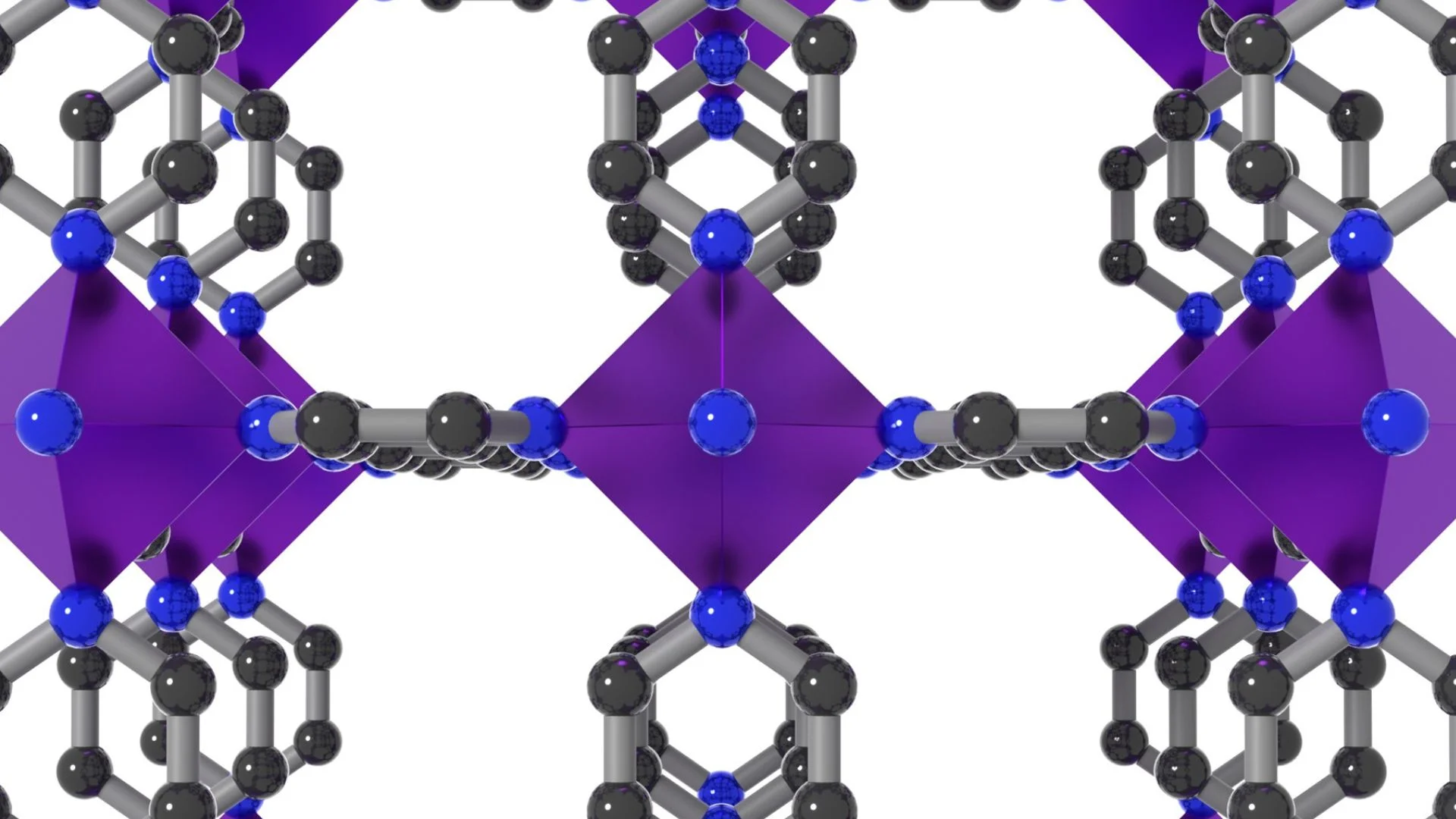
The material itself is built in a very different way compared to traditional magnets. Instead of using metal alloys or oxides, the researchers created a metal–organic network. In this structure, metal atoms are connected by organic molecules.
This design gives scientists more control. By adjusting the chemical building blocks, they can fine-tune both the material’s magnetic and electronic properties. This level of control is not easily possible with conventional magnetic materials.
The specific compound developed by the team is known as Cr(pyrazine)₃. It is made from chromium atoms linked together by a molecule called pyrazine.
READ ALSO: Talk Without Talking: AI Neckband Turns Silent Words Into Your Voice; Here’s How It Works
Pyrazine plays a key role in the material’s behavior. It carries an unpaired electron, which allows it to actively contribute to magnetism. This helps create the delicate balance in which internal magnetism is strong but external magnetism remains weak.
The structure forms a three-dimensional network. It repeats in a regular pattern, forming a stable, uniform crystal. This consistency supports the material’s reliable magnetic properties across the entire structure.
One of the most important features of the new material is its stability. Many similar materials exhibit balanced magnetism only at very specific temperatures. Outside those conditions, their properties break down.
Experiments show that its near-perfect magnetic balance remains stable across a wide temperature range. It continues to perform well even at elevated temperatures. This makes it much more practical for real-world use.
Despite the excitement, the researchers are careful about what they claim. The material has not yet been tested inside actual electronic devices. It is still at the stage of fundamental research.
“We have not created a finished technology, but we have shown that it is possible to achieve a combination of properties that many researchers have been looking for over many years,” Pedersen said.
It provides a new platform that other scientists can build on. The team now plans to explore how the material can be modified further. One key goal is to see if it can also conduct electricity, which would make it even more useful in electronic systems.
WATCH ALSO: China Sets World Record with 700 km/h Maglev
Another important step will be to produce the material in thin layers. Thin films are essential for integrating new materials into chips and circuits. If those steps succeed, the impact could extend across multiple fields.
Spintronics, in particular, stands to benefit. Devices based on electron spin could become smaller, faster, and more energy efficient. Reduced magnetic interference would allow engineers to design denser circuits without performance loss.
Beyond computing, the material may also find use in sensors and other advanced technologies that require precise control of magnetism. However, the discovery represents a shift in how scientists think about magnets.
Instead of focusing solely on strong external fields, researchers are beginning to explore materials in which magnetism remains hidden but remains powerful inside. It is a quiet kind of magnetism, but one that could speak loudly in the future of technology.