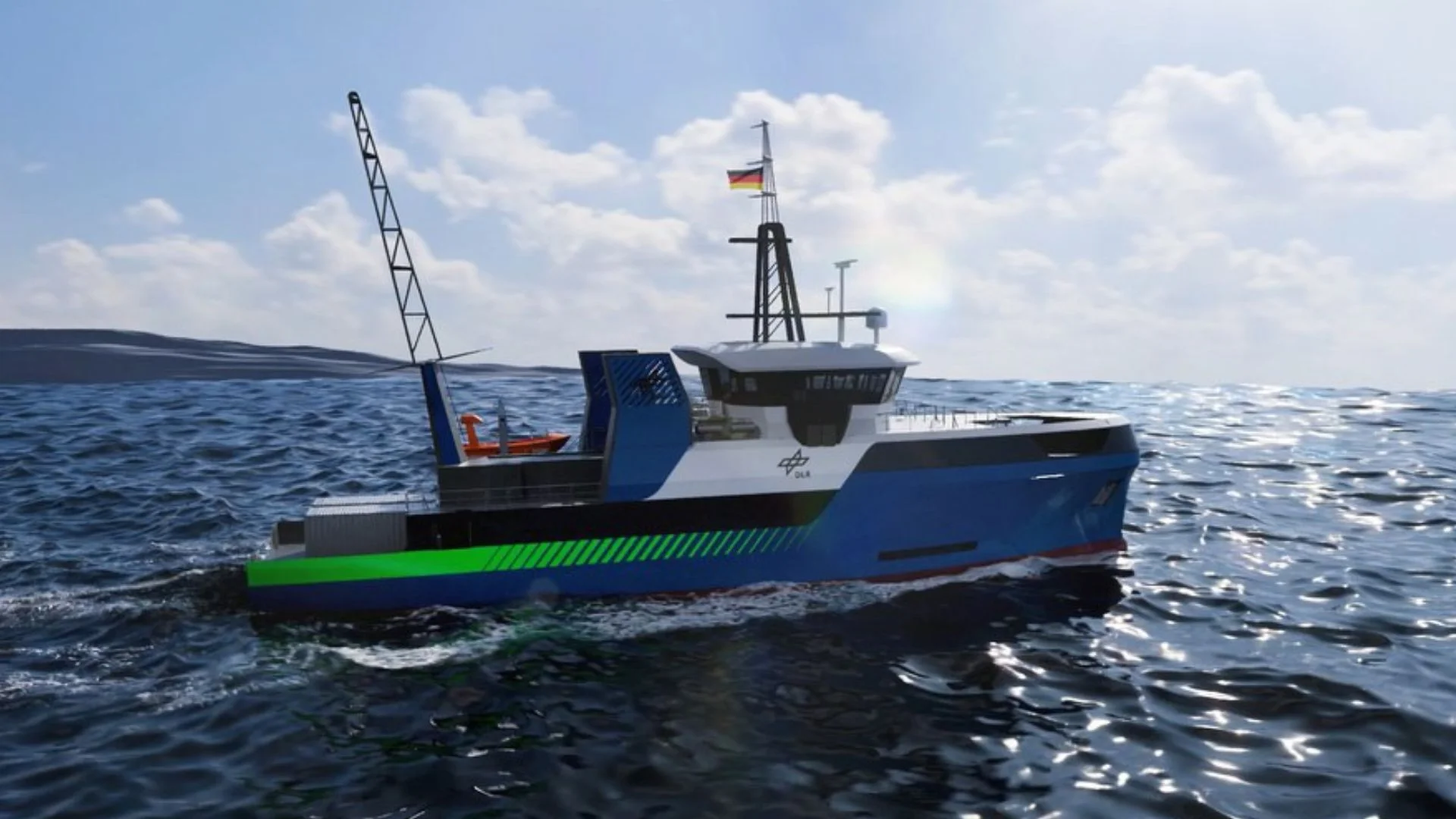
Germany has officially begun construction of MODULARIS, a new floating lab designed to test future maritime technologies at sea.
The project is led by the German Aerospace Center, DLR, and focuses on hydrogen propulsion, autonomous systems, and advanced maritime security technologies. The vessel will operate as a real-world testing platform for next-generation shipping solutions across European waters.
The keel-laying ceremony for MODULARIS took place on 20 May 2026 at the FSG Shipyard in Flensburg, northern Germany. The event marked the official start of assembly for DLR’s new seagoing technology platform. Government officials, industry leaders, and researchers attended the ceremony at the shipyard hall.
MODULARIS is designed as a floating laboratory for testing advanced maritime technologies under real operating conditions. The vessel’s name combines the word ‘modular’ with the Latin word ‘maris,’meaning ‘of the sea.’ DLR selected the name to reflect the ship’s flexible design and research-focused role.
READ ALSO: US Navy Equips Nine Destroyers With Operational Laser Weapon Systems to Counter Drone Threats
The German government is funding the project with a total investment of 36 million euros. DLR said the platform will help speed up the development and certification of future maritime systems. The project also supports Germany’s long-term strategy for cleaner and more advanced shipping technologies.
READ ALSO: Mohenjo-daro Grew More Equal as It Expanded, Challenging Urban Inequality Theories
The vessel will measure 48 meters in length and 11.5 meters in width. It will accommodate up to 20 people during research missions and sea trials. Test operations are expected to last up to 7 days.
MODULARIS will mainly operate in the North Sea, Baltic Sea, and Mediterranean Sea. These regions provide different environmental and operational conditions for technology testing. Researchers will use the vessel to study how new systems perform in real maritime environments.
Hydrogen Propulsion At Sea
DLR plans to use MODULARIS to test future propulsion technologies, including hydrogen-based systems. Researchers will also evaluate alternative fuels such as methanol and ammonia during sea operations. The vessel will feature a special experimental engine room built specifically for these trials.
Hydrogen is attracting strong interest in the shipping industry because it produces little or no carbon emissions during use. Methanol and ammonia are also being explored as cleaner alternatives to traditional marine fuels. Many countries and shipping companies are now investing heavily in low-emission maritime transport solutions.
The platform will also support research into autonomous navigation and digital maritime systems. Autonomous ships use sensors, software, and automation to operate with limited human intervention. These technologies are expected to improve safety, efficiency, and fuel management in future shipping fleets.
DLR said MODULARIS will carry redundant safety and control systems during testing. This means backup systems will remain active if one system fails during operations. Such safety measures are important because many technologies tested on board are still uncertified and experimental.
WATCH ALSO: Boston Dynamics has revealed that grippers are one of the most intricate parts of a humanoid robot
Researchers will also test advanced communication systems, sensor technologies, fuel cells, and battery solutions. Fuel cells generate electricity through chemical reactions rather than combustion. This process can reduce emissions and improve energy efficiency compared to conventional engines.
The vessel will also support uncrewed systems such as drones and remotely operated platforms. These systems are becoming increasingly important for maritime surveillance, cargo monitoring, and defense operations. Testing them at sea allows engineers to study performance in changing weather and operational conditions.
Kiel Maritime Innovation Hub
DLR is expanding its research presence in Kiel as part of the MODULARIS program. New laboratories, offices, and research facilities are being built on the MaK Campus with direct access to the sea. The expansion aims to create a major center for maritime innovation in northern Germany.
Kiel will serve as MODULARIS’s future home port after the vessel enters service in 2027. DLR said the combination of shore-based research infrastructure and a dedicated test vessel creates a unique development environment. The setup will allow researchers and industry partners to work closely together.
DLR Executive Board Chair Anke Kaysser-Pyzalla said the project will strengthen innovation, resilience, and technological sovereignty in Germany and Europe. She also invited government agencies, start-ups, and industrial companies to use the platform for joint testing activities. Small and medium-sized companies are expected to benefit from easier access to maritime testing infrastructure.
The project also highlights growing European interest in maritime security and energy independence. Governments are investing more in technologies that reduce fuel imports and strengthen domestic industrial capabilities. MODULARIS supports both goals by enabling faster testing of new propulsion and defense-related systems.
The construction process is being led by Lloyd Werft Bremerhaven, which subcontracted hull construction to FSG Shipyard. Both companies are part of the Heinrich Rönner Group. After hull construction in Flensburg, the vessel will move to Bremerhaven later this year for final assembly work.
WATCH ALSO: Microsoft delivers first large scale production cluster with more than 4,600 NVIDIA GB300 NVL72
During the keel-laying ceremony, shipyard workers and DLR representatives also completed the traditional coin ceremony. A lucky coin was placed beneath the vessel’s first steel module before it was positioned on the construction site. This maritime tradition is widely viewed as a symbol of safety and success during shipbuilding projects.
DLR also plans to use a digital twin for the MODULARIS platform. A digital twin is a virtual replica of the vessel that enables engineers to simulate operations and test systems before real-world deployment. This technology helps reduce development risks and improve testing efficiency.
As global shipping moves toward cleaner fuels and smarter operations, projects like MODULARIS are becoming increasingly important. The platform will allow researchers and companies to test technologies more quickly under real-world conditions at sea. Once operational, the vessel is expected to play a key role in shaping the future of sustainable and autonomous maritime transport in Europe.