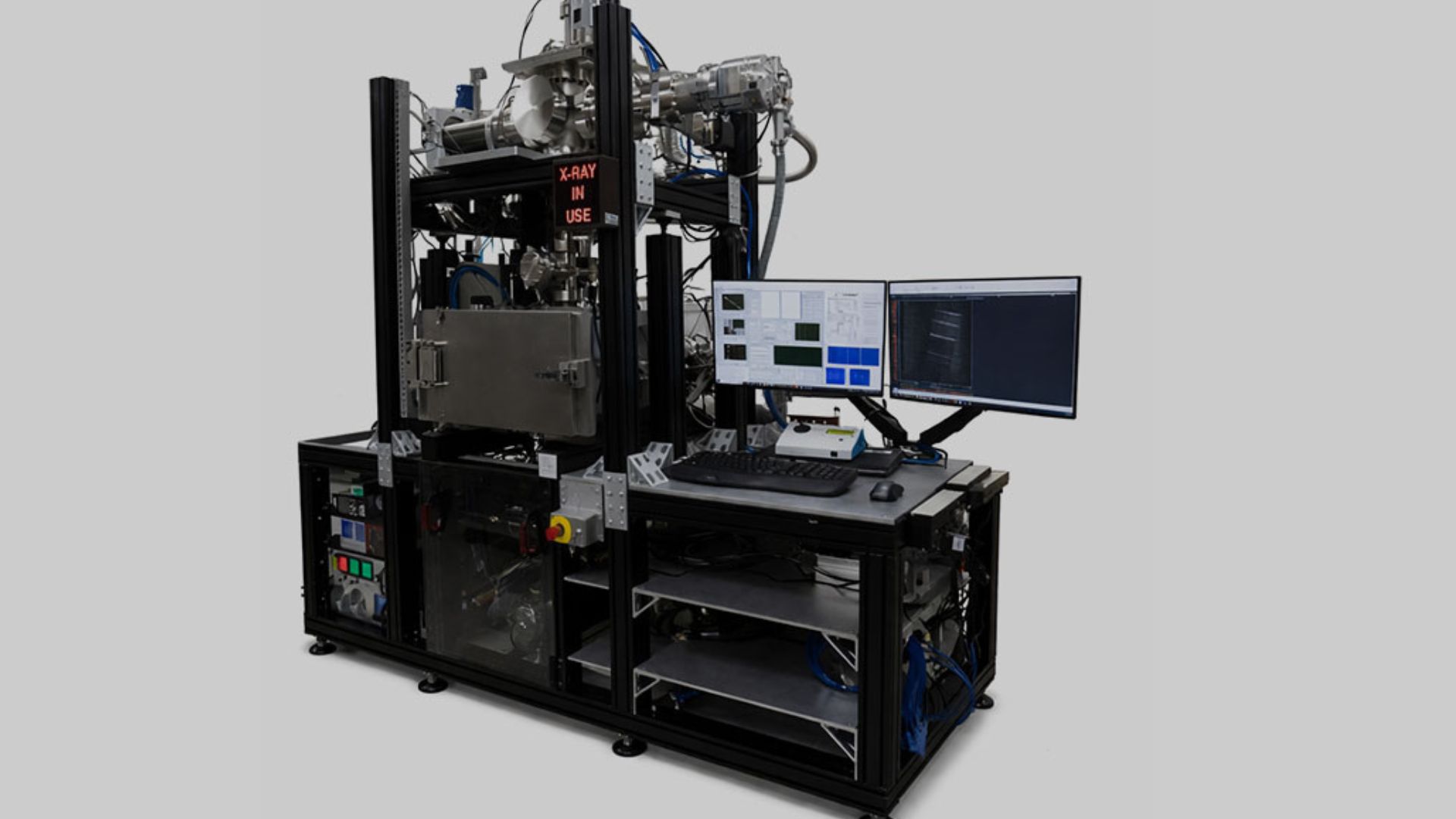
General Atomics has officially unveiled EXCALIBUR, a new laboratory platform built to simplify X-ray calibration and measurement for researchers.
The system combines advanced instruments into a single, compact setup that delivers accurate results faster. It is designed to support both scientific research and high-technology manufacturing where precision is essential.
EXCALIBUR Advances X-Ray Calibration
EXCALIBUR stands for Experimental X-ray CALIBration UseR facility. It was created to measure and fine-tune X-ray equipment used in advanced laboratories and industrial applications. The platform provides researchers with reliable information about materials before they are used in demanding experiments.
One of its main jobs is inspecting thin films, coatings, and foils used inside X-ray systems. These materials are extremely thin, ranging from thousands of times thinner than a human hair to as thin as very thin plastic sheets. They act as filters, protective barriers, vacuum seals, and specialized windows that control how X-rays travel through scientific instruments.
The quality of these materials directly affects the performance of X-ray equipment. Even small differences in thickness can change how much X-ray energy passes through a material. Accurate measurements help researchers avoid unexpected results during complex experiments.
READ ALSO: US Navy Advances Trident II D5LE2 and W93 Warhead to Strengthen Nuclear Deterrence
EXCALIBUR combines X-ray sources, precision detectors, X-ray cameras, automated measurement tools, and advanced analysis software into one laboratory platform. This allows scientists to study materials without cutting, damaging, or changing them. The system measures material composition, thickness, density, and X-ray transmission with high precision.
Researchers can also inspect multiple locations on the same sample during a single session. The system can examine dozens of samples in a single day. This saves valuable laboratory time while producing consistent measurement data.
Manufacturers often allow thin-film thickness to vary by around 10% to 20% during production. Such differences can influence the accuracy of scientific instruments and research results. EXCALIBUR helps researchers identify these variations before materials are installed in expensive equipment.
According to General Atomics, the system improves confidence in laboratory measurements while reducing the need for repeated testing. Faster calibration also supports rapid product development and quicker design improvements. These advantages are especially important for research programs working under tight schedules.
Supporting Fusion, Semiconductor, and Space Tech
The new system supports a wide range of scientific fields that depend on accurate X-ray measurements. These include fusion energy research, plasma science, semiconductor development, sensor technology, and space exploration. All of these industries require precise calibration to achieve reliable experimental results.
Fusion energy research depends heavily on X-ray diagnostics to study extremely hot plasma. Scientists use X-rays to understand how plasma behaves inside experimental fusion systems. Better measurements allow researchers to improve computer models and refine future reactor designs.
Semiconductor manufacturers also rely on precise material measurements during chip production. Small defects or unexpected material differences can reduce manufacturing quality. Reliable calibration tools help engineers maintain higher production standards.
Space technology is another area where accurate material testing is important. Scientific instruments carried by satellites and spacecraft must operate reliably under harsh conditions. Careful calibration before launch improves long-term performance and mission success.
General Atomics Director of the Center of Excellence in Advanced Diagnostics, Haibo Huang, said the new platform offers speed, flexibility, accuracy, and precision. He said EXCALIBUR supports rapid prototyping, advanced calibration, and performance modeling in shorter testing sessions. That combination allows researchers to complete more work without sacrificing measurement quality.
Improving Crystal Calibration
Another important feature of EXCALIBUR is its ability to calibrate X-ray Bragg crystals. These special crystals separate X-rays by wavelength, allowing scientists to study the detailed properties of X-ray sources. Researchers often describe these measurements as reading the unique fingerprint of an X-ray signal.
That fingerprint provides valuable information about plasma temperature, density, motion, turbulence, and impurities. Scientists also use it to compare real experimental results with computer simulations. Accurate crystal calibration is necessary because even tiny imperfections can affect measurement quality.
General Atomics recently demonstrated this capability in a study published in the peer-reviewed journal Plasma Physics and Controlled Fusion. Researchers used EXCALIBUR to calibrate a quartz crystal in Laue geometry. The work showed that detailed crystal calibration can be performed without relying entirely on large national research facilities.
READ ALSO: AWS Picks Anduril as Preferred Edge Provider to Bring Cloud Computing to the Battlefield
Traditionally, X-ray crystals are calibrated at major synchrotron laboratories. These facilities produce extremely bright X-rays but operate under high demand, making access limited for many researchers. Crystal manufacturers do not always have regular opportunities to perform detailed calibration after production.
General Atomics scientist and Inertial Fusion Technology project lead Ruben Santana said researchers sometimes use crystals without a full understanding of their performance.
He explained that limited access to calibration facilities reduces confidence in measurement accuracy during high-energy-density experiments. EXCALIBUR addresses this challenge by bringing advanced calibration into a standard laboratory environment.
The introduction of EXCALIBUR reflects the growing need for faster and more accessible scientific measurement tools across advanced industries.
As research in fusion energy, semiconductor manufacturing, plasma science, and space technology continues to expand, on-site calibration systems that deliver accurate calibration will play an important role in supporting future scientific and technological progress.