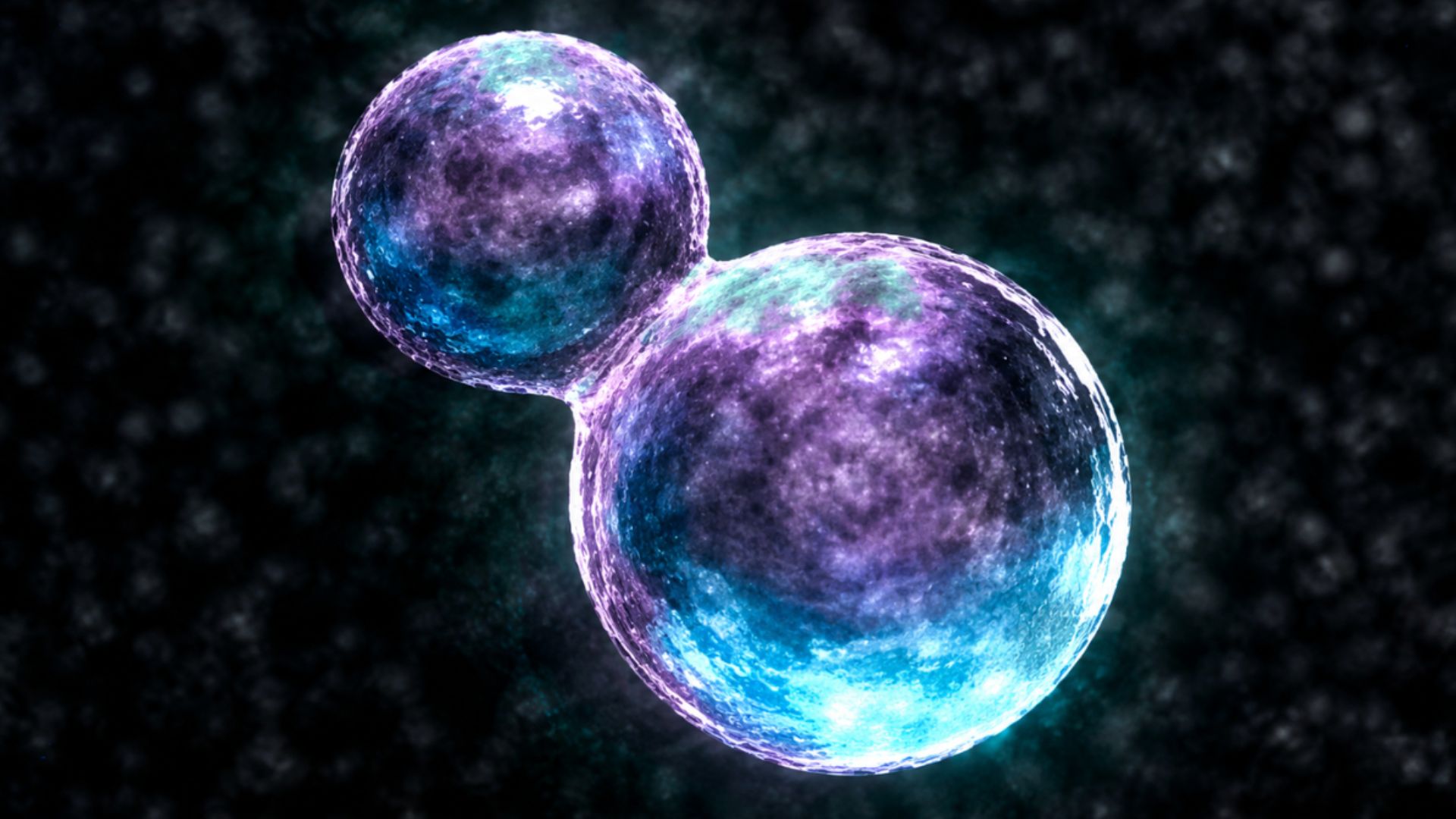
Scientists at the University of Minnesota have developed a synthetic cell assembled entirely from nonliving materials.
The laboratory-made system can grow, copy its genetic material, divide into new cells, and pass useful traits to future generations. The team says the achievement marks an important step in the long-term effort to build artificial life.
The research was published as a preprint on bioRxiv. This means the study is publicly available but has not yet undergone peer review. Independent scientists will examine the findings before they are formally accepted by a scientific journal.
The researchers named their artificial system SpudCell. Unlike earlier synthetic biology projects, it was not created by modifying an existing living organism. Instead, every major part was assembled from carefully selected nonliving chemical components.
How SpudCell Works
SpudCell has a genome of approximately 90,000 DNA base pairs. That genetic information allows the synthetic cell to produce proteins, copy its DNA, absorb nutrients, grow, and divide into daughter cells. These are some of the key features that scientists use to define living systems.
READ ALSO: Organic Transistor Combines Memory, Computing and Light at Under 3.5V for Wearables
The synthetic cell still depends on laboratory support to survive. Researchers must provide nutrients and specialized molecular components from outside the cell. Without those materials, SpudCell cannot continue to grow or divide.
The system also relies on ribosomes purified from E. coli bacteria. Ribosomes are tiny structures that read genetic instructions and build proteins needed for life. Because SpudCell cannot yet produce all of its own molecular machinery, it still depends on these externally supplied biological parts.
One important part of the experiment focused on evolution. Scientists introduced a genetic change that allowed some synthetic cells to grow faster than others. Over several generations, those faster-growing cells produced more offspring and became more common in the population.
This result demonstrated a simple form of natural selection. Natural selection is the process in which organisms with helpful traits reproduce more successfully over time. It is one of the basic principles behind biological evolution.
Why This Synthetic Cell Research Matters
The researchers describe SpudCell as the first minimal synthetic cell that combines growth, DNA replication, cell division, and genetic competition in a single laboratory-built system. They said these features bring science closer to understanding how life can emerge from chemistry. The study also helps scientists explore the basic rules that allow living cells to function.
Despite the achievement, the synthetic cell remains far simpler than even the smallest naturally living cells. Researchers found that after five generations, only about 30 percent of daughter cells inherited the complete synthetic genome. This limits the system’s ability to maintain stable growth over many generations.
Scientists say these limitations show that fully self-sustaining artificial life has not yet been achieved. SpudCell still needs constant laboratory support and cannot survive outside controlled conditions. Even so, the research demonstrates that many essential features of life can be recreated using nonliving materials.
READ ALSO: UK Unveils Common Combat Vessel to Replace Type 45 Destroyers With Drone-Led Fleet
The technology could support future work in biotechnology and medicine. Artificial cells may one day help scientists produce valuable chemicals, manufacture medicines, or study diseases in safer laboratory systems. They also offer researchers a simpler platform for understanding how natural cells work.
The growing field of synthetic biology also raises important safety questions. As laboratory-made cells become more advanced, researchers say clear biosafety and biosecurity rules will be necessary. Strong oversight will help ensure that future developments are used responsibly and safely.
The University of Minnesota team said future research will focus on making synthetic cells more independent. Scientists plan to improve how the cells build their own molecular machinery, distribute DNA more accurately during cell division, and allow natural mutations to develop without direct human intervention.
As these improvements continue, synthetic biology is expected to play a larger role in scientific research while helping experts better understand the fundamental processes that make life possible.