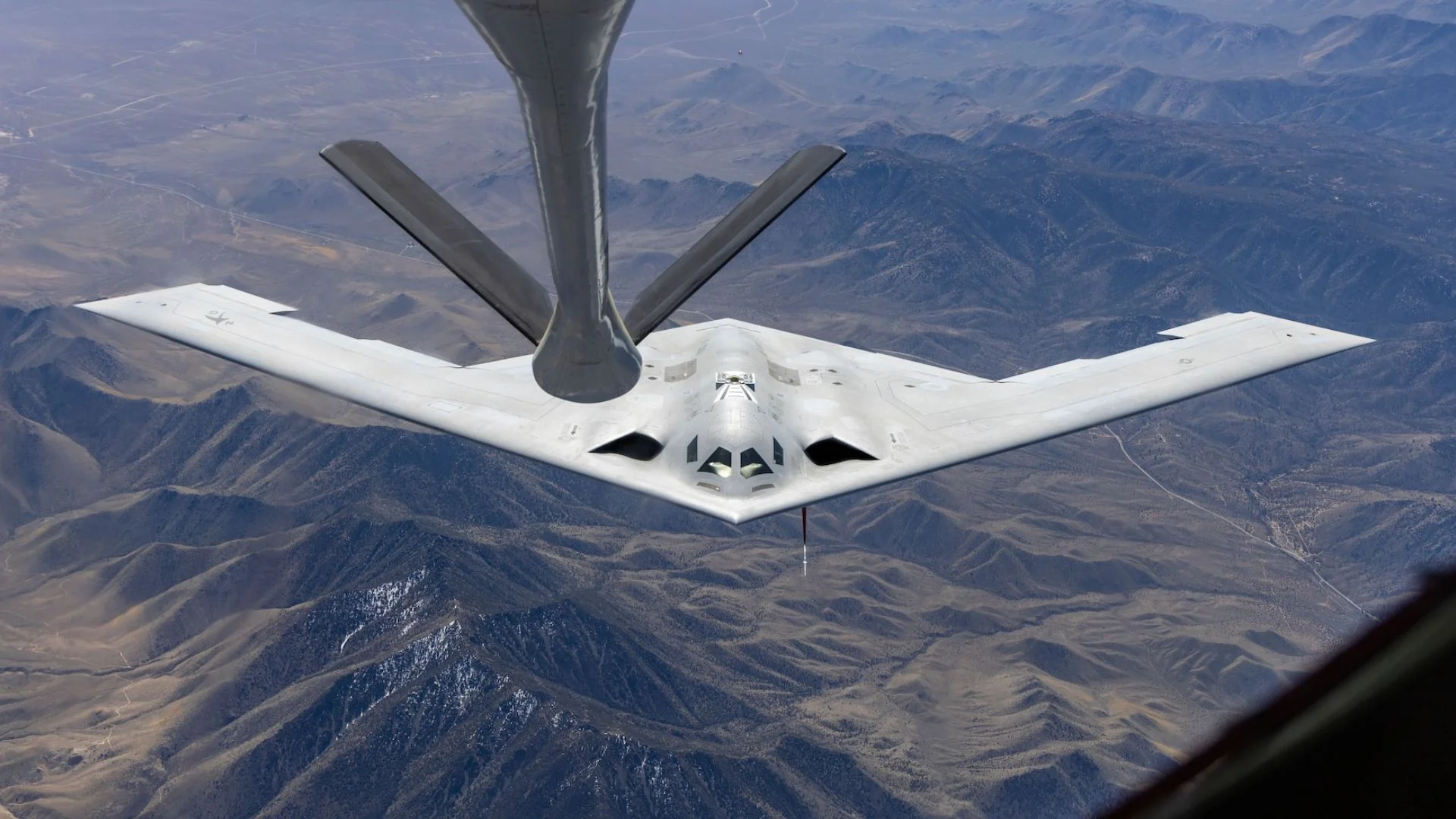
A new image of the B-21 Raider has given the world its first complete overhead view of the next-generation stealth bomber.
The photograph, taken during aerial refueling trials, offers a rare and detailed look at one of the most secretive aircraft programs currently under development.
Until now, only limited angles of the B-21 had been released. Previous images showed the aircraft from the front or at a slight elevation. This latest picture changes that. It captures the Raider from above, revealing design elements that had remained hidden from public view.
The image was released by Northrop Grumman, the company building the aircraft. It shows the first B-21 test airframe, named ‘Cerberus,’ flying in formation behind a tanker aircraft during early refueling trials.
READ ALSO: MQ-4C Triton Vanishes Mid-Flight After 50,000 Ft Drop, US Navy Confirms Crash
Aerial refueling is a key step in testing any long-range bomber. It proves the aircraft can stay in the air for extended missions, which is central to its role.
Northrop Grumman highlighted the new bomber’s efficiency in its official statement. The company said the B-21 is the most fuel-efficient bomber ever built. It consumes only a fraction of the fuel used by earlier fourth- and fifth-generation aircraft.
The statement read, “The B-21 reduces the need for tanker support and gives commanders more flexibility in planning missions.” This efficiency means fewer support aircraft are needed, making operations simpler and more adaptable.
The company also revealed that it has invested more than $5 billion in digital engineering and production systems for the program. This investment is helping speed up manufacturing. The first operational B-21 is expected to be delivered to Ellsworth Air Force Base in 2027.
The B-21 is part of the Long-Range Strike Bomber program, which aims to give US the ability to strike targets anywhere in the world. One of its biggest strengths is endurance.
WATCH ALSO: International Space Station crew wishes New Year 2026
Even though the Raider is smaller than the B-2 Spirit, it is designed to fly farther. Engineers achieved this by focusing on a highly efficient planform design that reduces drag and improves performance at high altitude.
Another key difference lies in its engines. The B-2 uses four engines, but the B-21 likely uses only two. This assumption is based on visible design features and contrails observed in earlier images. Fewer engines can mean lower weight and better fuel efficiency.
However, the B-21 is expected to carry a smaller weapons payload than the B-2. Instead, it trades payload size for longer range. The aircraft is built to carry a large amount of fuel, allowing it to travel farther without relying heavily on tankers.
The tanker seen in the newly released image is a special aircraft based at Edwards Air Force Base. Known as the “Ghost” tanker, it carries the tail number 61-0320. It plays a unique role in supporting advanced flight testing missions.
The overhead image reveals several important features of the B-21. One of the most noticeable is the open refueling receptacle on top of the aircraft. Around it are painted markings similar to those on modern stealth fighters such as the F-22 Raptor and F-35 Lightning II. These markings help guide tanker crews during refueling while maintaining the aircraft’s stealth profile.
WATCH ALSO: India’s DRDO successfully completes user evaluation trials of Akash-NG Missile System
Another major highlight is the design of the air intakes. The B-21 uses deeply blended inlets that are smoothly integrated into the aircraft’s body. This design helps reduce radar visibility, which is a critical feature for stealth missions.
But the most sensitive and intriguing part of the image is the exhaust system. The exhaust of a stealth aircraft is one of its most guarded secrets. It plays a major role in reducing the aircraft’s infrared signature, making it harder to detect by heat-seeking sensors.
In the B-21’s case, the exhaust appears to be deeply embedded in the aircraft’s body. It has a chevron-shaped design, but unlike the B-2, the direction is reversed. The exhaust outlets are located far forward, away from the aircraft’s trailing edge. This placement helps hide the heat signature from observers below or behind.
However, the image raises questions. There is no clear indication of special heat-resistant materials or cooling structures, as are usually seen in such designs. The B-2, for example, uses a distinct cooling system to manage hot exhaust gases.
In the B-21’s case, these features are not visible. This has led to speculation that the image may have been altered to hide sensitive details. It is common practice to edit official images of advanced military systems to protect classified information. So while the image reveals a lot, it likely does not show everything.
Another interesting detail is the cockpit design. The B-21 has very small cockpit windows compared to older aircraft. This reduces the aircraft’s radar signature from the front.
Designers appear to have carefully balanced visibility for pilots with the need to remain undetectable. The aircraft’s high operating altitude also helps reduce the importance of large windows.
A separate side-view image from the same test shows the B-21 flying close behind the tanker. This angle gives a better sense of its size.
READ ALSO: UK University Unveils AI Chip 2,000x More Efficient By Processing Data Directly In Hardware
The bomber appears relatively compact. Its length seems similar to that of an F-15 fighter jet. Its wingspan is estimated to be between 145 and 155 feet. Despite its smaller size, the B-21 is expected to deliver powerful performance thanks to its advanced design and long-range capability.
So far, the program appears to be progressing smoothly. Reports suggest that it is on schedule and within budget. This is notable, especially given the history of the B-2 program, which faced major cost overruns.
Lessons from that earlier program seem to have shaped the development of the B-21. The use of digital tools and modern manufacturing methods has helped control costs and improve efficiency.
The release of this overhead image marks an important moment. It shows that testing is moving forward and that more details about the aircraft are slowly being revealed.
Even so, the B-21 remains one of the most secretive aircraft in the world. As testing continues, more images and information are expected to emerge. Each new detail adds to our understanding of this advanced bomber.
However, this first overhead look offers a rare glimpse into the design and capabilities of a platform that will play a major role in future airpower.