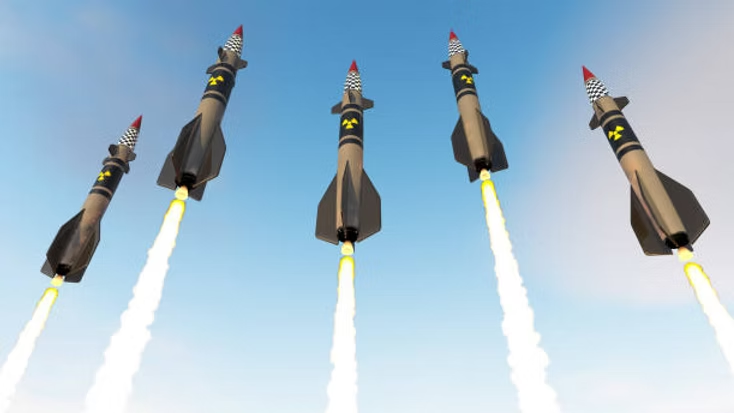
Chinese aerospace firm Lingkong Tianxing unveiled the YKJ-1000 hypersonic glide missile with a range of 1,300 kilometers and Mach 7 speed at a production cost of approximately $99,000, making it 40 times cheaper than the $4.1 million SM-6 naval interceptor.
The “cement-coated” missile uses civilian materials including foamed concrete, BeiDou navigation chips, and camera modules from the drone market, according to military commentator Wei Dongxu on CCTV. Chairman Wang Yudong, former chief designer at China Academy of Launch Vehicle Technology, said the achievement reflects integration of defense technology with civilian industrial capabilities.
Chinese aerospace firm Lingkong Tianxing unveiled a hypersonic glide missile last week that has a range of up to 1,300 kilometers (800 miles) and a top speed of Mach. The YKJ-1000 has been nicknamed the “cement-coated” missile for its use of civilian-grade materials such as foamed concrete in its heat-resistant coating. According to slides widely circulated online, the unit production cost of this missile, already in mass production after successful combat trials, may be as low as 700,000 yuan (around $99,000).
A single SM-6 naval interceptor costs about $4.1 million, over 40 times the price of one YKJ-1000. Meanwhile, the THAAD system costs $12-15 million for each interceptor, while the Patriot PAC-3 that Taiwan hopes to buy would cost $3.7-4.2 million each. This imbalance between low-cost offense and high-cost defense has the potential to change the logic of warfare.
READ ALSO: https://www.modernmechanics24.com/post/china-moyujian-strike-helicopter-tests
The missile indicates how China’s massive civilian manufacturing capacity could be used to produce cutting-edge military technology at a low cost—something that may have a profound impact on global defense markets. “If this missile were introduced on the international defense market, it would be formidably competitive,” military commentator Wei Dongxu told state broadcaster CCTV on Tuesday.
“Many nations have yet to develop their own hypersonic missiles, and this one—with its long range, high destructive power, and strong penetration capability—would likely become a hot commodity due to its dirt cheap price. “If sold abroad, such a weapon could empower smaller nations to challenge major military powers—potentially altering the strategic balance around the world and posing a threat to advanced warships such as aircraft carriers.
For example, if Venezuela were to acquire enough missiles to threaten US carrier strike groups off its coast, it could potentially alter Washington’s strategic thinking because the effective combat range of a Ford-class nuclear carrier is 1,100 kilometers. This year, Yemen’s Houthi rebels have repeatedly claimed attacks on US aircraft carriers and the proliferation of cheaper missiles could make such attacks harder to counter.
The battlefield in Ukraine has already offered a similar lesson: when drones costing a few hundred dollars force the other side to use missiles worth hundreds of thousands of dollars.
WATCH ALSO: https://www.modernmechanics24.com/post/china-humanoid-robot-combat-moves
Even if a defender chooses to expend vast resources on a comprehensive shield, an attacker could saturate their defenses with volleys of low-cost missiles while mixing in more potent variants, such as the DF-17 produced by China’s state-owned contractors.
As a private enterprise, how Lingkong Tianxing has leveraged its funding, technology and talent to achieve cheap mass production of such advanced weaponry is a subject of keen interest to the Chinese public.
Relying on mature supply chains and accumulated technical expertise, the company can mass produce cutting-edge weapons that previously required huge sums of money.
According to the company, the warhead’s heat-resistant coating uses civilian-grade foamed cement and ingredients, structural parts can be die-cast and explosive separation nuts have been replaced by electric ones.
Components such as camera modules and BeiDou navigation chips, already ubiquitous and low-cost in the civilian drone market, can also be used in the construction. The company’s chairman, Wang Yudong, wrote on social media that the firm was “standing on the shoulders of giants,” embracing the fruits of the “made in China” strategy and reflecting “China’s overall social productivity.”
READ ALSO: https://www.modernmechanics24.com/post/lockheed-martin-17000-sqft-hypersonic-lab
“Behind this achievement lies a systemic transformation involving R&D philosophy, supply chain organization, storage and maintenance methods, as well as management and procurement models. It represents a process of integrating national defense technology with broader societal industrial capabilities,” he added.
The company’s research and development team was largely sourced from large aerospace groups and Wang himself was formerly the chief designer and deputy chief engineer at the China Academy of Launch Vehicle Technology.
Wei told CCTV that if the YKJ-1000 really could be sold “dirt cheap,” it could help in the future development of the country’s advanced anti-missile systems. In September, Vice-Premier Zhang Guoqing visited the company’s production plant during an inspection tour in Chengdu, Sichuan province.
The strategic implications extend beyond mere cost comparisons. Hypersonic missiles fly at speeds exceeding Mach 5 (five times the speed of sound), making them extremely difficult to intercept with current defense systems. At Mach 7, the YKJ-1000 gives defenders mere minutes to detect, track, and engage incoming threats.
WATCH ALSO: https://www.modernmechanics24.com/post/drdo-rocket-sled-escape-test-success
The 1,300-kilometer range places significant military and civilian infrastructure at risk from standoff distances. Combined with hypersonic speed and potentially maneuverable flight paths during the glide phase, such missiles challenge existing air defense architectures designed primarily for ballistic missiles and subsonic cruise missiles.
The cost differential proves particularly striking. If an attacker launches ten YKJ-1000 missiles costing $990,000 total, defending forces must expend multiple interceptors per incoming threat to ensure high probability of kill. At $4.1 million per SM-6, even a modest saturation attack quickly becomes economically unsustainable for defenders.
This cost asymmetry mirrors challenges already visible in Ukraine, where inexpensive drones force expensive air defense responses. Scaling this dynamic to hypersonic weapons with anti-ship capabilities could fundamentally alter naval operations, potentially keeping high-value assets like aircraft carriers farther from contested waters.
READ ALSO: https://www.modernmechanics24.com/post/scientists-detect-rare-lightning-side-bursts
The civilian technology integration represents another significant aspect. By leveraging mass-produced commercial components—BeiDou navigation receivers, camera modules, control electronics—Lingkong Tianxing avoids expensive custom military-grade development. This approach mirrors how commercial drones revolutionized battlefield reconnaissance by adapting consumer electronics.
However, some commenters online have expressed skepticism about the claimed cost breakdown. Particular questions surround how the price of fuel alone could be kept so low, to say nothing of the rocket engine. The company has said an article addressing these questions would be published soon.
WATCH ALSO: https://www.modernmechanics24.com/post/terranova-satellite-by-nordspace