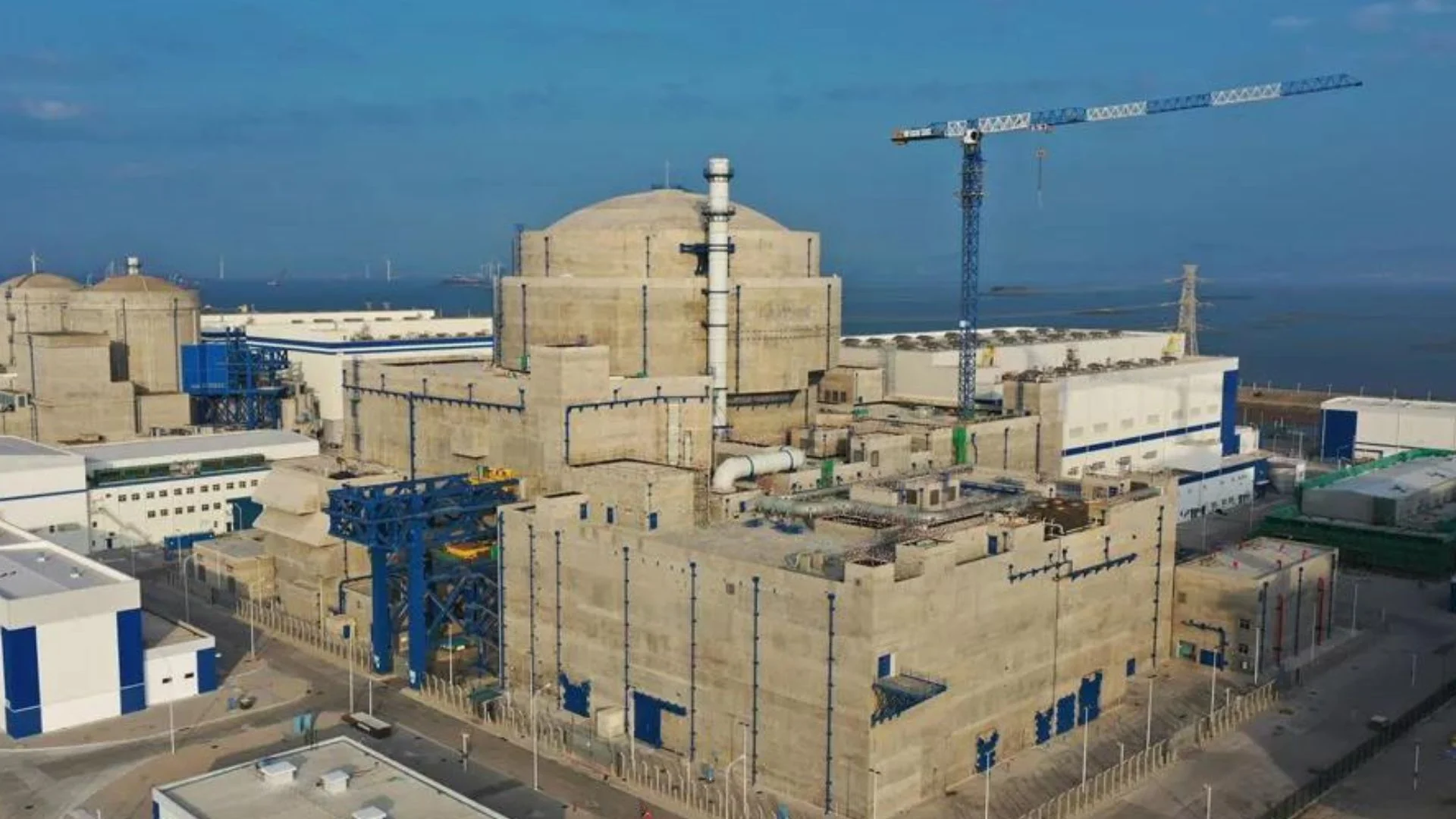
China has started construction on another Hualong One nuclear reactor at the Taipingling nuclear power plant in Guangdong province.
The new reactor unit marks a major step in the second phase of the country’s first Hualong One nuclear project in the Guangdong-Hong Kong-Macao Greater Bay Area (GBA).
The project is part of China’s wider plan to expand low-carbon energy production and strengthen domestic nuclear technology.
Workers began pouring the first concrete for Unit 4’s reactor building on Sunday. The start of this process officially signals the beginning of large-scale construction for the reactor unit.
READ ALSO: MQ-9A Reaper Tests APKWS Rockets to Counter Low-Cost Attack Drones at Lower Cost
China General Nuclear Power Group (CGN) confirmed the milestone as development work continues across the Taipingling project.
The Taipingling nuclear power plant is one of China’s most important next-generation energy projects. It uses the Hualong One reactor design, a third-generation nuclear technology developed entirely in China. The technology is designed to offer higher safety standards, stable electricity generation, and stronger operational efficiency.
Hualong One Reactor Expands China’s Nuclear Energy Goals
Each Hualong One reactor at the site can generate about 1,209 megawatts of electricity annually. The reactors are designed to provide large amounts of clean energy while reducing dependence on coal-fired power plants.
WATCH ALSO: Drum-shaped antenna reflector on NASA-ISRO NISAR satellite deployed
Chinese officials describe Hualong One as one of the country’s most advanced and independently controlled nuclear technologies.
Unlike older nuclear systems that relied heavily on foreign designs, Hualong One was developed with full Chinese intellectual property rights. The technology combines improved safety systems with simplified construction methods. It has also become a key part of China’s efforts to export nuclear technology to other countries.
The full Taipingling project will include six Hualong One reactor units built in three phases. Once completed, the plant is expected to generate more than 55 billion kilowatt-hours of electricity every year.
READ ALSO: Meet Gabi: South Korea’s Robot Monk Joins Buddhist Rituals Ahead of Buddha’s Birthday
CGN says that the level of power generation could save around 16.65 million tons of standard coal annually while cutting more than 50 million tons of carbon emissions.
The Greater Bay Area is one of China’s largest economic regions and includes major cities such as Hong Kong, Macau, and Shenzhen.
Rapid industrial growth and rising population levels have increased electricity demand across the region. Nuclear energy is becoming an important part of the area’s long-term power supply strategy.
Unit 1 of the Taipingling project entered operation earlier this year. The reactor started generating electricity on April 20 after connecting to the national power grid.
According to Chinese state media, the unit can produce more than 9 billion kilowatt-hours of electricity each year, enough to support the annual power needs of millions of residents.
WATCH ALSO: World’s first motorbike backflip between two moving trucks successfully completed
Construction work on other reactor units is also moving forward. Unit 2 is preparing for its first nuclear fuel loading, while major building work continues on Unit 3. CGN is also undertaking preparatory work for the third phase of the overall project.
China continues to expand nuclear power as part of its long-term clean energy targets. CGN currently operates 29 nuclear power units with a combined installed capacity of 33.04 million kilowatts.
The company also has 19 reactors under construction, including 17 units using Hualong One technology, showing that the reactor design will remain central to China’s future energy strategy.