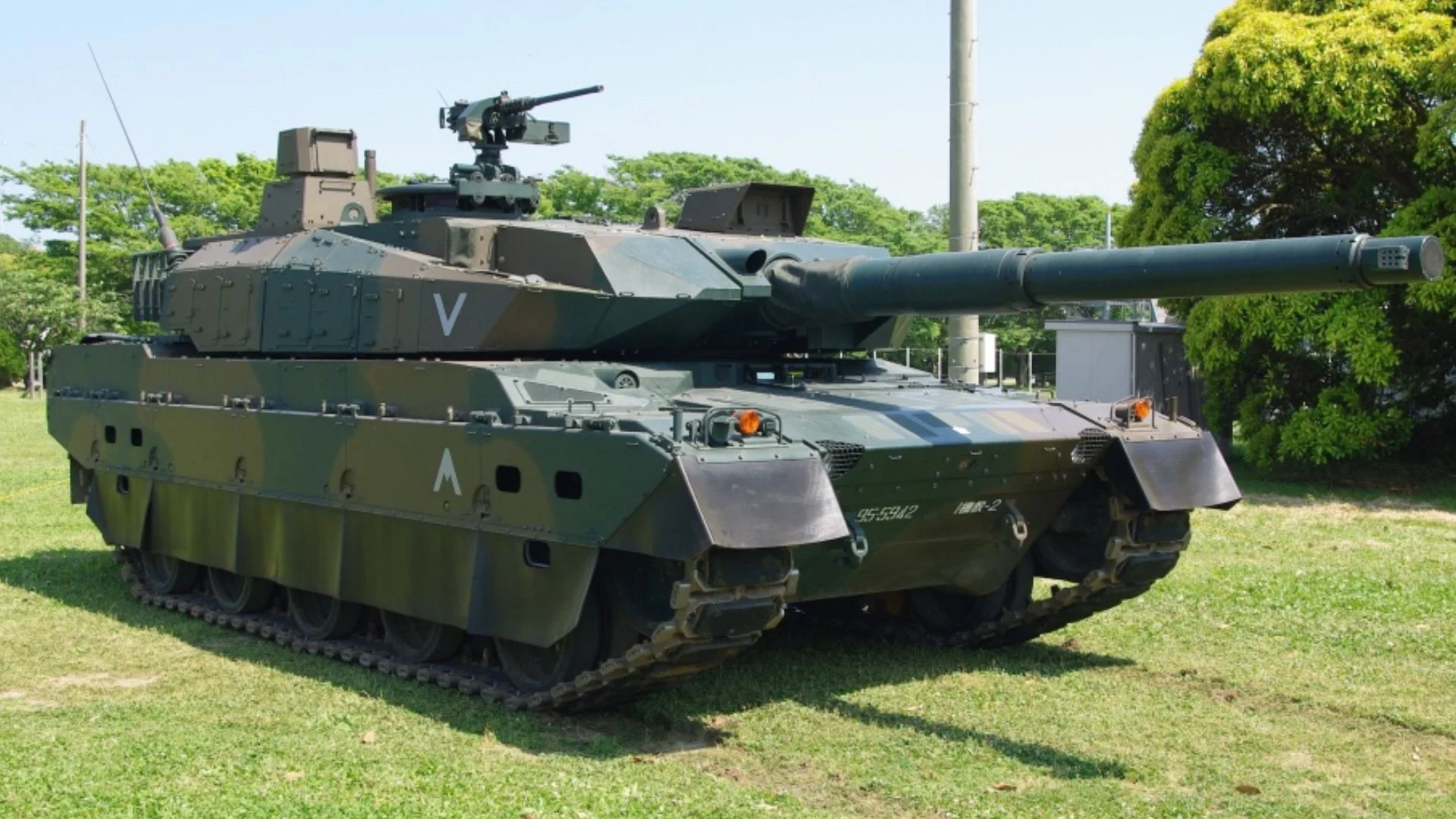
The Philippine Army has started evaluating Japan’s Type 10 main battle tank as part of its long-term armored modernization plans.
The review follows growing concerns about delays in the expansion of the Israeli-made Sabrah light tank fleet.
Philippine defense planners are now examining whether a heavier, yet still mobile, tank can better meet future operational needs.
The development was first reported by MaxDefense Philippines on May 9, 2026. The report said the Type 10 is being considered either as a complement to the Sabrah or as a replacement option for future armored purchases.
The decision reflects Manila’s effort to strengthen battlefield firepower while remaining within the country’s infrastructure constraints.
READ ALSO: China Sends Artificial Embryos to Space on Tianzhou-10 in World-First Development Study
The Philippine Army originally selected light tanks because many roads and bridges in the country cannot support very heavy armored vehicles.
Most modern Western tanks weigh between 60 and 70 tonnes, making them difficult to move across several parts of the archipelago. The Japanese Type 10 stands out because it weighs between 44 and 48 tonnes, depending on armor configuration.
That lower weight is important for operations in the Philippines. Military vehicles often need to cross small bridges, use ferries, and navigate narrow roads in both urban and rural areas. A lighter tank reduces pressure on transport systems and lowers the need for engineering support during deployments.
The Type 10 was designed for similar conditions in Japan. Japanese forces faced problems deploying the older Type 90 tank outside Hokkaido because many bridges could not support its weight. Japan later developed the Type 10 to improve nationwide mobility without sacrificing firepower.
Japanese assessments showed that about 84 percent of national bridges could support the Type 10. By comparison, only around 65 percent could handle the heavier Type 90. The same mobility advantage is now attracting attention from Philippine defense officials.
Why Type 10 Tank Matters
The Type 10 carries a 120mm smoothbore cannon developed by Japan Steel Works. The gun can fire Japanese and NATO-standard ammunition, including armor-piercing rounds designed to defeat heavily protected targets. The tank stores 36 rounds, with 14 ready inside the autoloader.
An autoloader automatically loads ammunition into the gun after each shot. This system reduces crew size from four soldiers to three and allows faster firing intervals. Reports indicate the Type 10 can fire every 3.5 seconds under combat conditions.
WATCH ALSO: Drum-shaped antenna reflector on NASA-ISRO NISAR satellite deployed
The Philippine Army’s current Sabrah tanks use a 105mm low-recoil gun. While effective against lighter threats, the smaller weapon has lower penetration than modern 120mm tank guns. Moving to a 120mm platform would significantly increase anti-armor capability.
The Type 10 can reportedly engage armored targets at ranges between 2,000 and 3,000 meters. That gives crews the ability to strike enemy vehicles before entering close combat. The larger gun also improves effectiveness against fortified positions.
Mobility remains one of the tank’s main strengths. The vehicle uses a 1,200-horsepower Mitsubishi diesel engine paired with a continuously variable transmission. It can reach speeds of around 70 kilometers per hour both forward and backward.
High reverse speed is uncommon for most tanks. Japanese designers included it to support rapid withdrawal after firing from hidden positions. This feature is especially useful in mountainous terrain and urban combat environments.
The tank also uses a hydropneumatic suspension system. This technology allows the chassis to adjust height and improves stability during movement. Similar systems are used by advanced tanks such as the South Korean K2 Black Panther and the French Leclerc.
Japanese demonstrations have shown the Type 10 firing while moving through rough terrain and changing direction quickly. These capabilities match conditions commonly found in Southeast Asia. Roads, jungles, and urban areas often limit maneuver space during military operations.
WATCH ALSO: World’s first motorbike backflip between two moving trucks successfully completed
The tank maintains a strong power-to-weight ratio of around 27 horsepower per tonne. That is close to the performance range of the Sabrah despite carrying heavier armor and a larger gun. Philippine planners see this balance as important for maintaining mobility during inter-island deployments.
Digital Warfare and Export Challenges
The Type 10 also includes advanced battlefield networking systems. Japanese doctrine increasingly treats tanks as connected battlefield nodes rather than isolated fighting vehicles. Crews can share targeting information, vehicle status, and battlefield positions through digital systems inside the tank.
Touchscreen displays provide real-time tactical updates during combat operations. Commanders can coordinate attacks faster and improve awareness across armored units. These systems are part of Japan’s FiCS and ReCS battle-management architecture.
For the Philippine Army, this creates both opportunities and challenges. Current Philippine armored units have limited battlefield networking capability. Any Type 10 purchase would likely require upgrades in encrypted communications and command systems.
Protection on the Type 10 focuses mainly on the front of the tank. The turret and frontal hull reportedly use advanced composite armor materials designed to stop kinetic and explosive threats. Side and rear protection are lighter than those on much heavier Western tanks.
Japan accepted this tradeoff to keep the vehicle mobile across the national infrastructure. The tank also includes laser warning receivers, smoke launchers, fire suppression systems, and nuclear, biological, and chemical protection equipment. Japan is also studying future active protection systems for the platform.
Production of the Type 10 began in 2010, and the tank entered Japanese service in 2012. Around 139 vehicles have been funded or ordered by Japan through fiscal year 2026. Mitsubishi Heavy Industries leads production while Japan Steel Works manufactures the main gun.
A Philippine purchase would carry major industrial significance for Japan. The Type 10 has never been exported before, largely because Tokyo maintained strict defense export restrictions for decades. Selling the tank overseas would require Japan to establish maintenance, training, spare parts, and ammunition support networks abroad.
Several concerns still remain for Philippine planners. The Type 10 has never seen combat or long overseas deployments. Its advanced electronics, suspension, and transmission systems may also increase maintenance demands compared to simpler armored vehicles already used by the Philippine Army.
Logistics may also become more complex if Philippine forces continue operating both 105mm and 120mm tank fleets. Separate ammunition types would require additional storage and supply systems. Military planners must also consider long-term operating costs and crew training requirements.
READ ALSO: DARPA XRQ-73 Hybrid-Electric Drone Begins Flight Testing at Edwards Base
The Philippine Army is also evaluating Japan’s wheeled Type 16 Maneuver Combat Vehicle. Japanese Ground Self-Defense Force Type 16 vehicles recently participated in Exercise Balikatan 41-2026 under Philippine climate and terrain conditions. Interest in both systems suggests Manila is building a more mobile and distributed armored doctrine for future operations.
The shift reflects changing regional security requirements across the Indo-Pacific. Instead of focusing on large-scale continental warfare, the Philippine Army appears to be prioritizing fast redeployment, mobile firepower, and operations across multiple islands. The final decision on future armored purchases may shape the country’s ground combat strategy for decades.