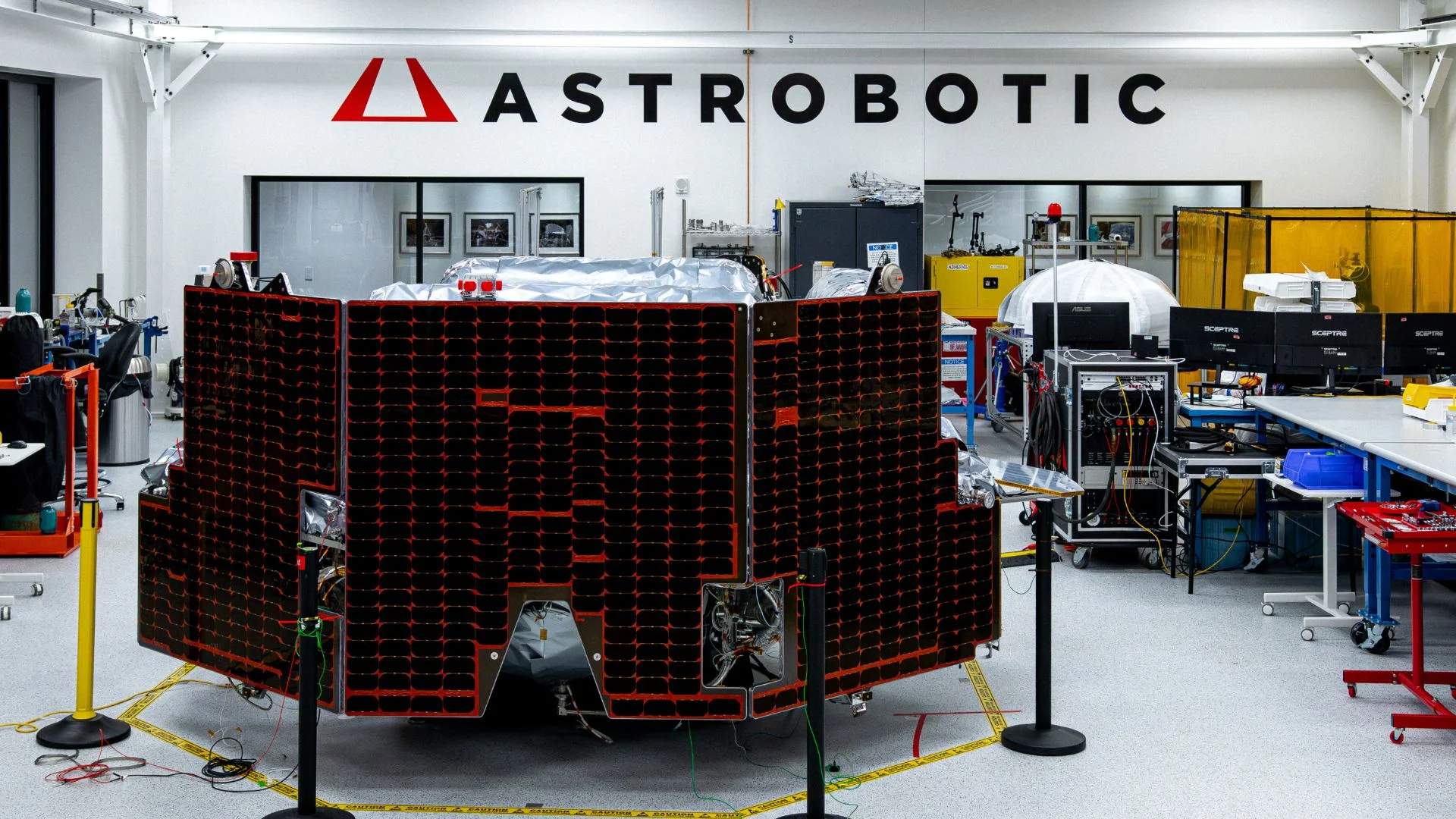
Astrobotic has officially introduced its Griffin-1 lunar lander, the company’s largest spacecraft built for Moon exploration so far.
The lander will support NASA’s Moon Base II mission under the agency’s Commercial Lunar Payload Services (CLPS) program. The launch is currently targeted for late 2026 aboard a SpaceX Falcon Heavy rocket.
The unveiling took place at Astrobotic’s headquarters in Pittsburgh. Company officials confirmed that final integration work is nearing completion. The spacecraft will soon begin environmental testing before moving into launch preparations.
Astrobotic Chief Executive Officer John Thornton described Griffin-1 as an infrastructure-focused lunar lander. He said the spacecraft is designed to support future Moon base activities. The mission is expected to help lay the groundwork for long-term operations on the lunar surface.
Griffin-1 Carries Rover and Payloads
One of the mission’s most important payloads is the FLIP rover developed by California-based Astrolab. The rover will be delivered to the Moon to demonstrate new surface mobility technologies. NASA plans to use data from such missions to prepare for future astronaut operations.
READ ALSO: Battery Bath Revives Used Lithium-Ion Cells to 95% Power While Slashing Recycling Costs
Griffin-1 will also carry Astrobotic’s BEACON CubeRover. The rover is being developed in partnership with Mission Control Space Services. It is designed to test technologies that could support future robotic exploration missions.
Another key payload is the European Space Agency’s LandCam-X system. This technology aims to improve landing accuracy on the Moon. Better landing precision is important because future missions will target more challenging lunar locations.
The lander will transport a total of 10 payloads from 6 countries. Four additional NASA payloads will travel aboard the FLIP rover. Together, these instruments will collect scientific data and test new technologies in the harsh lunar environment.
Several symbolic and cultural payloads are also included on the mission. One item is a plaque carrying messages from children in Japan collected by Nippon Travel Agency. Another is the Galactic Library to Preserve Humanity, a highly miniaturized archive containing literature, art, and other cultural records.
The mission will also carry a MoonBox capsule. This capsule contains digital submissions from people around the world stored on microSD cards. Such payloads reflect growing international interest in participating in lunar exploration.
Larger Than Peregrine
Griffin-1 follows Astrobotic’s first lunar mission, Peregrine Mission One, launched in January 2024. Peregrine became the first mission under NASA’s CLPS program. However, a propellant leak shortly after launch prevented the spacecraft from reaching the Moon.
READ ALSO: China Launches First Marine Welding Robot System, Transforming Offshore Platform Construction
The new Griffin lander is significantly larger and more capable than Peregrine. While both spacecraft stand about 2 meters tall, Griffin spans approximately 4.5 meters. The larger design allows it to transport heavier cargo and more complex payloads.
Astrobotic states that Griffin can deliver up to 625 kilograms of payload to the lunar surface. This increased capacity makes it suitable for larger scientific instruments and exploration equipment. Such capabilities are becoming increasingly important as lunar missions grow more ambitious.
NASA launched the CLPS program to partner with private companies for lunar transportation services. Instead of building every lander itself, the agency purchases delivery services from commercial providers. This approach reduces costs while encouraging innovation across the space industry.
The CLPS program directly supports NASA’s Artemis campaign. Artemis aims to return astronauts to the Moon and establish a sustainable human presence there. Robotic missions like Griffin-1 help test technologies, study lunar conditions, and deliver equipment before human crews arrive.
Before launch, Griffin-1 will travel to NASA’s Jet Propulsion Laboratory in California for environmental testing. Engineers will expose the spacecraft to conditions similar to those experienced during launch and spaceflight. These tests help ensure that all systems perform as expected.
WATCH ALSO: World’s largest nuclear fusion research project ITER has reached a new milestone
After testing is completed, the lander will move to Florida for final mission preparations. The FLIP rover will then be integrated with the spacecraft. Engineers will conduct final checks before the launch campaign begins.
The Griffin-1 mission represents another step in the expanding partnership between NASA and commercial space companies. By delivering advanced technology, conducting scientific experiments, and carrying international payloads, the lander will support preparations for future lunar bases.