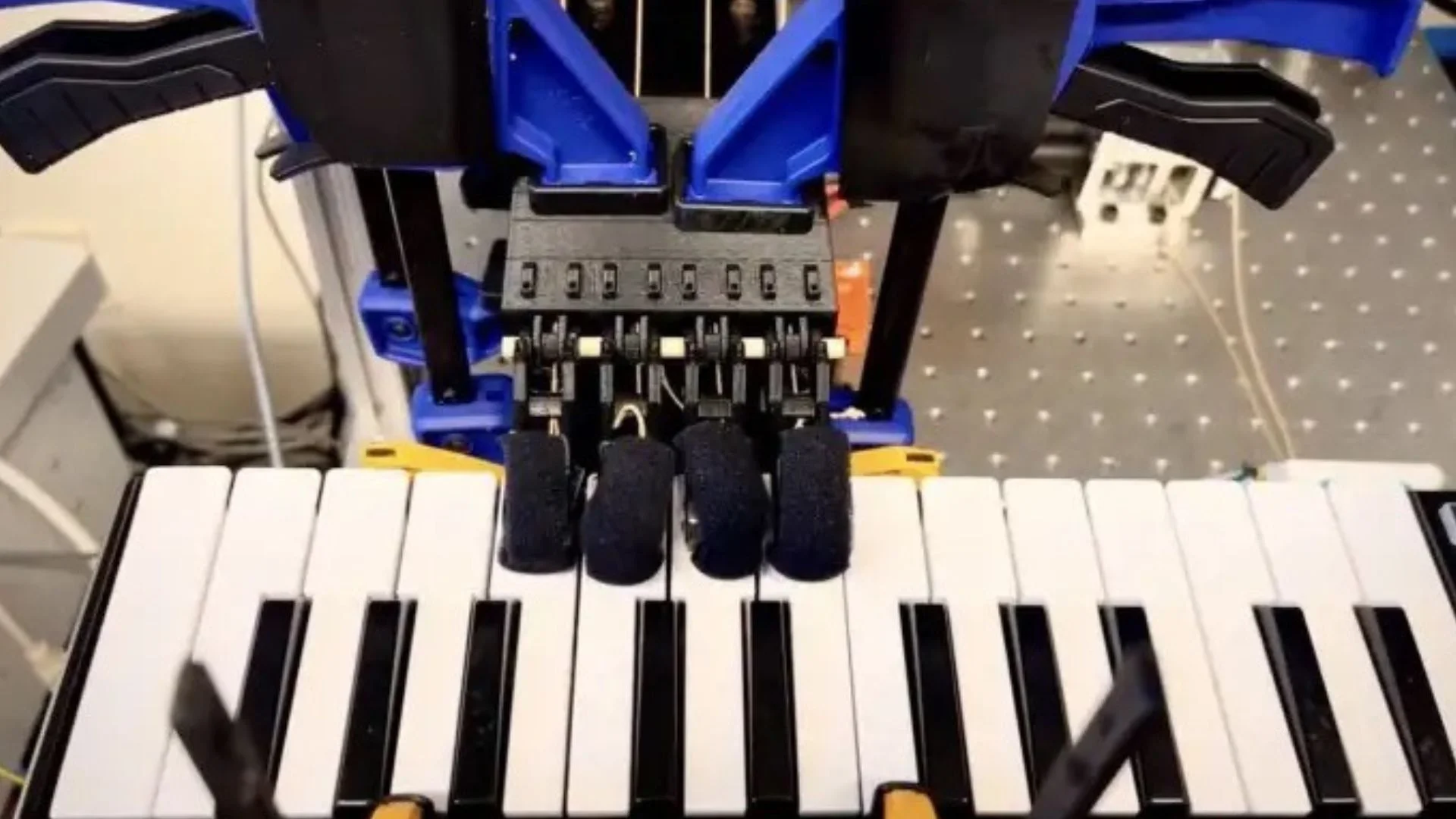
A research team at the USC Viterbi School of Engineering created a robotic hand that learns to play music by listening.
The machine practiced on a keyboard for only two minutes before repeating a melody it had never heard before. Researchers say the project demonstrates a new way for robots to learn movements through experience instead of detailed programming.
The robotic system is called the Musician Hand. It was developed by doctoral researcher Hesam Azadjou under the guidance of biomedical engineering professor Francisco Valero-Cuevas. The findings appeared in the Journal of the Royal Society Interface.
The robot learned using a process known as motor babbling. This method mimics how babies learn to control their arms and fingers through random movements and repeated practice. Instead of receiving exact instructions, the robotic hand explored the keyboard on its own and learned how its movements created different sounds.
During the short learning session, the hand randomly pressed piano keys while recording both the sounds and finger movements. Neural networks then connected the audio information to the motions needed to recreate the notes. After this practice, the robot successfully played back a melody containing around 30 notes in a single attempt.
The robotic hand uses four tendon-driven fingers powered by small electric motors. Researchers designed the structure to imitate the mechanics of a human hand as closely as possible. This design helped the system perform delicate and coordinated finger movements required for playing piano music.
READ ALSO: US Army Turns TRV 150 Resupply Drone Into Rocket Launcher in Alabama Battlefield Test
Perceptual Robotic and Self-Learning Systems
Scientists describe the project as an example of perceptual robotics. This approach allows machines to observe their surroundings, experiment with actions, and improve performance through feedback. The system learns by interacting with the environment rather than relying entirely on large databases or prewritten commands.
Valero-Cuevas explained that animals and humans often act effectively without perfect information. He said living beings constantly make small guesses and adjust based on results. The team wanted to show that robots can learn in a similar way through exploration and adaptation.
Researchers tested the robot’s musical performance in front of two judges. The judges listened to performances from the robot alongside recordings from four human pianists without knowing which performer was which. According to the research team, the judges sometimes struggled to identify the robotic performance.
The experiment highlighted how quickly machine learning systems can adapt when combined with physical interaction. Traditional robotics often relies on large amounts of training data and detailed programming instructions. The Musician Hand instead learned from direct experience in a short period of time, using only a laptop computer.
This research also reflects a growing shift in robotics toward more flexible and human-like learning systems. Companies and laboratories worldwide are exploring machines that can adapt to changing situations rather than repeating fixed tasks. Such systems are especially important in healthcare, manufacturing, and home assistance technologies.
Medical and Therapy Applications
Researchers believe the same technology can support future medical treatments and rehabilitation tools. One major focus is helping people with movement disorders such as Parkinson’s disease. Current assistive devices often struggle to adapt as a patient’s physical condition changes over time.
The USC team imagines wearable robotic systems that learn a person’s movement patterns early in treatment. These devices could later help patients maintain their natural walking style, balance, or hand movements as symptoms progress. Instead of forcing standard movements, the system would support each individual’s personal motion patterns.
Azadjou also pointed to physical therapy as another important use. A robotic system could learn therapist techniques and guide patients through exercises at home. The machine could also adjust exercises in real time based on the patient’s progress and response.
Researchers say this adaptive learning model could improve rehabilitation after strokes or injuries. It may also help elderly people remain independent for longer periods by assisting with daily movements. Similar systems could eventually support workers in factories, construction sites, or other physically demanding jobs.
The project arrives as robotics companies increasingly combine artificial intelligence with advanced sensors and lightweight mechanical systems. Engineers are working to build machines that interact more naturally with humans and respond to unpredictable environments. The Musician Hand offers an early example of how such systems can learn complex physical skills quickly.
WATCH ALSO: Called Ascentia, the platform is developed by American company Collins Aerospace
Why the Research Matters
The piano-playing robot is still a research prototype, not a commercial product. However, experts say the study demonstrates that machines can learn sophisticated motor skills without massive computing resources or years of programming. This could reduce development costs and speed up the creation of personalized robotic systems.
The research also raises important questions about the future relationship between humans and intelligent machines. Instead of replacing human abilities, scientists are increasingly designing robots that adapt to and support people in everyday life. The focus is shifting from automation alone toward collaboration between humans and machines.
Valero-Cuevas said the robot learned a form of artistic expression using very limited training. He argued that the project challenges long-standing assumptions in traditional robotics. The study suggests that flexible learning and adaptation may become central features of future robotic systems.
As robotics research continues to evolve, scientists expect self-learning machines to play a larger role in healthcare, therapy, and daily living support. The principles behind the Musician Hand may eventually lead to devices that understand human movement in more natural and personalized ways.