NASA has completed a major structural test of an advanced aircraft wing designed to support the next generation of fuel-efficient commercial airplanes.
Engineers deliberately pushed the lightweight wing beyond its intended operating limits to understand how it performs under extreme stress. The results confirmed the accuracy of NASA’s design models and provided valuable information that will guide future aircraft development.
The test focused on a 15-foot-long wing known as the Structural Wing Experiment Evaluating Truss-bracing, or SWEET-15. The wing is part of NASA’s effort to develop aircraft that consume less fuel while maintaining strength and safety. It builds on the agency’s earlier Transonic Truss-Braced Wing concept, which uses a long, slender wing supported by an aerodynamic strut.
Longer and thinner wings can improve fuel efficiency because they create less drag during flight. However, these designs also experience greater bending forces than conventional wings. That makes structural testing essential before such concepts can be considered for future commercial aircraft.
Advanced Wing Structure
NASA designed and built the SWEET-15 test article at its Langley Research Center in Hampton, Virginia. The wing combines five advanced composite manufacturing and assembly technologies that reduce weight while maintaining structural strength. After construction, the wing was transported to NASA’s Armstrong Flight Research Center in Edwards, California, for detailed testing.
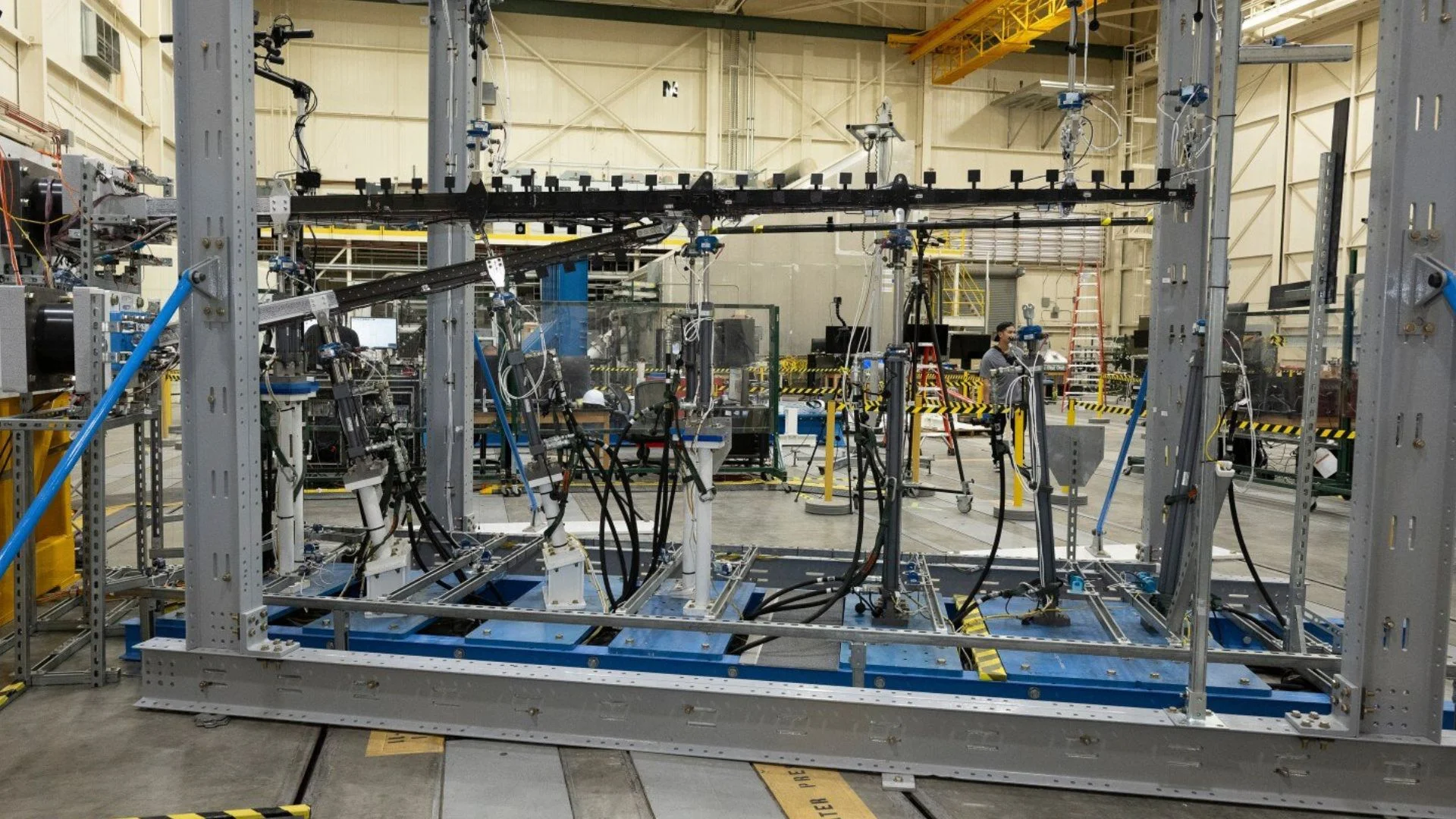
Engineers spent several months gradually increasing the forces applied to the wing inside the Flight Loads Laboratory. They installed numerous sensors across the structure to monitor how it responded as stress increased. These included fiber-optic strain sensors, which measure tiny changes in the material with high precision.
READ ALSO: Voyager Signs Geisinger as First Major Health Partner for Space-Based Medical Research
The collected data closely matched predictions generated by NASA’s computer models. According to the initial findings, the wing handled all expected in-flight loads without showing structural problems. The successful results also validated the manufacturing methods used to build and connect the composite wing components.
NASA Tests The Wing
After completing normal structural evaluations, engineers carried out a planned test-to-failure. They continued increasing the loads beyond the wing’s certified design limit to determine its maximum strength and identify where damage would first appear. This approach helps researchers better understand the safety margins built into the design.
The wing ultimately failed at approximately 127 percent of its design limit load. Visible damage first appeared near the rear edge of the wing and in the upper wing cover before the structure reached its final failure point. The findings provided valuable information about how the joints connecting the wing to its main support strut and smaller jury strut behave under extreme conditions.
Testing a structure until failure allows engineers to compare real-world performance with computer simulations. The information helps improve future aircraft designs by identifying areas where strength can be increased or weight reduced. Such testing also supports the development of safer and more reliable commercial aircraft.
Building Future Aircraft
The SWEET-15 project marks the first time a representative composite truss-braced wing has undergone this level of structural evaluation.
NASA researchers from multiple centers worked together on the project while using specialized agency technologies, including a Fiber Optic Sensing System originally developed for aircraft and spacecraft research. The collaboration combined expertise in design, manufacturing, testing, and structural analysis.
READ ALSO: Joyson Electronics Debuts Robotic Hand, AI Brain, and Smart Battery Tech at WAIC 2026
NASA also used its Integrated Structural Assembly of Advanced Composites robotic manufacturing system during the wing’s development. The technology helps produce lighter and stronger composite parts with greater precision than many traditional manufacturing methods. Reducing aircraft weight remains one of the most effective ways to improve fuel efficiency and lower operating costs.
Commercial aviation continues to search for designs that reduce fuel consumption and emissions without sacrificing safety. Lightweight composite structures and new wing shapes are important as airlines and manufacturers work toward more efficient fleets. Research programs such as SWEET-15 provide the technical data needed before these concepts move closer to practical aircraft designs.
The project is being carried out under NASA‘s Subsonic Flight Demonstrator program within the agency’s Research Technology Mission Directorate. Researchers will now study the large volume of test data to refine future airframe designs and improve structural models. The findings are expected to support the development of more efficient commercial aircraft in the years ahead.