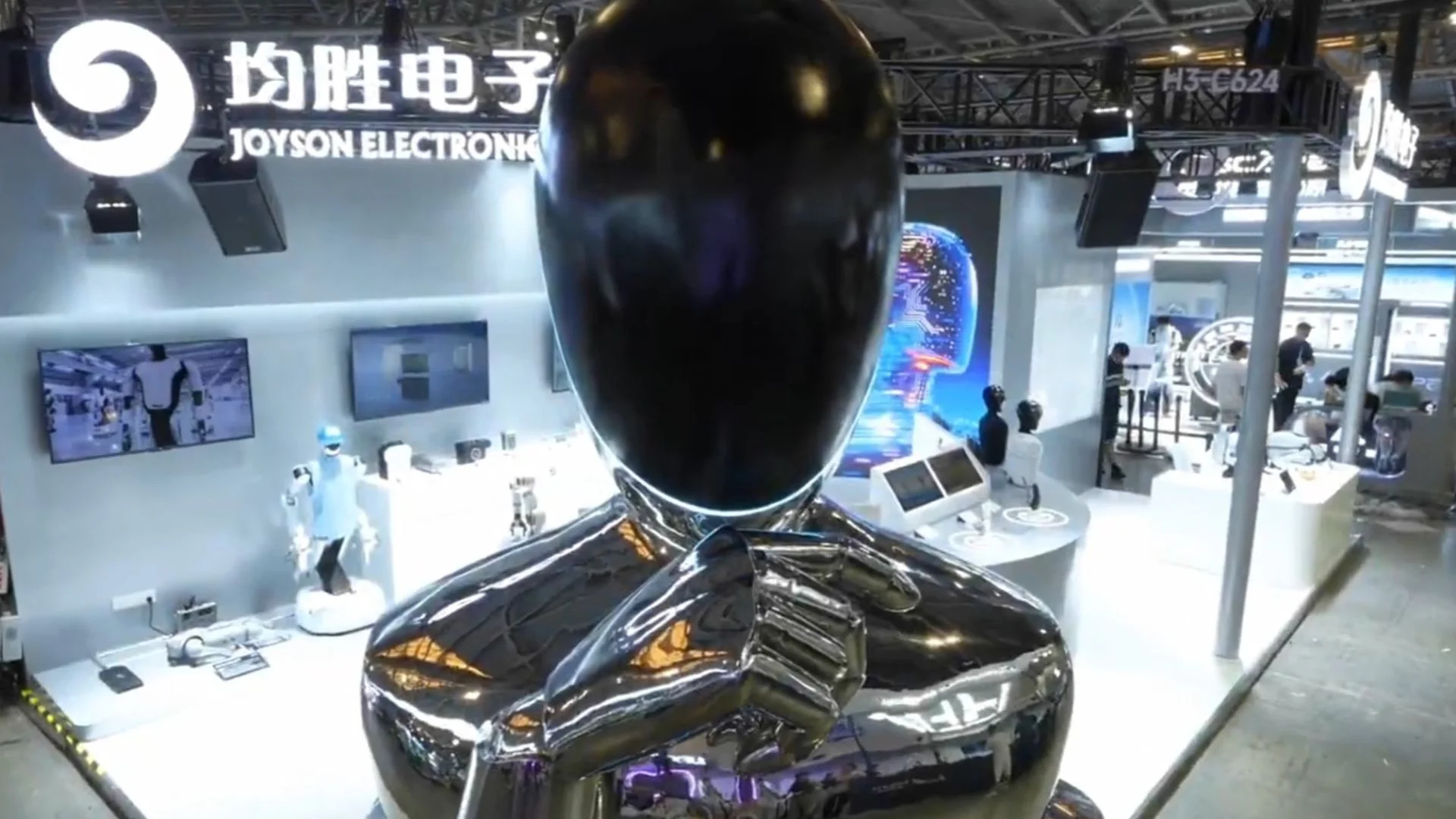
Joyson Electronics introduced a wide range of embodied artificial intelligence technologies during the 2026 World Artificial Intelligence Conference (WAIC).
The company presented new robotic hardware, intelligent software, advanced battery technology, and sensing systems designed to support the growing robotics industry. The announcement also highlighted the company’s progress in moving several of these products from development into commercial production.
The latest portfolio includes a dexterous robotic hand, an embodied AI brain, a third-generation AI head assembly, electronic skin, solid-liquid hybrid batteries, and robot controllers. Joyson Electronics said several controller products have already entered volume production. The company is also supplying these controllers to leading robotics manufacturers.
Embodied AI refers to artificial intelligence that operates inside physical machines such as robots. Unlike traditional AI software, embodied AI allows robots to understand their surroundings, make decisions, and perform physical tasks. As industries adopt automation, companies are investing in technologies that improve robot performance and flexibility.
Robotic Hand Advances
One of the main products unveiled at WAIC 2026 was the TeleHand series of dexterous robotic hands. Joyson Electronics developed the entire system internally, covering both hardware and software. The company introduced a Professional Edition for advanced applications and a Basic Edition aimed at wider industrial deployment.
The Professional Edition features an integrated palm structure combined with a hybrid actuation system. This design combines direct-drive motors, tendon-driven movement, and linkage mechanisms inside the palm itself. The approach improves movement accuracy while keeping the hand lighter and more compact.
The robotic hand offers 20 degrees of freedom, allowing finger movements that closely resemble those of a human hand. Higher degrees of freedom enable robots to perform more delicate tasks with greater flexibility. Such capabilities are important for manufacturing, inspection, and service applications that require careful object handling.
READ ALSO: Mystery Space Balls Wash Up on Australian Beach, Officials Reveal Their True Origin
Joyson Electronics also developed its own miniature frameless actuators for the TeleHand platform. These motors are nearly half the size of conventional alternatives and weigh about 30 percent less. Despite their smaller size, they provide two to three times the torque density of similarly sized hollow-cup motors.
The company also introduced its electronic skin technology alongside the robotic hand. The sensing system detects force and touch with high precision while remaining thin and flexible. It can measure pressure from different directions and even detect nearby objects before direct contact.
Electronic skin gives robots a sense of touch that helps improve object handling. Instead of relying only on cameras, robots receive physical feedback during movement. This reduces the risk of damaging fragile items while improving operational safety.
The TeleHand platform also includes a unified multimodal architecture known as PHINO. The system combines different types of sensor information into a single decision-making process. This allows the robotic hand to switch smoothly between industrial operations and service-oriented interaction.
Joyson Electronics also introduced a more affordable Basic Edition of the TeleHand. Although designed for lower cost, the company said it maintains industrial-grade reliability. Internal factory deployment has also helped validate the design under real operating conditions.
WAIC Debut Sparks Robotics Buzz
Alongside the robotic hand, Joyson Electronics unveiled its third-generation AI head assembly. The system combines perception, movement, and system-level control within a single platform. It allows robots to produce smoother head movements and more natural facial expressions.
The modular design supports faster product development for robot manufacturers. Companies can move from concept design to prototype testing and large-scale manufacturing more efficiently. The flexible architecture also allows easier customization for different robot designs.
The company also presented its embodied AI brain platform. This solution combines hardware and software into a unified operating system for robots across different sizes and applications. Joyson Electronics said the goal is to make robots easier to deploy while supporting continuous learning.
The hardware portion is called the Embodied AI PC, or EAPC. It combines computing functions normally handled separately by different control systems. Computing performance ranges from 40 TOPS to 2070 TFLOPS, allowing customers to select processing power based on application requirements.
TOPS and TFLOPS measure how many calculations a processor performs each second. Entry-level robots require less computing power for simple tasks. More advanced robots performing complex operations need much higher processing capability.
Joyson Electronics designed the EAPC using a modular architecture. The compact design improves heat management while supporting different robotic platforms. The company also said its existing automotive manufacturing network helps reduce production costs.
The software component, known as the Embodied AI Operating System(EAOS), contains three major functional systems. Each one focuses on a different part of robot intelligence. Together they help robots understand environments, make decisions, and improve over time.
The World Model serves as the robot’s understanding system. It gathers information from multiple sensors and builds a digital representation of surrounding environments. The software can also simulate possible outcomes before the robot performs an action.
The Agentic OS manages planning and execution. It divides complex tasks into smaller actions and selects the right tools or movement skills. This allows robots to coordinate robotic arms, dexterous hands, and mobile platforms more effectively.
The Memory System enables long-term improvement through experience. It stores current information, previous tasks, and learned operational skills. Over time, robots can use accumulated knowledge to complete similar tasks more efficiently.
Joyson Electronics said the embodied AI brain has already been deployed in selected real-world applications. Current deployments include industrial automation and automated charging systems. These early projects provide practical experience before wider commercial expansion.
READ ALSO: Hidden Atomic Structure in Metal Alloys Fuels ‘Corrosion Highways’ in Nuclear Reactors
Smarter Power Solutions
Power supply remains one of the biggest challenges facing advanced robots today. Many battery systems offer limited operating time while requiring long charging periods. Safety and high-power performance also remain important concerns.
Joyson Electronics introduced its Crystal Energy solid-liquid hybrid battery solution to address these issues. This battery combines the characteristics of traditional liquid batteries with features of solid-state technology. The result is higher energy storage while maintaining strong safety performance.
The battery delivers an energy density of 380 watt-hours per kilogram. Higher energy density allows robots to operate longer without increasing battery size. According to the company, overall operating endurance improves by about 60 percent.
The battery is designed for more than 2,000 charging cycles. It operates across temperatures ranging from -20 to 60 degrees Celsius. The system also supports wired and wireless charging while reaching 80 percent capacity in about 30 minutes.
Joyson Electronics paired the battery with its Crystal Energy Ultra-Control Battery Management System. The BMS continuously monitors battery cells and manages operating conditions. It operates across temperatures from-40°C to 105°C while providing automotive-grade safety protection.
Battery management systems play an important role in electric devices. They monitor battery health, prevent overheating, and extend service life. These functions improve reliability for robots operating in demanding industrial environments.
The company also introduced its first gallium nitride motor driver. Gallium nitride is a semiconductor material that offers higher efficiency than conventional silicon components. Joyson Electronics said the new driver achieves more than 95% energy conversion efficiency while reducing overall size by 40%.
Industry Focus Grows
Global interest in embodied AI has increased rapidly as companies seek smarter automation systems. Manufacturers are looking beyond traditional industrial robots toward machines capable of adapting to changing environments. Advances in computing, sensors, batteries, and AI software have accelerated this transition.
READ ALSO: China Defends RoboCup Humanoid Title as Standardized Robots Reshape AI Research
Automotive suppliers have become increasingly active in robotics because many technologies overlap. Electric motors, sensors, controllers, batteries, and safety systems already play central roles in modern vehicles. These capabilities provide companies like Joyson Electronics with experience that can be applied to robotic systems.
Joyson Electronics said it is following a dual strategy that combines internal product development with external investments. The company aims to strengthen its position across multiple core robotics technologies. It is also expanding testing through practical industrial deployment to improve product readiness.
The company believes robotics is entering a stage of wider commercial adoption. Its latest product portfolio reflects efforts to supply complete hardware and software solutions rather than individual components. By combining manufacturing experience with AI development, Joyson Electronics aims to meet the growing demand for capable, reliable, and cost-effective robotic systems as embodied AI enters more real-world applications.