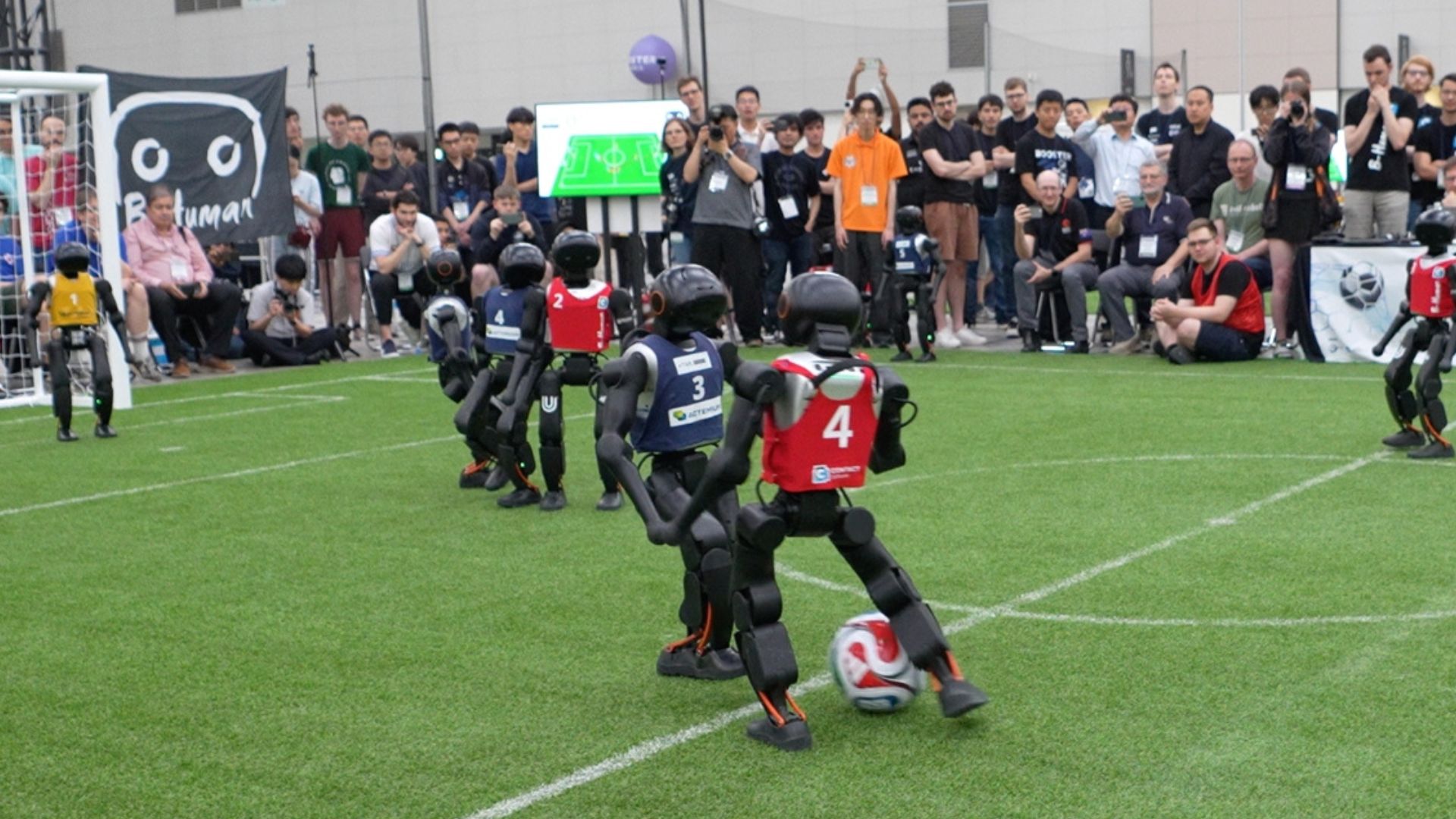
China’s THU Huoshen Team from Tsinghua University successfully defended its Humanoid League title at RoboCup 2026, the world’s largest artificial intelligence and robotics competition.
The event concluded in Incheon, South Korea. The victory reinforced China’s growing presence in humanoid robotics and embodied AI research.
The latest title follows the team’s historic victory in Brazil last year, when it ended a 28-year championship drought for Chinese competitors. The team competed using the Booster T1 humanoid robot platform developed by China’s Booster Robotics. The company specializes in designing humanoid robots for research and advanced AI applications.
RoboCup Robots Get Smarter
Booster Robotics said this year’s competition reflected a growing international move toward standardized hardware platforms for embodied AI research. Instead of designing robots entirely from the ground up, many teams now rely on advanced platforms that provide a common starting point. This allows researchers to spend more time improving intelligence rather than rebuilding basic mechanical systems.
In earlier RoboCup competitions, teams invested significant effort in designing robot bodies, developing hardware, and creating basic movement systems. That process consumed considerable research time and resources before teams could focus on intelligent behavior. Standardized platforms have changed that development model by reducing the need for repeated engineering work.
As a result, participating teams concentrated on improving visual recognition, faster decision-making, and cooperation between multiple robots. These capabilities help robots identify objects, react to changing situations, and work together more effectively during matches. The shift demonstrates how the field is moving from hardware development toward smarter software and AI systems.
Smarter Robot Training
Booster Robotics also highlighted the growing role of simulation-based development tools in robotics research. These virtual environments allow developers to train and test AI systems before transferring them to real robots. The process reduces development time while lowering costs and technical barriers for research teams.
Simulation tools create realistic digital environments where robots can practice movements, recognize objects, and improve decision-making. Once the software performs well in simulation, developers can deploy it directly onto physical machines with fewer adjustments. This approach enables students and researchers to experiment more efficiently without depending entirely on expensive hardware testing.
READ ALSO: TNO and Destinus Unite to Build Advanced Radar Seekers for Europe’s Air Defence Future
The company said these improvements are making embodied AI research more accessible to a wider range of developers. Younger researchers can now focus on building advanced AI capabilities instead of spending years developing basic robotic hardware. This wider access may encourage faster innovation across the robotics industry.
AI Improves Teamwork
RoboCup Federation President Ubbo Visser said the competition demonstrated how far humanoid robotics has progressed in recent years.
He noted that teams displayed stronger cooperation and increasingly advanced technical skills throughout the tournament. Visser added that combining improved humanoid hardware with modern AI has raised robot football to a much higher level.
Industry observers also noted improvements in robot stability and operating speed during this year’s matches. According to South Korean robotics publication iRobotNews, bipedal humanoid robots performed with greater balance and smoother movement than in previous competitions. These improvements allowed robots to react more quickly during gameplay while maintaining stability.
The advances support RoboCup’s long-term objective of building a humanoid robot football team capable of defeating the human FIFA World Cup champions by 2050. Although today’s robots remain far behind professional human players, experts believe development has accelerated significantly in recent years. The steady progress suggests that AI, robotics, and mechanical engineering continue to evolve together.
Future Sports Robotics
Yoshihiro Tanaka, CEO of AI consulting company taziku, said RoboCup 2026 showed that robot football is becoming increasingly engaging to watch.
He explained that each play combines several complex technologies, including ball recognition, posture control, balance recovery, and rapid decision-making. These systems operate together within seconds, demonstrating how multiple AI capabilities work as one.
Robot football also serves as an important testing ground for technologies that extend beyond sports. Many of the same systems used during matches can support future applications in manufacturing, healthcare, logistics, emergency response, and service robotics. Competitions like RoboCup provide researchers with practical environments to improve robot intelligence under real-world conditions.
China’s latest RoboCup victory reflects both its continued investment in humanoid robotics and the broader evolution of embodied AI worldwide. As hardware becomes more standardized and AI systems grow more capable, researchers are expected to accelerate the development of intelligent robots for a wide range of real-world applications.