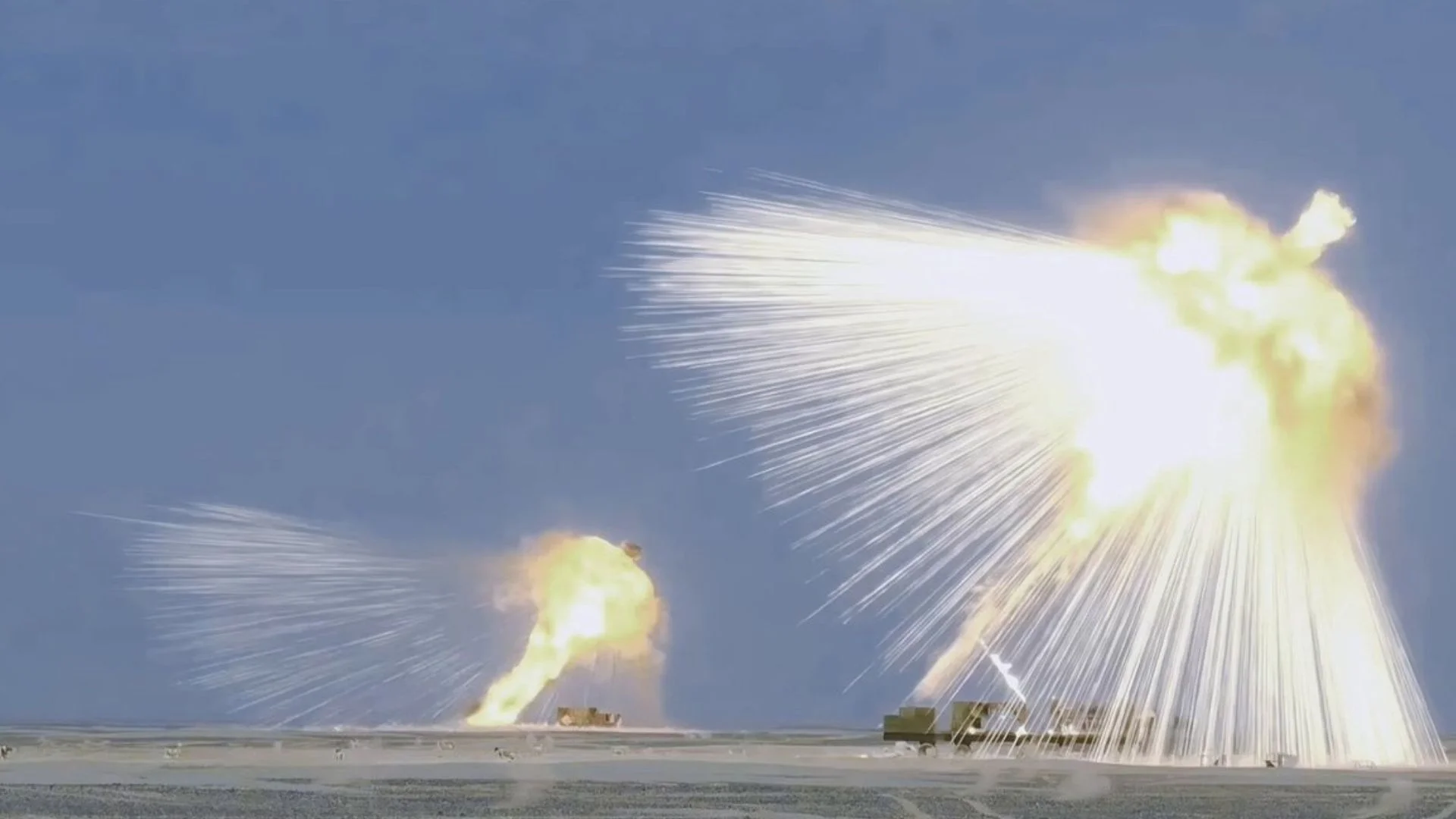
China has released footage showing its PHL-191 long-range modular multiple launch rocket system(MLRS) firing during a live-fire exercise.
The video was published by China Military Online and the Chinese Ministry of National Defense. It highlights what appears to be the use of an airburst-capable munition designed to spread its effects over a wider area.
The footage shows rockets striking a target zone followed by several explosions occurring above or just over the ground. Instead of creating a single impact point, the blasts appear to spread fragments across a larger section of the battlefield. This type of effect is generally intended to target dispersed troops, lightly protected vehicles, and exposed military equipment.
China has not identified the specific rocket used in the exercise. It also has not released details about the munition’s range, warhead, fuze, firing distance, or accuracy. Even so, analysts say the visible effects provide clues about the PLA’s evolving approach to long-range fire support.
The demonstration reflects a growing emphasis on suppressing enemy forces before ground operations begin. Rather than focusing only on destroying individual targets, the system appears designed to disrupt movement and reduce enemy effectiveness across a wider area. This approach fits modern military concepts that rely on shaping the battlefield before major combat starts.
PHL-191: Modular Launcher Design
The PHL-191 is a wheeled rocket artillery system built around a modular launcher design. Different launcher modules allow it to fire several types of guided rockets and tactical missiles depending on the mission. This flexibility enables commanders to choose different weapons without replacing the entire launcher.
Publicly available defense assessments identify the system as part of the PHL-16, PCH-191, and AR-3 family of Chinese rocket artillery. The launcher shown in the new video closely matches the eight-round configuration displayed during earlier Chinese military parades. Analysts believe it was likely equipped with two four-round modules carrying 370 mm rockets.
READ ALSO: NASA Tests SWEET-15 Composite Wing To Failure For Future Fuel-Efficient Aircraft
This assessment is based on comparisons with previously displayed launchers rather than official confirmation. Camera angles and protective launcher covers prevent precise measurement of the rocket canisters. China has not officially confirmed the ammunition configuration shown in the exercise.
The same modular launcher can reportedly carry smaller 300 mm guided rockets as well as larger tactical missiles. This allows units to switch between missions that require wide-area suppression or deep precision strikes. Such flexibility makes the system suitable for different battlefield conditions.
Understanding Airburst Effects
An airburst munition is designed to explode above the target instead of on direct impact. This allows metal fragments to spread over a larger area rather than being absorbed into the ground. The result can increase effectiveness against exposed personnel and lightly protected equipment.
The explosions shown in the video appear to occur at similar heights across the target zone. That pattern suggests the munition may have been designed for controlled airburst effects. However, the footage alone cannot confirm the type of fuze or the exact technology used.
Airburst weapons are not intended for every target. Hardened bunkers, underground command centers, and heavily armored vehicles normally require different warheads or direct-impact weapons. As a result, military forces often use several munition types depending on the target.
China has not provided any information about the system’s accuracy or circular error probable. The video also does not reveal whether the burst height was controlled by a programmable timer, proximity sensor, or another method. Those technical details remain unknown.
Strategic Battlefield Impact
The PHL-191 combines long range with high mobility. Like other modern rocket artillery systems, it is designed to fire quickly and relocate before enemy forces can respond. This shoot-and-scoot approach improves survivability during combat.
Public assessments estimate that the launcher can fire 300 mm guided rockets to around 150 kilometers. The larger 370 mm rockets are reported to reach between 280 and 350 kilometers. A tactical missile configuration is widely believed to extend the system’s reach to roughly 480 to 500 kilometers.
The system is often compared with the American HIMARS and M270 launchers because all three use guided rockets for long-range precision fire. However, the PHL-191 has its own launcher layout and should not be viewed as a direct equivalent. Each system supports different ammunition and operational concepts.
The US also fields area-effect guided rockets such as the M30A1 GMLRS Alternative Warhead. That munition spreads preformed tungsten fragments without using traditional explosive submunitions. The Chinese demonstration appears to show a similar battlefield effect, although no direct technical comparison can be confirmed from the available footage.
The exercise also highlights the importance of battlefield suppression as a military mission. Damaging radar systems, communication vehicles, generators, or exposed crews can temporarily disable an air-defense position without destroying every launcher. Such attacks can create opportunities for follow-on aircraft, missiles, or ground forces.
READ ALSO: 150-Million-Year-Old Fossil Unlocks Missing Link in Bird Tail Evolution Mystery
Long-range rocket systems achieve their greatest value when linked with modern command-and-control networks. Drones, reconnaissance aircraft, surveillance systems, and secure communications help identify targets and guide artillery fire. The released video shows only the final strike rather than the wider network supporting the operation.
The launcher itself also faces operational risks. Large rocket launches can be detected by counter-battery radars, electronic surveillance, and airborne reconnaissance. Mobility, camouflage, decoys, and rapid relocation therefore remain essential parts of its battlefield use.
Although the exercise did not mention Taiwan, the demonstration has attracted attention because of China’s broader military modernization.
Public US defense assessments identify the Eastern Theater Command as responsible for operations involving the East China Sea and Taiwan. Those same reports also list the modular PHL-16 and PCH-191 launcher family as part of the PLA Army’s growing long-range fire capability.
The released footage does not identify the participating artillery unit or suggest that the exercise simulated a Taiwan-related operation. Nevertheless, the apparent airburst effects illustrate the type of capability that could support wider joint military campaigns. Such weapons may be used to suppress artillery positions, command posts, air-defense sites, and troop concentrations before other forces begin larger operations.
China’s latest demonstration provides another look at how long-range rocket artillery continues to evolve. The video emphasizes flexible launchers, apparent airburst munitions, and wide-area battlefield suppression rather than only deep precision strikes. As countries continue investing in advanced artillery and integrated battlefield networks, systems like the PHL-191 are expected to play an extremely important role in future military operations.