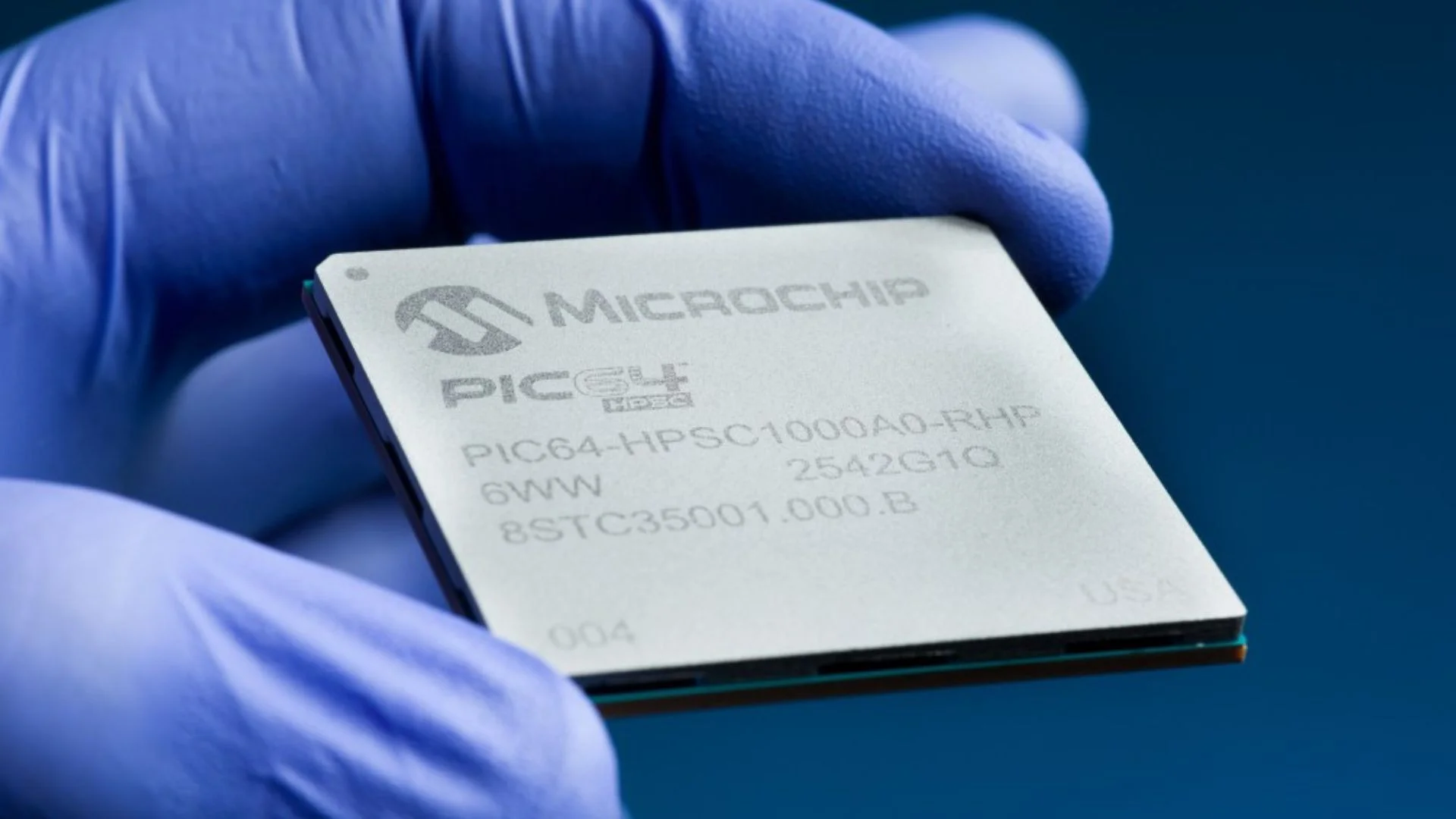
NASA has partnered with Microchip Technology to develop a new generation of spaceflight chips designed for future missions to the Moon, Mars, and deep space.
The new processors are expected to deliver 100 times more computing power than current space-qualified systems while improving reliability, energy efficiency, and onboard autonomy.
The project marks a major step toward preparing spacecraft for longer, more complex missions beyond Earth orbit.
NASA Spaceflight Chips Boost Smarter Missions
NASA announced a new initiative under the High-Performance Spaceflight Computing program. The project focuses on building a system-on-a-chip(SoC), for future spacecraft and satellites. These chips combine several computing functions into a single compact unit.
The new chips will come in two versions for different mission needs. One version will be radiation-hardened for deep-space and long-duration missions, while the other will be radiation-tolerant for satellites operating in low Earth orbit.
READ ALSO: Artificial Muscle Combines Sensing and Movement in One Structure for Humanoid Robots
Radiation protection is important because space environments can damage standard electronic systems over time.
NASA said the radiation-hardened chips are designed for missions to the Moon, Mars, and beyond. These missions expose spacecraft to intense cosmic radiation for years at a time. Traditional processors used on Earth cannot survive such conditions without special protection.
The SoC design also combines networking and computing functions into one device. This reduces the size, weight, and complexity of spacecraft electronics. It also improves power efficiency, which remains one of the biggest challenges for long-range space missions.
Future NASA missions will require spacecraft and rovers to make more decisions independently. Communication delays between Earth and Mars can take several minutes, making real-time control difficult. Faster onboard computers help spacecraft react more quickly without waiting for instructions from mission control.
NASA said the new chips will support scalable computing systems connected through advanced Ethernet networks. Multiple chips can work together to deliver greater processing power when needed. Operators can also switch off unused functions to save energy during long missions.
WATCH ALSO: Elon Musk’s Neuralink Robot Makes Brain-Computer Connection Possible
This flexible approach is important because spacecraft often face strict power limits. NASA has already used similar strategies on earlier missions, such as Voyager 1. Engineers recently powered down some instruments on the spacecraft, which is nearly 50 years old, after detecting lower power levels.
Modern Mars missions already rely heavily on onboard computing systems. NASA’s Perseverance Rover uses satellite maps, camera data, and onboard processors to navigate the Martian surface. The rover compares terrain images with orbital data to determine its exact location without constant human guidance.
Technology Beyond Space Exploration
NASA believes the technology created through this partnership may also support industries on Earth.
The agency said future applications may include drones, energy systems, medical equipment, communication services, artificial intelligence, and high-speed data transmission. Space technology has historically influenced many products now used in daily life.
Several common consumer technologies originated in space research programs. According to the NASA Jet Propulsion Laboratory, innovations such as camera phones, memory foam, wireless headphones, LED lighting, and water purification systems all trace part of their development to space exploration efforts.
READ ALSO: Iran’s Uranium Stockpile Becomes Military Target as US-Israel Talks Shift to Action Plans
Unlike consumer-focused chip makers, NASA’s project places stronger emphasis on durability and efficiency. Companies like Apple, NVIDIA, and TSMC mainly focus on raw performance for commercial markets. NASA and Microchip are instead targeting secure, reliable, and energy-efficient systems that can survive extreme space environments.
The partnership arrives as global interest in lunar exploration and Mars missions continues to grow. Governments and private companies are planning more ambitious space programs that demand smarter onboard computing systems.
NASA’s next-generation chips will become a key technology powering the future of deep-space exploration.