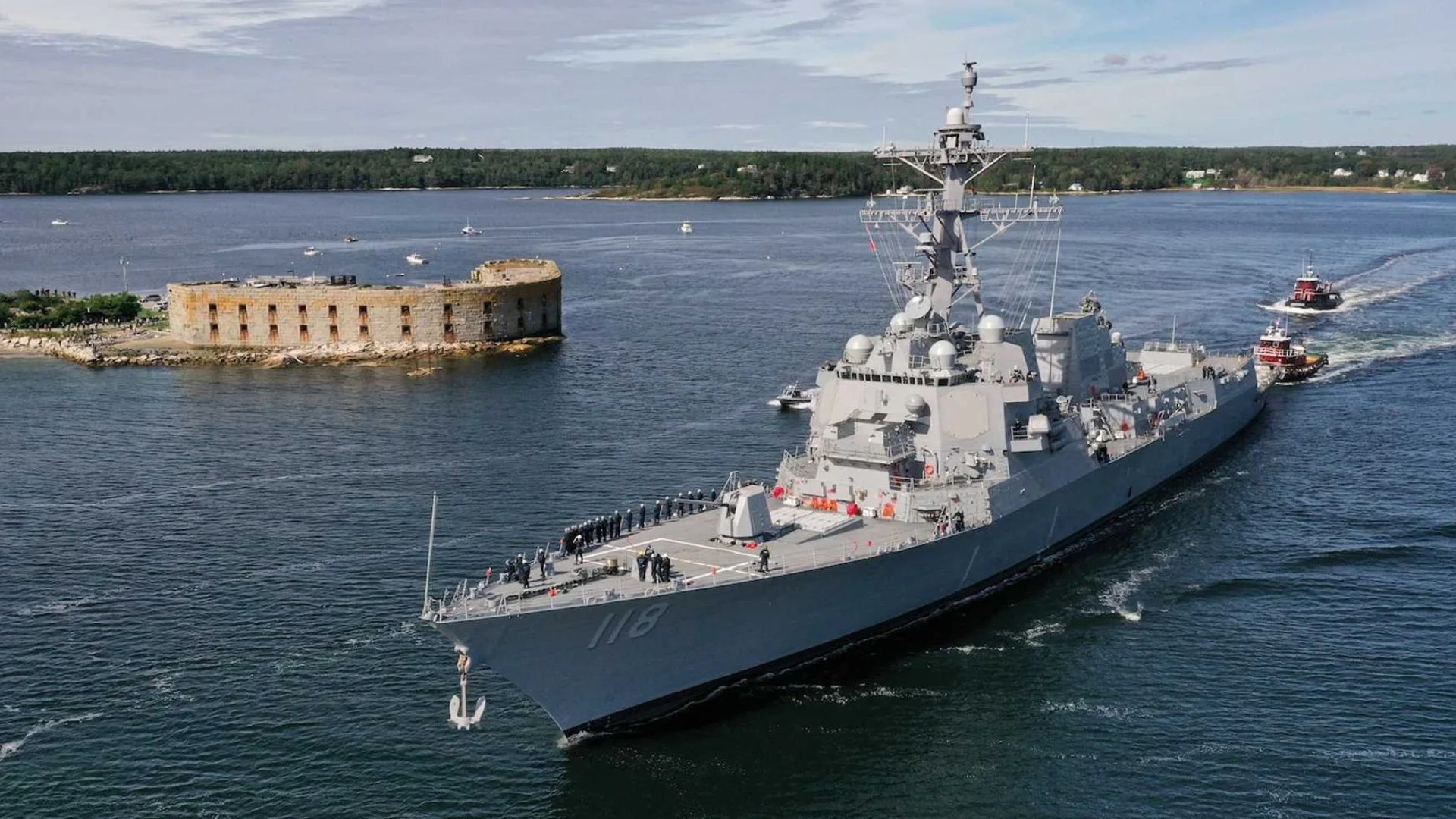
The US Navy has awarded Bath Iron Works a contract to build the future USS Robert R. Ingram (DDG-149), continuing the production of the advanced Flight III Arleigh Burke-class destroyers.
Announced on May 6, 2026, the new warship will become the 98th Arleigh Burke-class destroyer and strengthen the Navy’s missile defense and multi-domain combat capabilities amid rising global security demands.
Flight III Destroyer Program With USS Robert R. Ingram
The contract keeps one of the Navy’s most important warship production lines active. It also supports the Navy’s long-term plan to maintain fleet strength while next-generation destroyers remain years away.
The future DDG(X) program is still in early development and is not expected to begin procurement before 2032.
USS Robert R. Ingram will be the 21st Flight III-configured Arleigh Burke destroyer. These ships represent the latest and most capable version of the class. The Navy considers them central to modern air and missile defense operations.
READ ALSO: Maiasaura Dinosaur Teeth Reveal 75-Million-Year-Old Parenting Habits Similar to Modern Birds
Bath Iron Works in Maine and Ingalls Shipbuilding in Mississippi are currently the only two American shipyards building Arleigh Burke destroyers. The Navy uses this dual-yard system to maintain steady production capacity. The arrangement also helps protect the US naval industrial base during periods of high demand.
The contract arrives as the American shipbuilding industry faces workforce shortages and supply chain delays. Rising costs have also affected several major Navy ship programs. Maintaining continuous destroyer construction helps stabilize suppliers and preserve skilled labor.
Bath Iron Works has built 39 Arleigh Burke destroyers since the late 1980s. The company remains one of only two US shipyards with experience producing large Aegis-equipped warships. That experience is considered essential for maintaining current naval readiness.
Flight III Destroyers Bring Major Radar and Missile Defense Upgrades
The Flight III version of the Arleigh Burke-class introduces major improvements over earlier destroyers. The most important upgrade is the AN/SPY-6(V)1 Air and Missile Defense Radar. This advanced radar significantly improves the ship’s ability to detect and track threats.
The SPY-6 radar uses active electronically scanned array technology. It is designed to detect smaller targets at greater distances compared to the older SPY-1D radar. Navy officials say it is around 30 times more sensitive than previous systems.
The radar works together with the Aegis Baseline 10 combat system. This system enables the ship to track and engage multiple threats simultaneously. It supports defense against ballistic missiles, cruise missiles, drones, aircraft, and surface threats.
Integrating the new radar required major changes inside the ship. Engineers upgraded electrical generation systems, cooling systems, and internal layouts to support the higher power demand. These changes increased the ship’s displacement to nearly 9,700 tons fully loaded.
WATCH ALSO: American company’s next-generation ejection seat offers a 92% survivability rate
USS Robert R. Ingram will carry 96 Mk 41 Vertical Launch System cells. These launchers can fire several different types of missiles depending on mission requirements. The destroyer can carry SM-2, SM-3, SM-6, ESSM, Tomahawk, and ASROC weapons.
The destroyer is designed for simultaneous air defense and ballistic missile defense operations. This layered defense approach has become increasingly important in recent years. US Navy warships now regularly face missile and drone threats during deployments.
Flight III destroyers also retain strong anti-submarine warfare capabilities. The ships include sonar systems, towed arrays, torpedo launchers, and two MH-60R Seahawk helicopters. These aircraft support surveillance, anti-submarine missions, targeting, and rescue operations.
Additional defensive systems improve survivability during combat. These include the Phalanx Close-In Weapon System, electronic warfare equipment, decoy launchers, and torpedo countermeasure systems. The ships also feature Kevlar protection and hardened compartments designed to limit battle damage.
The destroyers are powered by four General Electric LM2500 gas turbines. Together, they generate about 105,000 shaft horsepower. The ships can travel at speeds above 30 knots with a range of roughly 4,400 nautical miles at cruising speed.
Crew size is expected to remain around 380 personnel. Despite the larger systems and upgraded electronics, the Navy has kept the general hull design largely unchanged. However, officials acknowledge that the current design is approaching its physical limits.
Vice Admiral Brendan McLane said in 2025 that the Flight III design was effectively maxed out. Future technologies such as directed-energy weapons and larger hypersonic systems may require a larger ship design. That challenge is one reason the Navy continues work on the DDG(X) program.
USS Robert R. Ingram Honors Medal of Honor Recipient
The future destroyer is named after Robert Roland Ingram, a Navy corpsman who served with the US Marines during the Vietnam War. He was born in Clearwater, Florida, in January 1945. Ingram enlisted in the Navy in 1963 and later deployed to Vietnam in 1965.
During combat operations in Quang Ngai Province on March 28, 1966, Ingram repeatedly crossed open ground under enemy fire to treat wounded Marines. He also helped redistribute ammunition and assist evacuations during intense fighting. Ingram suffered four gunshot wounds while continuing to aid fellow service members.
Earlier that year, he had already received the Silver Star for bravery under fire. However, recognition for his March 1966 actions was delayed for decades due to missing paperwork from the Vietnam era. President Bill Clinton eventually awarded him the Medal of Honor on July 10, 1998.
The naming of DDG-149 continues the Navy tradition of honoring service members who displayed extraordinary courage in combat. Officials say the ship reflects both military service and long-term commitment to national defense. The Navy often uses destroyer names to preserve important military history.
Operational demand for Arleigh Burke destroyers has increased sharply in recent years. US Navy warships have played major roles in missile defense missions across the Red Sea, Eastern Mediterranean, and Persian Gulf. Several destroyers intercepted missiles and drones during regional conflicts between 2023 and 2025.
Ships such as USS Carney, USS Mason, USS Gravely, USS Arleigh Burke, and USS Cole conducted multiple intercept operations during attacks linked to Houthi and Iranian-backed forces. In April 2024, USS Arleigh Burke and USS Carney used SM-3 missiles against Iranian ballistic missiles targeting Israel. That event marked the first combat use of the SM-3 interceptor.
READ ALSO: Pentagon UFO Files Released: Hovering Objects, Flashing Lights, and Unanswered Questions
These operations reinforced the importance of advanced radar systems and large missile inventories. Navy planners now view destroyers as critical assets for continuous missile defense patrols. Their role has expanded far beyond traditional Cold War anti-air warfare missions.
The Navy currently operates 75 Arleigh Burke-class destroyers across several variants. Longer-term planning studies have examined expanding the Flight III fleet to as many as 42 ships. The ships are expected to replace many of the retiring Ticonderoga-class cruisers over the coming years.
Each Flight III destroyer currently costs about $2.2 billion in FY2024 dollars. That figure does not include all government-furnished equipment or missile inventories. Continued procurement also supports American defense manufacturing tied to radar systems, combat electronics, missile launchers, and propulsion equipment.
The USS Robert R. Ingram contract highlights the Navy’s effort to balance future modernization with immediate operational needs. While the DDG(X) program aims to introduce a larger and more flexible warship, the Flight III destroyer remains the Navy’s most capable and available surface combatant today.
Continued production ensures the fleet can meet growing security demands while preserving the industrial base needed for future naval programs.