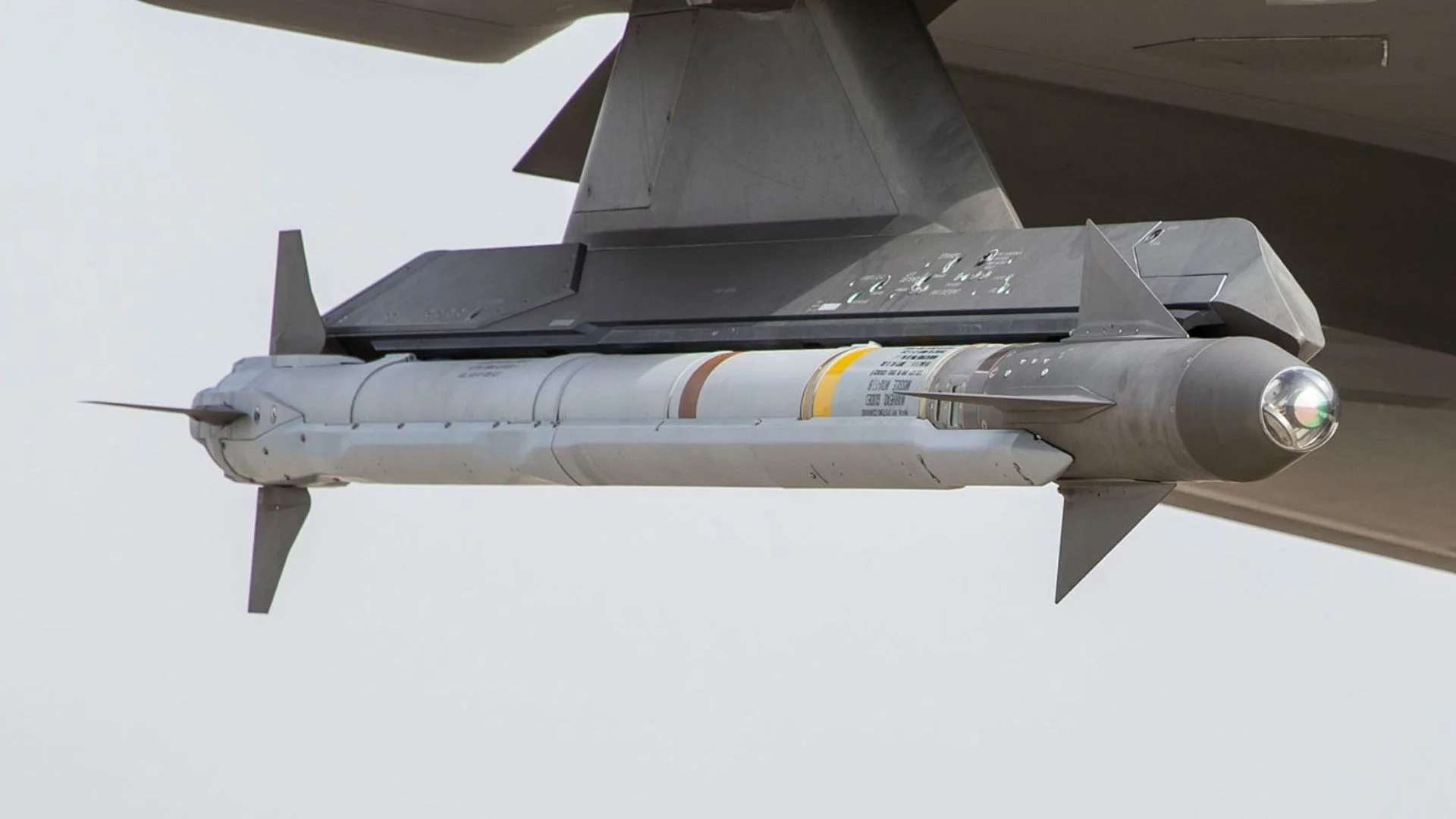
The US Navy and Air Force are working together on a new compact variant of the AIM-9X Sidewinder missile.
The project aims to create a smaller air-to-air weapon that can fit inside advanced combat aircraft and autonomous drones.
The Navy requested $83.3 million for research and development in its fiscal 2027 budget proposal.
Smaller AIM-9X Designed for Future Drone Combat
The new missile will use technology already proven in the existing AIM-9X system. Engineers plan to redesign the missile into a more compact body while improving flight performance and range. Budget documents describe it as an airframe optimized for internal carriage on advanced aircraft.
The effort directly supports the US Air Force’s Collaborative Combat Aircraft program. The CCA initiative focuses on autonomous drone wingmen that can fly alongside fighter jets during combat missions. These drones are expected to carry extra weapons, conduct reconnaissance, and support manned aircraft in dangerous airspace.
READ ALSO: US Army Launches Baltic Balloon Surveillance Test to Strengthen NATO Border Security
The Air Force plans to spend nearly $1 billion in 2027 to begin purchasing the first generation of these drones. Officials see the drones as an important part of future warfare against technologically advanced rivals such as China. Carrying more missiles inside stealthy aircraft and drones is becoming a major priority for US military planners.
Why a Compact AIM-9X Sidewinder Matters
The current AIM-9X Sidewinder is already one of the most widely used short-range air-to-air missiles in the world. It is carried by aircraft, including the F-15, F-16, F-22, and F-35. The missile uses infrared guidance to track the heat signature of enemy aircraft.
Earlier versions of the AIM-9 family were used during the Vietnam War. More recently, an F-22 used an AIM-9X missile to shoot down a Chinese surveillance balloon off the coast of South Carolina in February 2023. The missile family has remained in service for decades thanks to continuous upgrades and improved targeting systems.
The standard AIM-9X measures about 9.4 feet in length. By comparison, the AIM-120 AMRAAM missile is around 12 feet long. Officials have not revealed the dimensions of the compact version, but defense analysts believe a smaller missile could allow drones to carry more weapons internally.
Retired Air Force Colonel John Venable said smaller weapons increase aircraft carrying capacity. He explained that drones still under development can benefit from more compact missiles because engineers can fit more of them into the limited internal space. This becomes especially important for stealth aircraft that rely on internal weapons bays to avoid radar detection.
General Atomics and Anduril are currently competing in the first phase of the Air Force’s CCA program. General Atomics developed the YFQ-42A ‘Dark Merlin,’ while Anduril built the YFQ-44A ‘Fury.’ The Dark Merlin stores weapons internally, while the Fury carries missiles externally.
WATCH ALSO: World’s first motorbike backflip between two moving trucks successfully completed
Venable said a compact Sidewinder design might allow some drones to carry four or more missiles. That increase would give drone wingmen deeper magazines during combat missions. Military planners believe this added capacity could help US aircraft survive longer in large-scale conflicts.
The new compact missile is expected to retain many features from the latest AIM-9X Block II variant. That version includes improved electronics and a lock-on-after-launch capability. This technology enables the missile to receive targeting updates after launch via a datalink.
Older AIM-9 variants required pilots to point the missile directly at a target before firing. This process is known as lock-on-before-launch. It forced stealth aircraft such as the F-22 to expose missiles outside the aircraft before engaging enemy targets.
The newer system allows missiles to launch first and lock onto targets later. This feature enhances stealth and gives aircraft greater flexibility in combat. It also supports beyond-visual-range engagements, where pilots attack targets they cannot directly see.
Even with these advances, some experts remain cautious about operational performance. Venable said he is not fully convinced the missile can function effectively from a fully internal launch position until testing proves it. He noted that aircraft may still need to partially expose missiles before firing.
The Navy has already funded early risk-reduction work for the compact missile design. Research in 2027 will continue to improve the hardware and software systems linked to the new weapon. Developers are focusing on balancing a smaller size with range, speed, and targeting performance.
READ ALSO: Anion Engineering Boosts CO2 Adsorption Sevenfold in Polymeric Ionic Liquid Materials
The compact Sidewinder may also improve the capabilities of larger drones such as the MQ-9 Reaper. A lighter missile could give drones both defensive and offensive air combat options. That flexibility may become increasingly important as drones take on larger roles in future military operations.
The project reflects a broader shift in modern warfare toward unmanned systems and distributed firepower. Smaller missiles paired with autonomous drones could allow the US military to spread combat capability across larger formations. As testing and development continue, the compact AIM-9X may become a key weapon in the next generation of air combat.