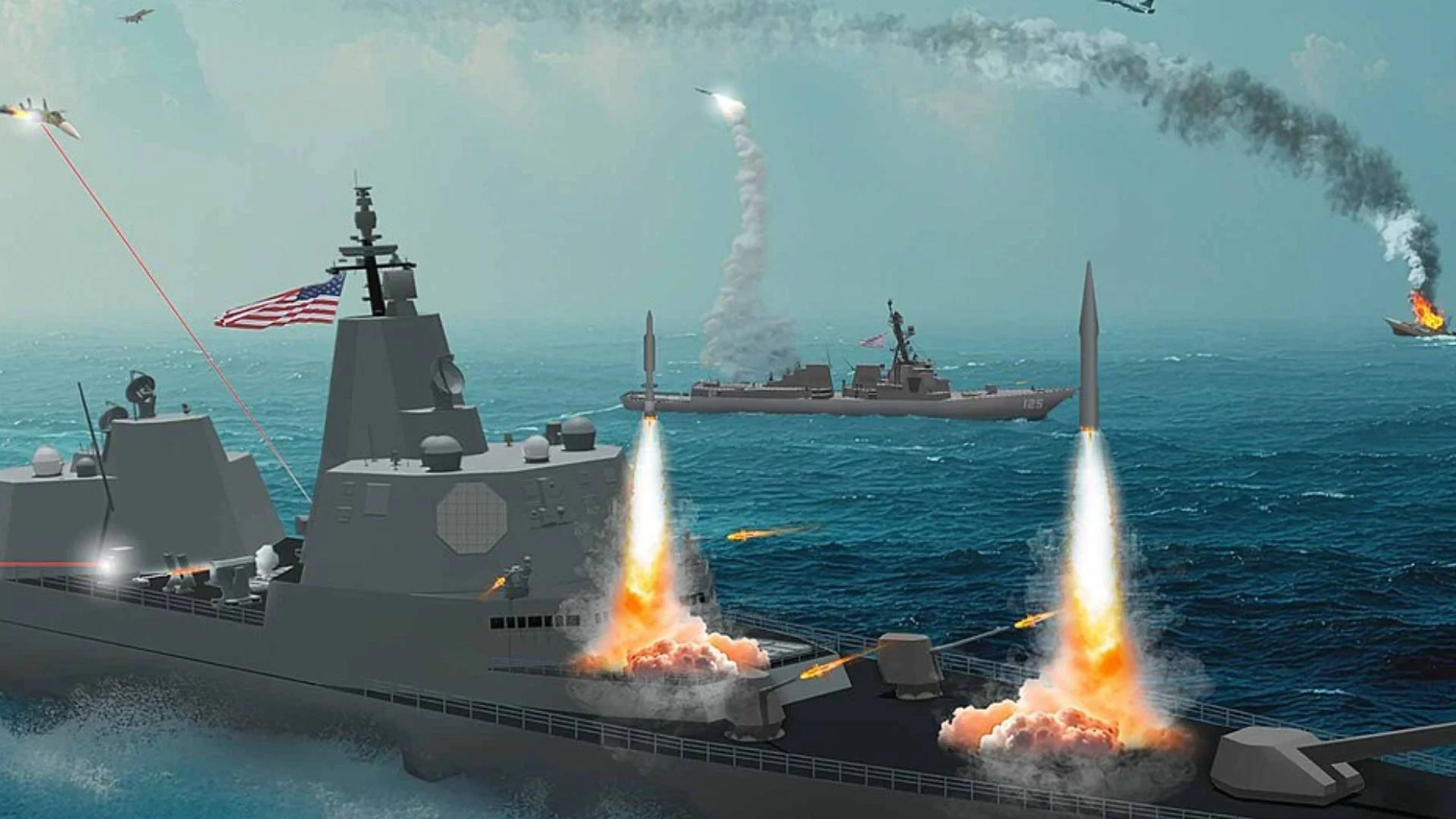
The US Navy is planning to begin construction of the Trump-class battleship by fiscal year 2028, marking one of its most ambitious investments in scale and technology.
Service officials say the Navy will spend around $46 billion over the next five years to design and develop the new battleship. The goal is to move quickly from planning to construction, as global security challenges continue to evolve.
The idea for the new class was first announced by Donald Trump in December. At the time, he described a powerful new warship equipped with advanced systems, including hypersonic weapons, electronic rail guns, and high-powered laser weapons. Now, those early ideas are turning into detailed plans.
READ ALSO: US Army Selects Vector AI Drone to Sharpen ISR Reach and Precision
Secretary of the Navy John Phelan confirmed that discussions with industry partners are already underway. The Navy is currently working with two vendors as it refines the ship’s design.
“We are talking to two different vendors right now,” Phelan said while speaking to reporters at the Sea Air Space exposition. He explained that the final decision will depend on how the design process develops and what each company can deliver.
He added that shipyard capacity will also play a key role. The Navy wants to move fast and begin construction as early as 2028. “We are looking to get moving quickly and lay the keel in ’28,” Phelan said.
To support this timeline, the Navy is requesting about $1 billion in advance procurement funding for fiscal year 2027. This funding will help prepare materials and systems before construction begins. In addition, the service is requesting $837 million in research and development funding for the same year.
WATCH ALSO: Drum-shaped antenna reflector on NASA-ISRO NISAR satellite deployed
Looking ahead, the Navy plans to request around $17 billion in procurement funding for the first Trump-class battleship in fiscal 2028. A second ship is expected to follow, with an estimated $13 billion request planned for 2030.
However, officials say these numbers are still early estimates. Costs may change as key design decisions are finalized. One major question is whether the ship will use nuclear power or a conventional propulsion system.
“We are still working through those details,” Phelan said. “We will understand the real costs better as we move forward.”
The push for a new battleship comes after challenges with next-generation destroyer programs. Navy leaders believe a larger ship platform is needed to carry more advanced systems and handle future missions.
Rear Adm. Ben Reynolds explained that the battleship will offer capabilities that current destroyers cannot provide.
READ ALSO: US University Dual-Bacterial Sensors Turn Chemical Clues Into Electric Signals
“This ship will do many things our destroyers cannot,” Reynolds said. He compared it to how frigates fill operational gaps that larger ships cannot handle.
The Trump-class battleship is expected to have a larger hull, giving it more space for weapons, sensors, and power systems. This added size is seen as critical for integrating next-generation technologies. At the same time, the Navy is increasing its overall shipbuilding budget.
For fiscal year 2027, the service is requesting $65.8 billion for shipbuilding. This is a major jump from the $27.2 billion approved in the fiscal 2026 budget. Of the new request, about $60.2 billion comes from the base budget, while $5.6 billion is expected from reconciliation funding.
Reynolds said recent global events have reinforced the need for this investment.
“Current operations clearly show why this effort matters,” he said. “This is a large investment, but we want to build strong contracts and encourage more industry participation.”
The Navy also plans to diversify its supplier base. Officials believe this will strengthen production capacity and reduce supply chain risks. In total, the service aims to procure 34 ships in fiscal year 2027. This includes a wide range of vessels designed for different missions.
WATCH ALSO: Chinese company’s humanoid robot has mastered Webster flip, defies physics
The list includes one Columbia-class submarine, two Virginia-class submarines, and one Arleigh Burke-class destroyer. It also includes one America-class amphibious assault ship and a San Antonio-class amphibious transport dock.
Additionally, the Navy plans to acquire six medium landing ships and one frigate. Officials also mentioned a ‘Special Mission Ship,’ requested by a combatant command, though details about this vessel remain limited.
Beyond shipbuilding, the Navy is also increasing its investment in aircraft and weapons systems. The fiscal 2027 budget request includes $34.4 billion for aircraft procurement. About $27 billion comes from the base budget, with another $7.4 billion from reconciliation funds.
Part of this funding will support the development of the Navy’s next-generation fighter jet, known as F/A-XX. The request includes $140 million for the program in fiscal 2027.
Reynolds noted that funding allocated for F/A-XX in fiscal 2026 has not yet been fully spent. Around $1.7 billion remains available for use as the program progresses.
The Navy is also planning a major increase in munitions procurement. One example is the Tomahawk Land Attack Missile. The service wants to procure 785 of these missiles in fiscal 2027, a sharp rise from just 55 in the previous year. The total cost is expected to be around $3 billion.
In another move, the Navy is requesting, for the first time, Patriot Advanced Capability-3 Missile Segment Enhancement interceptors. The service plans to procure more than 400 of these systems.
READ ALSO: Locus Array Debuts: The Warehouse Robot That Rewrites Fulfillment
Lockheed Martin recently announced that it has received a contract to support this effort. The company will handle development, integration, and testing of the PAC-3 system within the Navy’s Aegis Combat System. This system is already deployed on many Navy destroyers and cruisers, making it a key part of the fleet’s defense network.
Taken together, these plans show a Navy preparing for a more complex and demanding future. From advanced battleships to expanded missile inventories, the service is making large investments to stay ahead in modern naval warfare.
The Trump-class battleship stands at the center of this shift. While many details are still being finalized, the program signals a clear direction: bigger ships, stronger capabilities, and faster timelines.