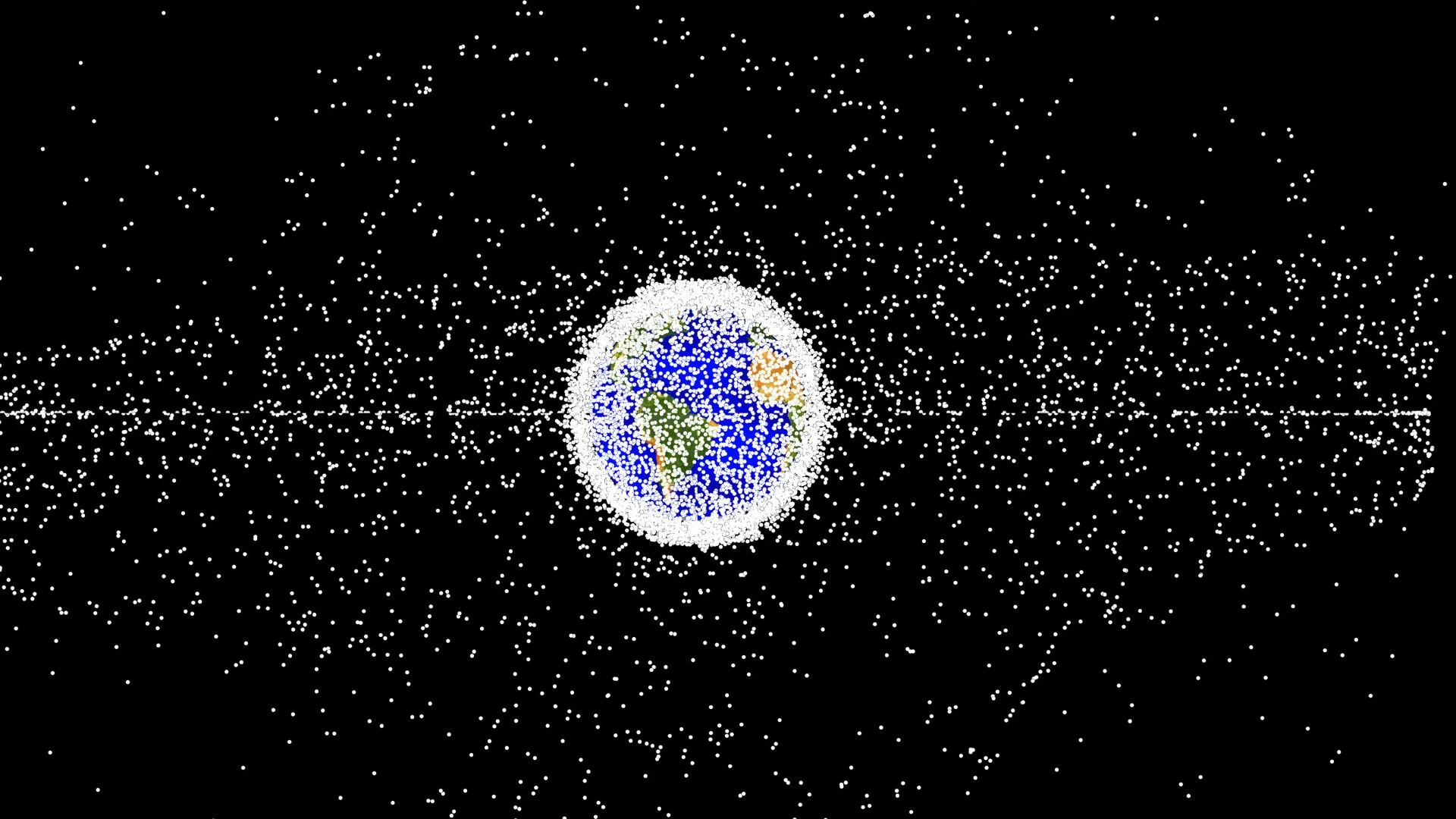
A growing cloud of space debris in low Earth orbit is threatening the satellites that track Earth’s climate, wildfires, oceans, and pollution.
Scientists warn that the rising number of objects in orbit is forcing climate-monitoring spacecraft to perform more collision-avoidance maneuvers.
These evasive actions consume valuable fuel, shorten satellite lifespans, and can disrupt the flow of important scientific data.
One of the clearest examples involves NASA’s Aqua satellite. Aqua has spent more than two decades studying Earth’s atmosphere, oceans, and land from space. The satellite also plays an important role in wildfire detection and emergency response.
On Jan. 8, 2025, Aqua detected one of the first warning signs of a major wildfire in California. Infrared sensors onboard the satellite identified unusual heat signatures linked to the deadly Palisades fire. The fire later destroyed thousands of homes and caused multiple deaths.
Aqua uses a scientific instrument called the Moderate Resolution Imaging Spectroradiometer(MODIS). The system captures infrared data that the naked eye cannot detect. NASA converts that information into GPS coordinates that emergency teams use to track fires on maps.
This satellite-based system often spots fires before emergency calls arrive from the ground. That early warning can save time during fast-moving disasters. It also helps firefighters understand how fires spread across large areas.
READ ALSO: China’s 16MW Floating Wind Turbine Powers 4,200 Homes With Clean Energy
However, NASA scientists have reported growing gaps in data collected by Aqua and other Earth-monitoring satellites.
Internal records show that several observation datasets were affected after satellites changed course to avoid incoming debris. These interruptions may seem small now, but researchers warn that they are increasing over time.
Aqua is part of NASA’s Earth Observing System(EOS). The system includes three major satellites: Aqua, Terra, and Aura. They study forests, clouds, oceans, air pollution, and climate patterns worldwide.
The EOS mission has helped scientists better understand climate change and environmental damage. The satellites tracked deforestation in the Amazon rainforest and studied how tiny atmospheric particles affect cloud formation.
They also discovered that parts of Earth’s oceans are becoming darker because of changes in marine ecosystems.
Since 2005, the EOS satellites have performed at least 32 debris avoidance maneuvers. Several of those movements reportedly affected scientific measurements and data quality. Scientists say every maneuver creates both operational and scientific challenges.
Why Space Debris Is Becoming a Bigger Threat
Space debris includes dead satellites, broken rocket parts, paint fragments, and debris from space collisions. Even tiny objects can cause severe damage because they travel at extremely high speeds in orbit. A small fragment hitting a satellite can instantly destroy sensitive equipment.
The amount of tracked debris in orbit has increased sharply over the past two decades. In 2005, the European Space Agency tracked around 16,000 objects in orbit. By 2026, that number had climbed above 44,000.
Scientists believe the real number is far higher. ESA estimates that more than one million smaller pieces of debris remain too tiny to track properly. Many of those fragments still pose a serious risk to spacecraft.
WATCH ALSO: Lightweight advanced materials are transforming aerospace innovations
Some debris comes from satellite collisions or anti-satellite weapon tests. China created a major debris cloud in 2007 after destroying one of its own satellites during a military test. Russia has also faced criticism for similar activities in orbit.
In April 2026, two Russian spacecraft reportedly passed within just 10 feet of each other in orbit. Such close encounters increase concerns about future collisions. Experts fear a chain reaction known as Kessler Syndrome, where one collision creates more debris that triggers additional crashes.
So far, ESA has confirmed four major satellite collisions in space history. One incident occurred in 2021 involving a climate satellite. A piece of debris from a Russian Zenit-2 rocket struck China’s Yunhai-1 02 weather satellite.
Low Earth Orbit faces the highest debris risk because many satellites operate there. Climate satellites must stay relatively close to Earth to capture detailed environmental data. That places them directly inside the most crowded orbital zone.
Aqua itself orbits about 438 miles above Earth’s surface. The satellite circles the planet about 14 times every day. It travels from pole to pole while scanning Earth’s land, oceans, and atmosphere.
Satellites also need fuel to maintain stable orbits. Earth’s gravity is uneven because of mountains, oceans, and shifting mass across the planet. Solar radiation can also slowly change a satellite’s position and rotation.
Without regular corrections, satellites drift away from their assigned paths. That can damage data accuracy or increase collision risks with other spacecraft. As a result, operators must constantly balance fuel use between orbit corrections and debris avoidance.
Insurance companies are also closely watching the growing problem. Andrew Bonwick, vice president at Relm Insurance, said every maneuver reduces a satellite’s operational life. He explained that fuel is one of the most limited resources onboard a spacecraft.
READ ALSO: Appalachian Mountains Hold 2.5M Tons of Lithium, Enough for 130M EVs
The rising danger is also making it harder to insure satellites. Government agencies and nonprofit organizations increasingly carry the financial risks themselves. This creates extra pressure for climate monitoring missions that already face tight budgets.
Aqua Nears Retirement as Risks Continue Rising
NASA launched Aqua in 2002 with a planned mission life of six years. The satellite has now operated for nearly 24 years thanks to careful engineering and fuel management. During that time, it survived multiple technical failures and continued delivering valuable climate data.
Engineers managed issues including battery failures, damaged solar cells, and equipment problems. Despite those setbacks, Aqua completed more than 126,000 orbits around Earth. Scientists used its data in at least 30,000 research studies.
The satellite is now approaching the end of its mission. NASA plans to shut Aqua down later this year after almost a quarter-century in space. Only about 66 pounds of fuel remain onboard.
That remaining fuel is reserved for Aqua’s final descent into Earth’s atmosphere. NASA wants the spacecraft to burn up safely after retirement. Once the fuel runs out, Aqua will no longer be able to dodge incoming debris.
Collision risks increase significantly when satellites lose maneuvering ability. US government standards aim to keep collision risks below one in 1,000 during operations. That protection becomes much harder once a spacecraft can no longer change course.
Other Earth observation missions have already experienced unexpected failures. MethaneSAT, designed to track methane emissions, stopped transmitting data after only 15 months in orbit in 2025. Investigators never fully agreed on the exact cause of the failure.
British Earth observation company SatVu faced a similar issue with its HOTSAT-1 satellite. The spacecraft lost its infrared imaging capability only months after launch. Industry experts say insurance coverage prevented the company from incurring severe financial damage.
NASA is preparing newer systems to continue some of Aqua’s work. The agency’s VIIRS program already supports wildfire detection on multiple satellites. Private companies are also entering the field with new monitoring technologies.
READ ALSO: Spider With Smiley Face Found 12,000 KM From Hawaii in India’s Himalayan Forests
Google recently announced plans to build a satellite network focused on wildfire detection. The system aims to identify smaller fires with higher image quality and faster updates. That reflects growing demand for real-time climate and disaster monitoring tools.
Still, scientists say replacing Aqua’s long-term climate record will not be easy. Continuous datasets collected over decades are extremely valuable for climate research. Interruptions or changes between missions can make long-term environmental trends harder to measure accurately.
The growing debris crisis highlights a wider problem facing the global space industry. More satellites are launching every year, while debris continues to accumulate in orbit.
Without stronger debris control measures, scientists warn that important Earth observation missions will face even greater risks in the years ahead.