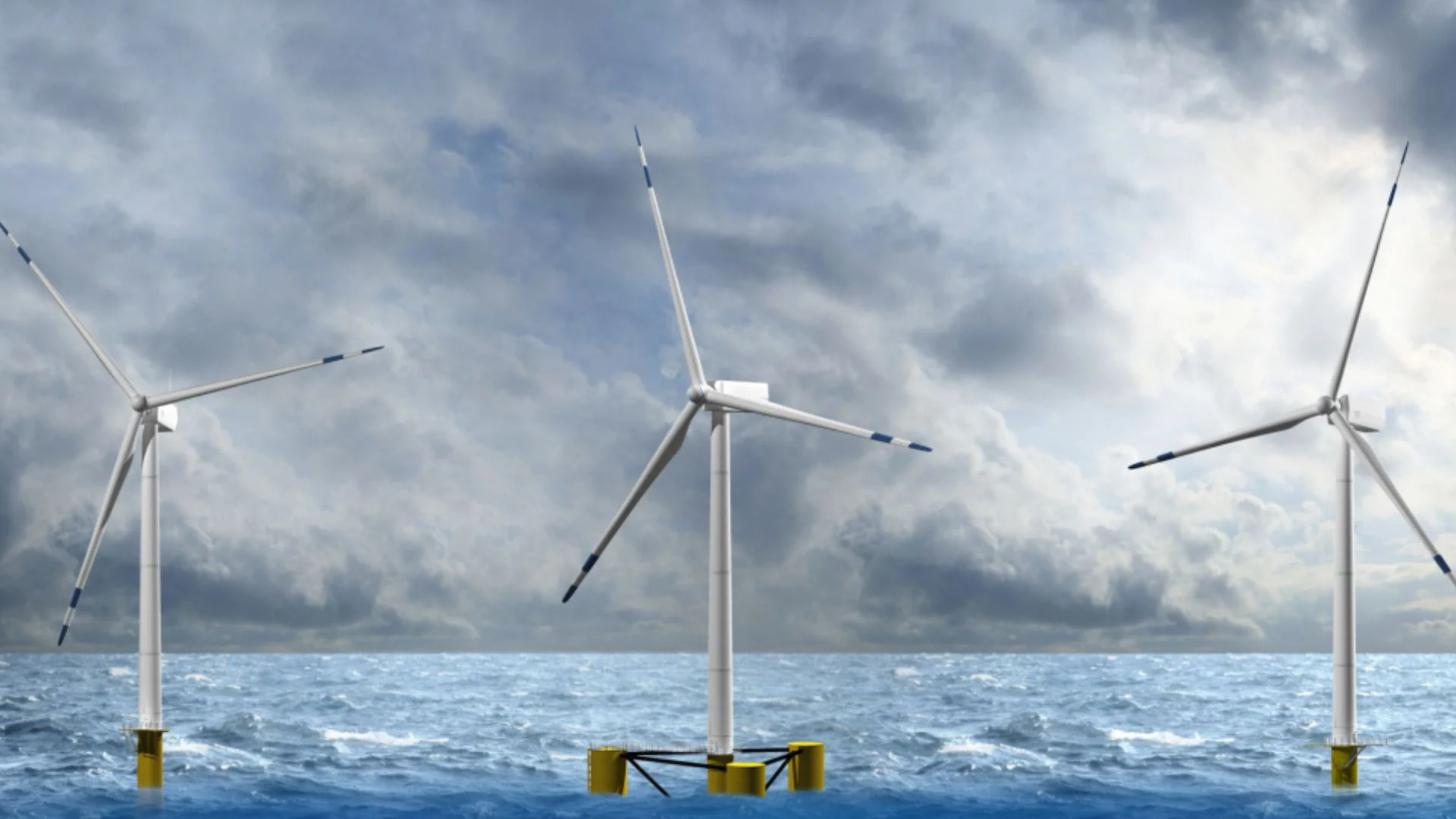
China has installed the world’s largest floating offshore wind turbine in deep waters off Guangdong province.
The project marks a major step in expanding renewable energy generation beyond shallow coastal regions.
The turbine is designed to operate in harsh ocean conditions while producing enough electricity to power thousands of homes every year.
Floating Wind Turbine for Clean Energy
The new floating turbine is called Three Gorges Pilot. It was developed by China Three Gorges Corporation and installed near Yangjiang in southern China. The company confirmed the completion of the offshore installation in early May.
The turbine has a power generation capacity of 16 megawatts. It stands on a floating semisubmersible platform instead of being fixed directly to the seabed. This design enables it to operate in waters too deep for conventional offshore wind farms.
Floating offshore wind systems are becoming important for countries with limited shallow coastal areas. Traditional offshore turbines need fixed foundations attached to the ocean floor. Floating systems remove that limitation and open larger ocean areas for renewable energy projects.
READ ALSO: Appalachian Mountains Hold 2.5M Tons of Lithium, Enough for 130M EVs
The turbine features a rotor diameter of 252 meters. Its blade tip reaches more than 270 meters above sea level. That makes the structure one of the tallest and largest floating wind systems deployed anywhere in the world.
Engineers completed most of the assembly work at Tieshan Port in southern China. The platform was later towed out to sea for final installation and testing. This method reduces construction complexity and lowers offshore installation time.
Designed to Survive Extreme Ocean Conditions
The Three Gorges Pilot was built for harsh marine environments. Engineers designed it to withstand waves up to 20 meters and wind speeds up to 264 kilometers per hour. Those conditions are comparable to a Category 5 hurricane.
The platform uses a complex mooring system to remain stable in deep water. It combines suction anchors, heavy anchor chains, and high-strength polyester lines. These systems help prevent drifting while keeping the turbine balanced during rough weather.
The structure also includes ballast systems and real-time monitoring equipment. Ballast systems help maintain stability by controlling weight distribution inside the platform. Monitoring systems track movement, stress, and environmental conditions during operation.
Floating turbines face major engineering challenges because ocean waves constantly move the platform. Engineers must protect the blades, drivetrain, and power systems from continuous motion. Long-term durability is important because repairs at sea are difficult and expensive.
The design includes structural features that absorb and distribute pressure from strong winds and waves. These improvements reduce the platform’s stress over time. Engineers expect the system to achieve a longer operational lifespan as a result.
WATCH ALSO: Chinese robotic company Unitree has unveiled its new humanoid robot H2
Massive Power Generation Potential
The floating turbine uses a 66-kilovolt dynamic subsea cable to transmit electricity. Unlike standard underwater cables, this system is built to flex and move with the floating platform. The cable uses reinforced armor layers and fatigue-resistant materials for long-term reliability.
At full efficiency, the turbine is expected to generate around 44.65 million kilowatt-hours of electricity every year.
According to US energy consumption estimates, that amount is enough to power about 4,200 homes annually. The project demonstrates how a single large turbine can support significant energy demand.
China has rapidly expanded offshore wind energy in recent years. The country is investing heavily in both fixed-bottom and floating wind technologies. Large-scale projects are part of its broader effort to increase renewable energy production and reduce dependence on fossil fuels.
The Three Gorges Pilot follows another major floating turbine project launched last year by China Huaneng Group and Dongfang Electric. The new system introduces improvements in structural engineering and offshore stability. It also highlights increasing competition in the global floating wind sector.
READ ALSO: US Air Force Tests Minuteman III ICBM as Sentinel Nuclear Missile Replacement Nears
Floating wind technology is gaining attention worldwide because many coastal regions have deeper offshore waters. Countries in Asia, Europe, and North America are exploring similar systems for future energy development. Deep-water wind farms also offer access to stronger, more consistent wind conditions.
The successful installation of the Three Gorges Pilot shows how floating wind farms are moving closer to commercial-scale deployment. Engineers and energy companies continue working to improve reliability, reduce costs, and increase energy output.