The US Naval Research Laboratory (NRL) is developing continuous biomanufacturing systems designed to improve the production of essential materials for military and commercial use.
The research focuses on replacing conventional batch-based manufacturing with smaller systems that can operate continuously for weeks or even months. Scientists believe this approach will reduce energy use, lower equipment needs, and improve the ability to manufacture products closer to where they are required.
Traditional biomanufacturing often depends on large fermentation tanks that complete one production cycle before starting another. This process requires significant infrastructure, consumes large amounts of energy, and involves downtime between batches. NRL researchers are working on an alternative that keeps production running without frequent interruptions.
Biomanufacturing Without the Downtime
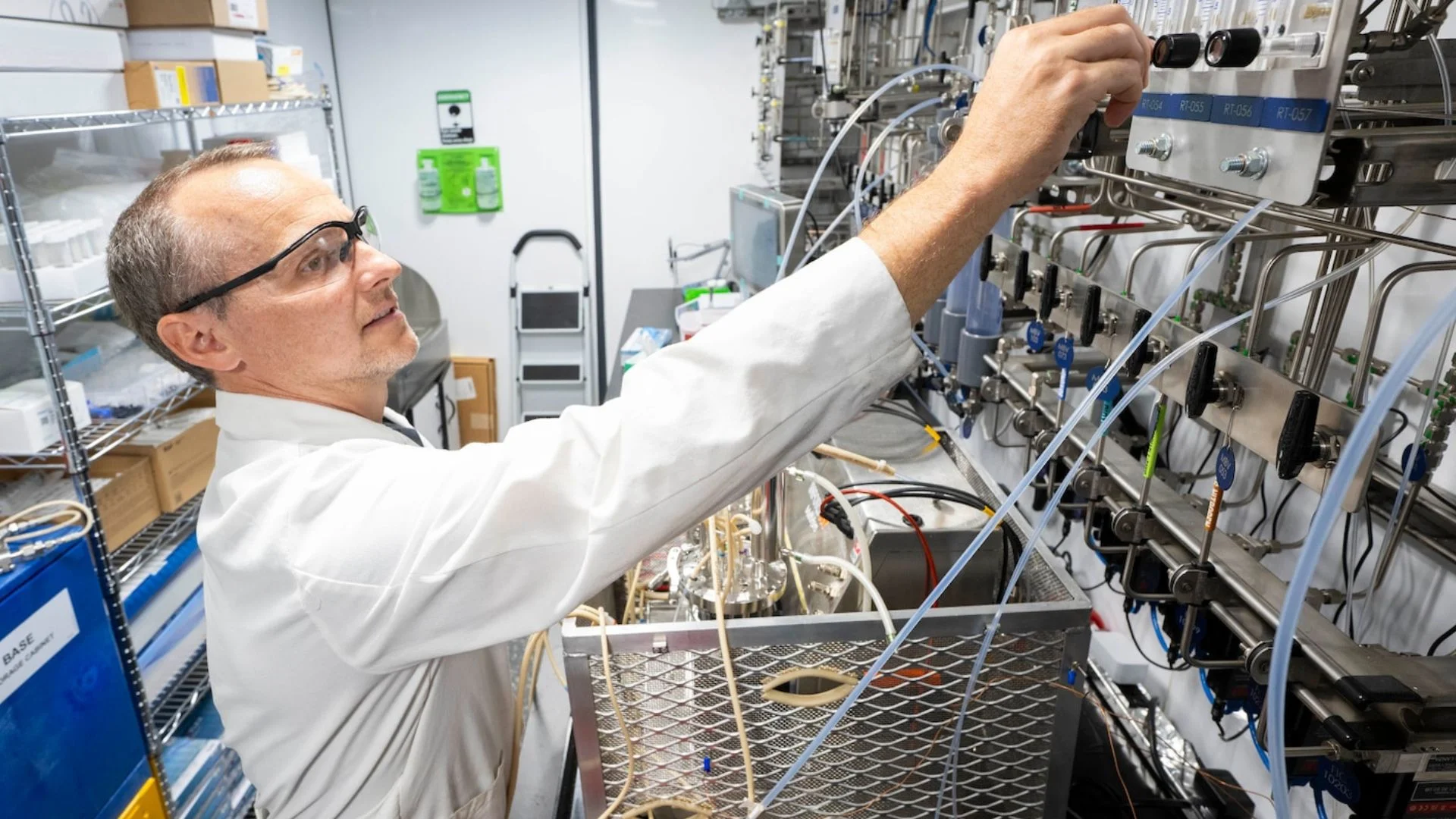
The new technology relies on biofilm-based reactors instead of standard fermentation tanks. In these reactors, microorganisms attach themselves to specially designed surfaces while nutrients continuously flow through the system. This setup allows more microbial cells to work in a smaller space, increasing production while reducing reactor size and power consumption.
Matthew Yates, a research scientist at NRL’s Center for Biomolecular Science and Engineering, said the goal is to develop systems capable of producing valuable molecules continuously for extended periods.
He said the technology aims to lower energy requirements, reduce operational complexity, and make manufacturing more efficient. According to Yates, continuous production offers a practical alternative to traditional methods that depend on repeated production cycles.
Researchers are developing production methods for several important materials. These include lubricant precursors, components used in munitions, active pharmaceutical ingredients, bioplastics, and single-cell proteins. Such products are expected to support future military operations while also serving commercial industries that depend on reliable manufacturing.
READ ALSO: Shade-Proof Solar Cells Combine 26% Efficiency With Long-Term Durability
3D Printing Support
Another key part of the project involves additive manufacturing, commonly known as 3D printing. Scientists use this technology to quickly design, produce, and modify bioreactors for different microorganisms and production needs. The process allows researchers to test multiple reactor designs much faster than conventional manufacturing methods.
Yates said additive manufacturing also improves operational flexibility. If production requirements change, new reactor parts can be designed and printed quickly instead of waiting for components to arrive from centralized factories. This capability may become especially useful during remote or field operations where replacement parts are difficult to obtain.
Researchers have also identified another possible advantage during testing. Some of the materials being produced appear to collect naturally inside the reactor structure, reducing the need for separate processing steps after production. If future studies confirm these findings, manufacturers may be able to combine production, separation, and concentration into a single process, lowering overall costs.
Marine Microbe Research
The research team is also studying marine microorganisms that can grow in seawater. These organisms reduce dependence on freshwater resources while using alternative feedstocks for production. This approach may expand manufacturing options in locations where freshwater supplies are limited.
NRL has already demonstrated a mobile biomanufacturing system housed inside a standard shipping container. Future versions are expected to integrate continuous production technology, allowing essential materials to be manufactured directly at the point of need. Such systems could reduce transportation requirements and improve supply chain resilience during military deployments or emergencies.
The project is being carried out in collaboration with the Air Force Research Laboratory and the US Army Combat Capabilities Development Command Chemical Biological Center.
The organizations are evaluating different microorganisms and production methods to identify the most effective continuous manufacturing platforms. The collaboration supports broader US Department of Defense efforts to strengthen biotechnology and domestic manufacturing capabilities.
Future Manufacturing Goals
Continuous biomanufacturing represents a different approach from conventional production by emphasizing smaller, adaptable systems instead of large centralized facilities. The technology also supports faster response to changing operational requirements because production equipment can be modified and deployed more easily. These advantages make it attractive for both defense missions and industrial manufacturing.
However, scientists plan to demonstrate larger-scale production while testing additional products and microbial strains. They will also evaluate how the technology performs under different operating conditions and manufacturing demands. The ongoing work is expected to help establish practical systems that deliver critical materials wherever they are needed, supporting more resilient and flexible manufacturing in the years ahead.