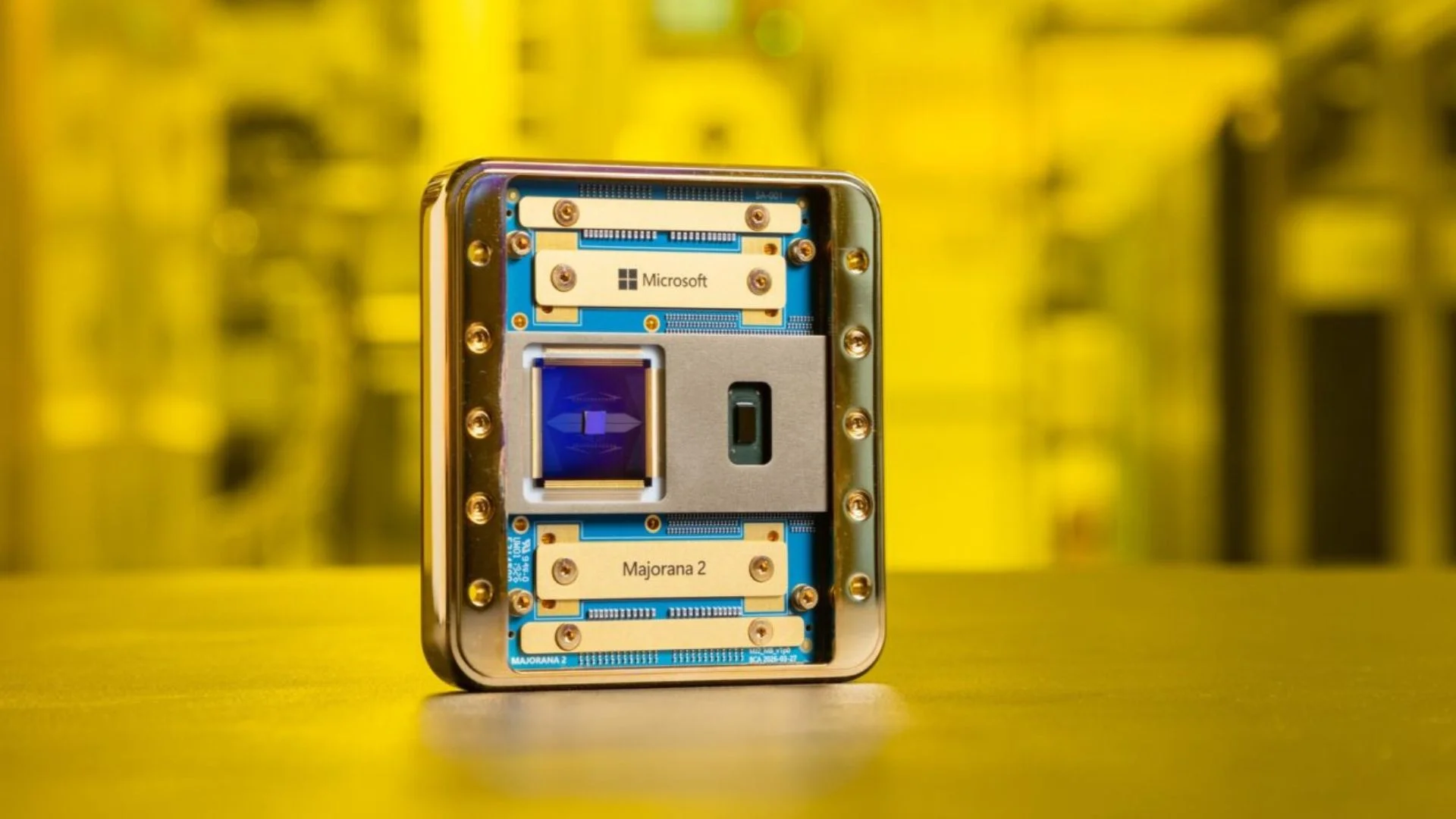
Microsoft has introduced Majorana 2, the next generation of its topological quantum computing chip.
The company says the new chip brings substantial improvements in reliability, speed, and scalability. These gains move Microsoft closer to its goal of building a commercially useful quantum computer.
The announcement also includes a revised timeline for quantum development. Microsoft now expects to achieve a scalable quantum computer by 2029. This target is five years sooner than the company’s earlier projections.
Majorana 2 builds on the foundation established by Majorana 1, which Microsoft introduced in 2025. The earlier chip demonstrated the use of topological superconductors in quantum computing. The new version refines that technology and improves overall performance.
Majorana 2 Redefines Quantum Stability
Quantum computers operate differently from traditional computers. Instead of using bits that represent either zero or one, they use qubits that can exist in multiple states at the same time. This ability allows quantum systems to tackle certain complex calculations much faster than conventional machines.
One of the biggest challenges in quantum computing is maintaining the fragile quantum state of qubits. Environmental interference can quickly disrupt calculations and create errors. Improving qubit stability is therefore one of the most important goals in the industry.
READ ALSO: From Fields to Flowers: Why Farmers Must Invest in Pollinator Habitats
Microsoft says Majorana 2 addresses this challenge with a new materials design. The company reports that the latest qubits remain stable 1,000 times longer than those in the previous generation. This improvement significantly increases the reliability of quantum operations.
According to Microsoft, Majorana 2 achieves an average qubit lifetime of about 20 seconds. In some cases, individual qubits remained stable for as long as one minute. These figures are far beyond the microsecond-scale lifetimes commonly seen in many quantum systems today.
The company compares the improvement to a dramatic increase in smartphone battery life. Instead of lasting a single day, the equivalent battery would operate for nearly three years before needing a recharge. The comparison highlights the scale of the reliability gains.
Microsoft says the new chip also performs quantum operations in about one microsecond. At the same time, each qubit remains extremely small, measuring roughly one-hundredth of a millimeter. Smaller and more reliable qubits make it easier to scale systems to larger sizes.
The company believes these advances create a practical path toward large-scale quantum computing. Such systems could eventually solve problems that classical computers cannot. Potential applications include healthcare, energy, materials science, manufacturing, sustainability, and food production.
Chetan Nayak, Microsoft Technical Fellow, said the company continues to focus on annual improvements across its quantum roadmap.
He noted that the team has achieved a thousandfold improvement over last year’s technology. According to Nayak, steady progress remains essential for delivering real-world value.
How AI Helped Build a Better Quantum Chip
A key part of the Majorana 2 story is the growing role of artificial intelligence in scientific research. Microsoft says its researchers relied on agentic AI systems throughout the development process. These AI tools were built using Microsoft Discovery, the company’s platform for scientific research and development.
READ ALSO: Montreal’s Hidden Climate Culprit: The Surprising Source Choking Our Air
Microsoft Discovery combines specialized AI agents with advanced reasoning systems. Researchers can deploy teams of AI agents to analyze information, generate hypotheses, optimize experiments, and support decision-making. Human experts remain in control of the process while AI handles large-scale analysis and automation.
The platform is now generally available to organizations. Microsoft says companies in industries such as life sciences, chemicals, materials, manufacturing, energy, and consumer products are already exploring its capabilities. The goal is to accelerate innovation across multiple scientific fields.
Microsoft also announced a new Discovery application for individual users. The app offers core capabilities from the broader platform and can run locally on personal computers. Users with a GitHub Copilot account can access the tool free of charge.
Inside Microsoft’s quantum program, AI agents support a wide range of tasks. They help manage workflows, coordinate research activities, automate measurements, and analyze large datasets. Scientists also use them to identify hidden problems and recommend potential solutions.
According to Nayak, AI has become a natural part of everyday work within the quantum team. The technology can summarize information, connect findings from different projects, and even suggest new research directions. Researchers then evaluate and validate the results.
The benefits become especially clear when dealing with massive amounts of data. Microsoft’s quantum program has accumulated nearly two decades of research information. Much of that data existed in separate systems and formats before AI tools helped connect it.
Zulfi Alam, Microsoft’s Corporate Vice President for Quantum, said AI agents can identify relationships that individual researchers might miss. By analyzing information across many disciplines and datasets, the systems can reveal patterns that are difficult for humans to detect. This broader view helps accelerate scientific progress.
WATCH ALSO: This US supersonic aircraft could slash flight times and silence the sonic boom
The technology also helps researchers working across different specialties. Quantum computing combines expertise from physics, engineering, software development, materials science, and manufacturing. AI tools make it easier for specialists to understand findings from other fields without becoming experts themselves.
Microsoft emphasizes that scientists remain central to the process. AI agents provide recommendations and analysis, but final decisions remain with researchers. The company describes this approach as keeping the scientist in the loop.
New Materials and Faster Research Cycles
One of the most important changes in Majorana 2 involves its materials stack. Majorana 1 used aluminum in its superconducting structure. Majorana 2 replaces aluminum with lead, creating significant improvements in device performance.
Lead is commonly used for radiation shielding in hospitals and industrial facilities. In a quantum computer, it helps protect delicate qubits from external disturbances. This added protection improves stability and reduces the risk of errors.
Developing the new materials stack required years of research. Scientists had to balance multiple trade-offs while preserving the properties needed for quantum computing. According to Microsoft, the switch to lead delivered major gains in device quality.
The company also uses AI to support future materials research. Designing quantum materials often requires precise control over atoms and impurities within a crystal structure. Small changes can dramatically affect performance.
Traditionally, researchers would conduct many rounds of experiments to identify the right combination. AI-driven simulations can narrow the search by highlighting the most promising options before laboratory testing begins. This approach reduces time, cost, and effort.
AI has also transformed how Microsoft performs measurements during quantum experiments. Creating a topological quantum state involves adjusting hundreds of parameters. Measuring and optimizing those conditions used to take weeks of work.
Using agentic AI, Microsoft developed specialized systems that automate much of the process. The technology can continuously adjust settings, evaluate outcomes, and search for optimal operating conditions. This reduces experimental timelines by orders of magnitude.
WATCH ALSO: US Air Force’s Sentinel missile brings improved range, accuracy, resiliency and flexibility
The AI can also generate detailed maps showing how different variables interact. Such analysis would be extremely difficult for a single researcher to perform manually. The result is faster experimentation and improved understanding of device behavior.
In another example, AI helped identify an uncalibrated temperature sensor that was affecting manufacturing data. By combining knowledge from physics, fabrication processes, and historical records, the system detected an issue that had gone unnoticed. Fixing such problems improves consistency and reliability.
Microsoft believes the lessons learned from Majorana 2 extend beyond quantum computing. The same AI-driven methods can support research in chemistry, energy, materials science, biotechnology, and other fields. As organizations seek faster innovation cycles, tools like Microsoft Discovery are becoming increasingly important.
The development of Majorana 2 represents both a quantum computing milestone and a demonstration of how AI is reshaping scientific research. With more reliable qubits, a faster path toward scalable systems, and growing use of agentic AI, Microsoft is positioning itself at the center of two rapidly evolving technologies.
As the company moves toward its 2029 target, the success of Majorana 2 will serve as a key test of whether advanced AI and quantum computing can accelerate each other’s progress and unlock new possibilities across science, industry, and society.