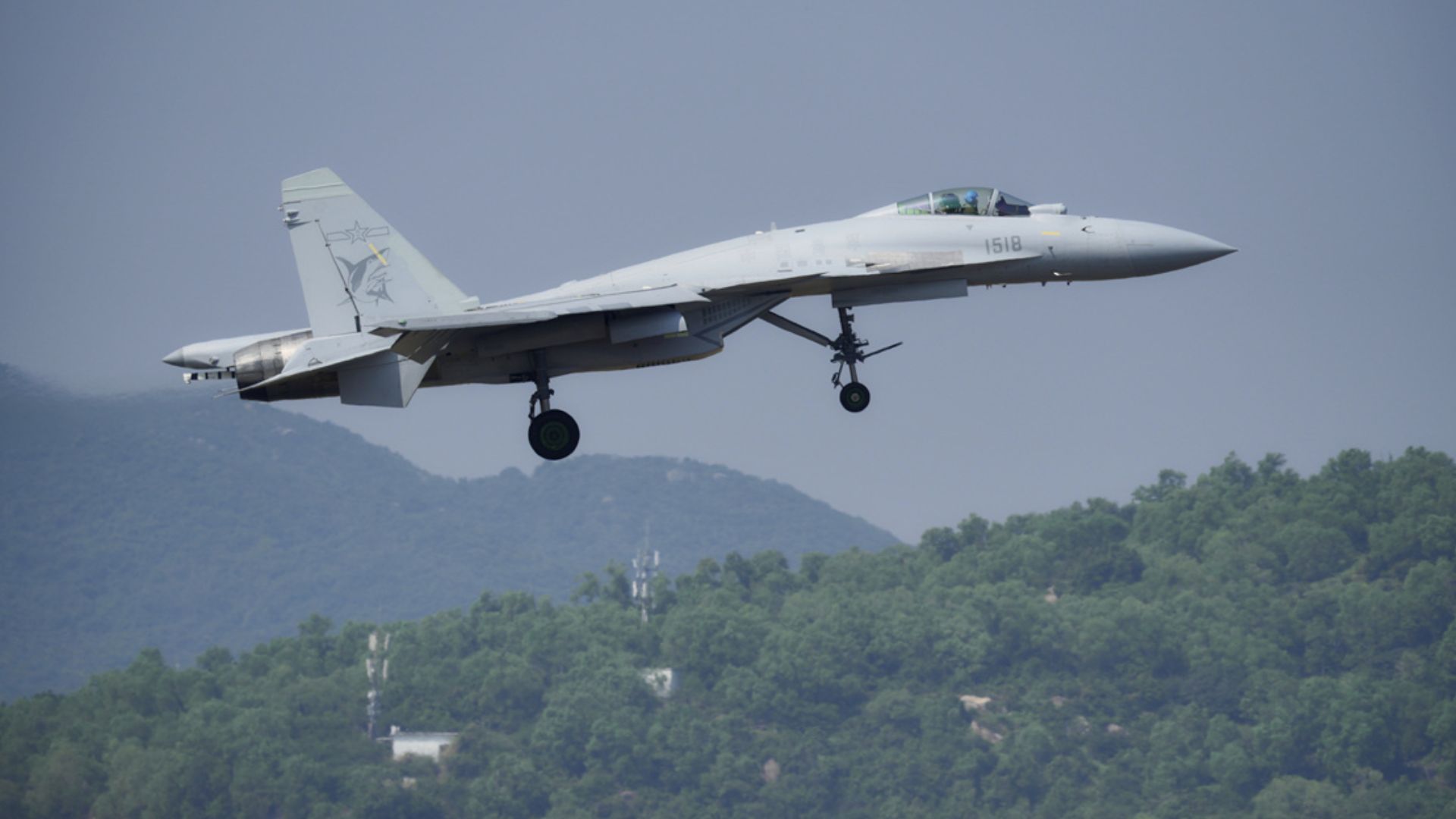
China has demonstrated that its upgraded J-15T carrier-based fighter can operate from both its older and newer aircraft carriers, marking an important step in the modernization of its naval aviation.
The move strengthens the Chinese navy’s ability to deploy advanced aircraft across different carrier platforms and improves operational flexibility. Recent military exercises also indicate that China is moving toward a more integrated carrier strike capability.
Images released after a 40-day mission in the South China Sea and the Pacific Ocean showed several J-15T fighter jets taking off from and landing on the Liaoning aircraft carrier. The mission ended on June 22 after extended naval operations in regional waters. The photographs provided fresh evidence that the upgraded aircraft is not limited to China’s newest carrier.
China currently operates three aircraft carriers, each with a different aircraft launch system. The Liaoning and Shandong use a ski-jump design, where aircraft gain lift from an upward-curved flight deck before taking off. The Fujian, China’s newest carrier, uses an electromagnetic catapult system that launches aircraft more efficiently and allows them to carry heavier fuel and weapon loads.
Electromagnetic catapult technology offers several operational advantages over the ski-jump method. It provides stronger and more controlled acceleration during take-off, helping aircraft launch with greater payloads and over shorter distances. At present, only China and the US have deployed aircraft carriers equipped with this technology.
The J-15T is an upgraded version of China’s first carrier-based fighter aircraft. It was originally designed to operate from carriers fitted with electromagnetic catapults, such as the Fujian. However, the latest images confirm that the aircraft can also operate successfully from ski-jump carriers such as the Liaoning.
J-15T’s Dual Carrier Capability
Military analysts say this dual capability increases the flexibility of China’s carrier fleet. The same aircraft can now serve across different carrier classes without requiring separate fleets for each launch system. This allows the navy to deploy its fighter aircraft more efficiently during operations.
Former People’s Liberation Army Air Force officer and military analyst Fu Qianshao said the J-15T’s ability to perform both catapult-assisted and ski-jump take-offs offers a major tactical advantage.
He said the aircraft can move between carriers during joint operations involving different carrier types. Fu added that this flexibility would help maintain combat effectiveness even if one carrier became unavailable.
According to Fu, transferring aircraft between carriers would allow China to continue naval operations with fewer disruptions. He also noted that the J-15T delivers significantly better overall performance than the original J-15 fighter. As a result, he expects the newer variant to gradually replace older aircraft operating from the existing ski-jump carriers.
READ ALSO: Charging electric vehicles five times faster in below‑freezing temperatures.
Military commentator Zhang Xuefeng also highlighted improvements introduced in the upgraded fighter. He said the J-15T carries longer-range missiles and features enhanced radar and targeting systems. These upgrades allow the aircraft to detect, track, and engage targets from greater distances than earlier versions.
The enhanced fighter also improves the combat capability of the Liaoning carrier. Better sensors and weapons strengthen its ability to defend against enemy aircraft while also supporting attacks on surface ships and land-based targets. This gives older carriers greater value as China expands its naval reach.
The latest deployment also points to closer coordination between China’s aircraft carriers. The Fujian completed major flight operation milestones in September 2025 by launching and recovering the J-15T, the J-35 stealth fighter, and the KJ-600 airborne early warning aircraft using its electromagnetic catapult system. Those successful tests demonstrated that the carrier was preparing for full operational service.
State media previously reported that the Fujian was expected to become fully operational by the end of 2025. Once fully integrated, it will join the Liaoning and Shandong to form a more capable carrier force. The ability to operate common fighter aircraft across all three carriers simplifies planning, logistics, and training.
China’s expanding carrier aviation capability reflects its broader effort to build a modern blue-water navy capable of operating farther from its coastline. Improved compatibility between aircraft and carriers allows naval forces to respond more quickly to changing operational demands.