Researchers at the Massachusetts Institute of Technology (MIT) have developed a new robotic system that allows small autonomous boats to assemble into floating structures on demand.
Named FloatForm, the technology enables multiple robot boats to connect, separate, and reorganize themselves with minimal human input. The work demonstrates how future cities may use rivers, canals, and waterfronts as flexible spaces instead of fixed boundaries.
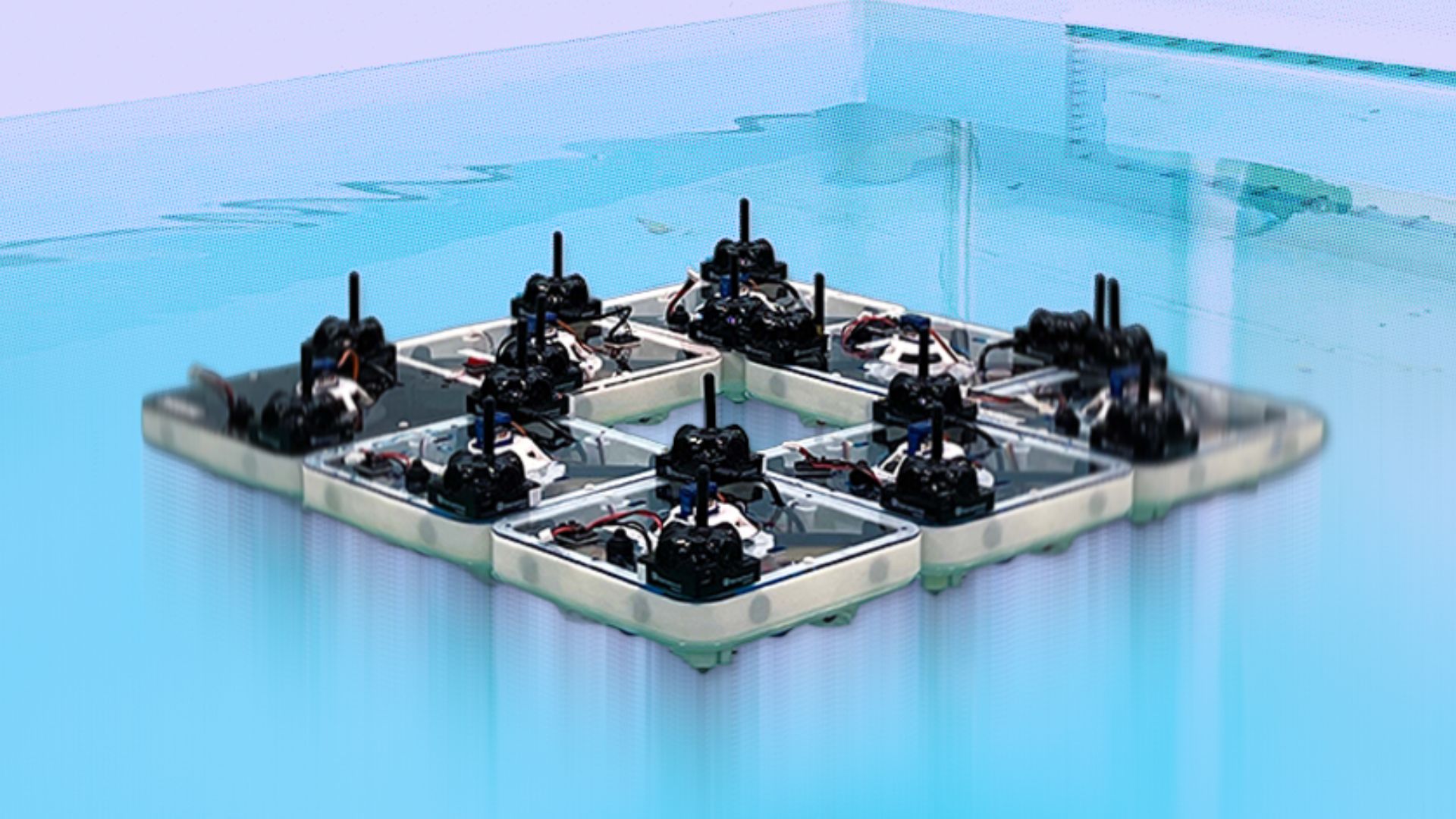
Each robot measures about 21 centimeters across, making it roughly the size of a dinner plate. Every unit operates independently with its own thrusters, sensors, battery, processor, and magnetic connection system. When several robots work together, they create larger floating platforms that can later split apart and take on new shapes.
Researchers believe this approach can help cities make better use of waterways that often remain underused. Temporary bridges, floating marketplaces, performance stages, and emergency response platforms represent only a few possible applications. Instead of building permanent infrastructure, cities could deploy robotic structures only when needed.
Floating City Vision
Daniela Rus, Panasonic Professor of Electrical Engineering and Computer Science at MIT and director of the Computer Science and Artificial Intelligence Laboratory (CSAIL), said that FloatForm presents a future in which waterfronts become programmable parts of urban environments.
She explained that autonomous boats can organize themselves into bridges, platforms, and other useful structures whenever required. Rus added that distributed robotics creates new opportunities for transportation, public spaces, emergency operations, and water infrastructure.
Lead author Wei Wang, now head of the Marine Robotics Lab at the University of Wisconsin-Madison, said the project transforms static water surfaces into adaptable public spaces.
He explained that urban environments may eventually expand or reorganize floating spaces automatically in response to changing needs. This flexibility allows cities to respond more efficiently to different events and situations.
Former MIT researcher Alejandro Gonzalez-Garcia described the project as a modular system that combines many small robots into one larger structure.
He said the technology may provide temporary bridges during emergencies to reduce traffic congestion. Floating markets and event platforms also represent practical uses for such robotic systems.
The research appears in the journal Nature Communications and builds upon MIT’s earlier Roboat project. That earlier effort introduced full-sized autonomous boats on Amsterdam’s canals through a partnership with the Amsterdam Institute for Advanced Metropolitan Solutions. While Roboat focuses on larger vessels, FloatForm explores how many smaller robots can coordinate efficiently.
Robot Boats Mimic Nature
The research team looked to biology for inspiration while designing the system. Fire ants naturally survive floods by linking together into floating rafts without relying on a leader. Each ant follows simple local behaviors, allowing the colony to form stable structures through teamwork.
FloatForm follows a similar principle by allowing every robot to make many decisions independently. Instead of relying on a single central computer, each robot primarily communicates with nearby neighbors. This distributed method makes the system more reliable because a single failure does not bring the entire group down.
Many existing robotic swarms rely heavily on centralized control. As more robots join the system, calculations become increasingly difficult and robots often wait for instructions before moving. FloatForm avoids this problem by allowing nearly every robot to move simultaneously while sharing only local information.
A lightweight planning system still plays an important role during assembly. It assigns the desired final position for each robot, ensuring that the completed structure matches the planned design. Once that goal is defined, the robots handle navigation, collision avoidance, and coordination on their own.
READ ALSO: BMW Deploys Figure 03 Humanoid Robot to Power AI-Driven Factory Logistics at Spartanburg
Researchers say this approach allows the system to scale much more efficiently. The computing effort depends mostly on nearby robots rather than on the total number in the swarm. As a result, adding more robots does not significantly slow down the assembly process.
Smart Robot Design
The team tested eight robotic boats inside an MIT water tank under controlled conditions. Starting from random positions, the robots repeatedly formed target shapes, connected into rigid platforms, separated, and reassembled into different configurations. Each demonstration required approximately four to eight minutes.
Once assembled, the robots also moved together as a single vessel. Each individual robot acted like a single motor within a much larger machine. Simulations indicated that the same coordination method can support swarms containing up to 64 robotic boats.
Researchers also observed another important advantage after the robots connected together. Larger structures remained more stable when exposed to waves and water movement. Similar to fire ant rafts, combining many small units created a stronger floating platform.
Connecting the robots required a specially designed magnetic latching system hidden inside every hull. A single electric motor controlled an origami-inspired mechanical structure that pushed magnets outward to connect them or pulled them inward to disconnect them. Alternating magnetic directions ensured that neighboring robots attached cleanly into square formations.
The locking system also improved energy efficiency. The mechanism required electricity only when attaching or releasing the robots, not while they were locked together. This design allows more battery power for movement, computing, and sensing instead of maintaining the connection.
Engineers faced several technical challenges while developing the boats. Four miniature thrusters arranged in an X-shaped layout provided movement in every direction, including sideways and rotational motion. Early versions proved difficult to control because the small boats responded too quickly to the powerful motors.
To improve stability, the team added fins that increased water resistance and refined the control software. They also adjusted the system to account for slight manufacturing differences between individual robots. Engineers further solved problems caused by strong magnetic attraction during the release process.
Future Water Networks
Across ten testing sessions, the robotic system completed its tasks without human assistance 90 percent of the time when using four boats. Success rates reached 70 percent when eight robots participated in the experiments. Even when individual robots temporarily lost their position, they successfully rejoined the group without interrupting the overall operation.
Researchers acknowledge that operating in real waterways presents additional challenges beyond indoor testing. Small boats are more vulnerable to waves, currents, and changing weather conditions than larger vessels. Future versions will require stronger connection systems and more robust hardware for open-water environments.
The researchers also plan to replace the laboratory positioning system with outdoor navigation technologies such as GPS or camera-based sensing. Importantly, the coordination software remains independent of the navigation method being used. That flexibility allows engineers to upgrade sensors without redesigning the overall control system.
Potential applications extend far beyond urban waterways. Temporary offshore work platforms, environmental monitoring stations, floating sensor networks, scientific research missions, and emergency docking systems are all potential future uses. The robots may also support marine inspections and maintenance in locations that are difficult to access using traditional infrastructure.
The research team believes many regions around the world can benefit from such technology. Cities with rivers, canals, lakes, or coastal waterways already have natural spaces where flexible floating infrastructure can add value. Examples include Venice, the Netherlands, Belgium, Norway’s fjords, and many other water-connected urban areas.
Independent experts also view the work as an important advance in distributed robotics. Steven Ceron, assistant professor at the University of Michigan, said coordinating self-assembling robots on water presents greater challenges than similar work on land.
He noted that shifting much of the decision-making to individual robots creates a more resilient system for future search operations, environmental monitoring, and marine infrastructure.
The project was led by researchers from MIT CSAIL and the Senseable City Lab, with additional collaboration from the University of Wisconsin-Madison, Politecnico di Milano, and KU Leuven. Funding came primarily from the Amsterdam Institute for Advanced Metropolitan Solutions, with additional support from the University of Wisconsin-Madison.
As development continues, FloatForm offers a practical vision for turning waterways into adaptable infrastructure that responds to changing urban and environmental needs.