China has unveiled two new energy technologies aimed at extending drone flight time and improving aerial performance.
Researchers developed a lightweight hydrogen fuel cell system for industrial drones, paired with an advanced lithium-sulfur battery with a significantly higher energy density than conventional lithium-ion batteries.
The new hydrogen fuel cell stack, created by the Chinese Academy of Sciences, has already passed a national scientific and technological appraisal for industrial use.
The system was developed by the Dalian Institute of Chemical Physics(DICP). Engineers described the stack as a ‘hydrogen heart’ because it powers drones with hydrogen fuel while keeping the system lightweight.
The fuel cell combines high power output with an air-cooling design. Unlike many fuel cell systems that require heavy cooling equipment, this setup removes extra weight and improves efficiency.
READ ALSO: Carbon Nanotube Fibers Challenge Copper in EV, Drone and Aircraft Wiring Race
Researchers said the system can double the flight endurance of industrial drones compared to many current battery-powered models.
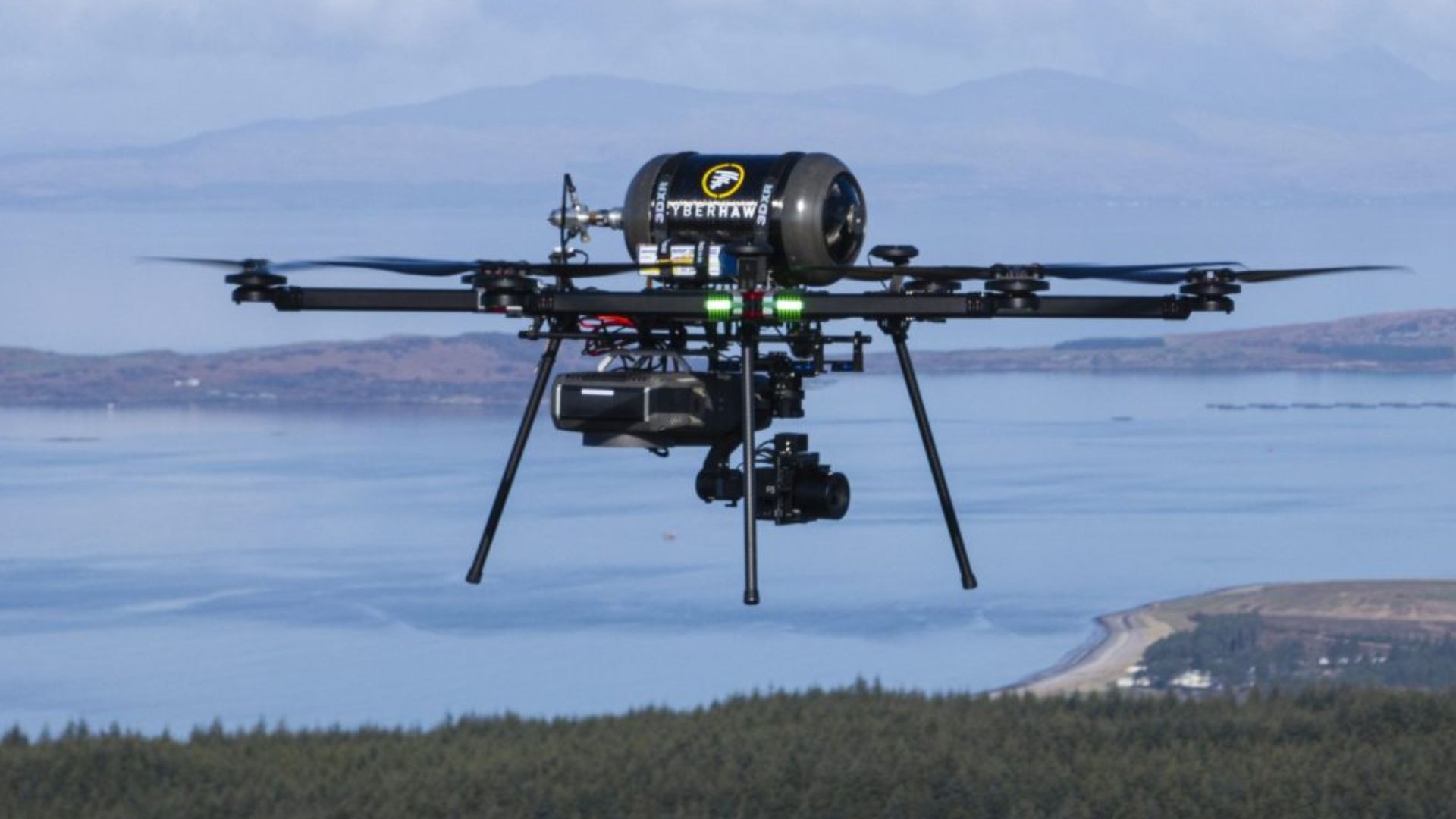
A hydrogen-powered drone equipped with the stack recently completed a successful test flight in Dalian in northeast China’s Liaoning Province.
During testing, the system reached a specific power of 1,970 W/kg. It also achieved an area power density of 1.15 watts per square centimeter, which reflects how efficiently the stack produces power within a compact space.
According to project lead Chen Zhongwei, the technology has moved beyond laboratory testing and is now ready for large-scale industrial use. Chen also serves as director of the State Key Laboratory of Catalysis at DICP.
The system is already being used in forestry operations, agricultural monitoring, power grid inspections, and emergency response missions.
Industrial drones are becoming more important in logistics, infrastructure inspection, and disaster management. However, limited battery life has remained a major obstacle for wider adoption. Most commercial drones rely on lithium-ion batteries, which offer limited flight time, especially when carrying heavy payloads.
Lithium-Sulfur Batteries Increase Drone Range
At the same time, another Chinese research team has developed a new method to improve lithium-sulfur batteries. The study, led by scientists at the Tsinghua Shenzhen International Graduate School, was published in the journal Nature. Researchers believe the design can help drones fly longer distances while carrying larger loads.
WATCH ALSO: India recently tested carried out the successful launch of Intermediate Range Agni-Prime Missile
Lithium-sulfur batteries are considered a promising alternative to traditional lithium-ion batteries because sulfur is abundant and inexpensive. These batteries also offer much higher theoretical energy density. Energy density measures how much energy a battery can store per unit of weight, which is critical for aircraft and drones.
Conventional drone batteries usually remain below 300 watt-hours per kilogram. This limitation creates range anxiety, where drones cannot stay airborne long enough for extended operations. The new lithium-sulfur prototype reached an energy density of 549 watt-hours per kilogram, nearly double that of many current drone batteries.
The main challenge with lithium-sulfur batteries has been chemical instability during charging and discharging. Sulfur forms soluble intermediates that drift through the battery, reducing efficiency over time. This process weakens performance and shortens battery lifespan.
Researchers addressed the issue by introducing a premediator molecule. According to researcher Zhou Guangmin, the molecule stays inactive until the battery begins operating. Once activated, it captures unstable intermediates and accelerates electrochemical reactions in the battery.
The team said the molecular design reduced internal battery resistance by 75 percent compared to standard designs. Tests showed the battery maintained nearly 82 percent of its capacity after 800 charge-discharge cycles. That level of durability is considered important for commercial drone operations that require frequent charging.
Why Longer Drone Endurance Matters
Longer-lasting drones can improve efficiency across several industries. Delivery drones could travel farther without recharging, while inspection drones could monitor larger infrastructure networks in a single mission. Search-and-rescue drones may also stay airborne longer during emergencies where time is crucial.
Hydrogen fuel cells and advanced batteries represent two different approaches to solving the same problem. Fuel cells provide continuous power using hydrogen, while higher-density batteries store more energy without increasing weight. Both technologies aim to improve endurance while reducing operational limitations.
READ ALSO: 2D-3D Perovskite Contact Pushes Solar Cell Efficiency to 26.25% With Higher Stability
China has invested heavily in low-altitude aviation and unmanned aerial systems in recent years. The country sees drones as an important part of future logistics, industrial automation, and public service networks. Better energy systems are expected to play a key role in supporting that expansion.
Researchers believe the new battery design may also benefit other technologies beyond drones. Possible applications include lithium-metal batteries, flow batteries, and battery recycling systems.
As testing continues, these energy advances may help shape the next generation of longer-range and more efficient unmanned aircraft.