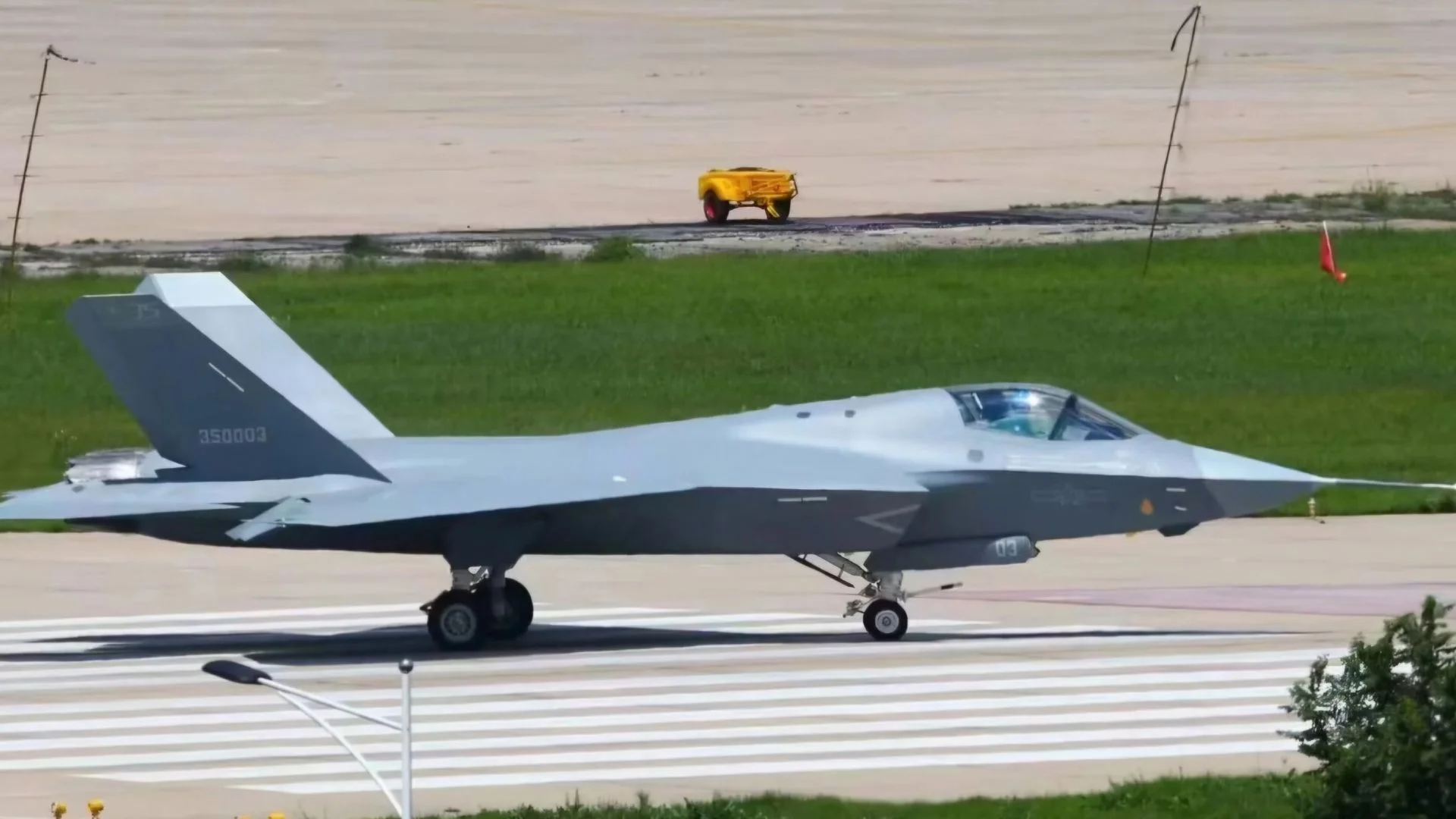
China’s navy is preparing to expand the use of its new J-35 stealth fighter across its carrier fleet.
At present, only the newest aircraft carrier, Fujian, is designed to fully support the advanced aircraft. However, recent developments suggest the older carriers Liaoning and Shandong are also being modified.
The J-35 is China’s next-generation carrier-based stealth fighter. It is designed to improve air combat, strike missions, and battlefield awareness. The aircraft is expected to become a major part of China’s naval aviation strategy in the coming years.
China currently operates three aircraft carriers. These include Liaoning, Shandong, and Fujian. The Fujian is the most advanced among them because it uses an electromagnetic catapult launch system.
This launch system helps heavier and more advanced aircraft take off more efficiently. It works differently from the ski-jump ramps used on the Liaoning and Shandong. Those older carriers currently operate the J-15 fighter jet.
Chinese state broadcaster CCTV recently added to speculation about carrier upgrades. A military-focused social media account linked to the broadcaster questioned whether the Liaoning was already training with the J-35 onboard. China rarely confirms military developments early, but state media sometimes hints at future plans.
READ ALSO: Chinese Scientists Build Lab-Grown Pacemaker That Mimics the Human Heart’s Natural Rhythm
Satellite Images Fuel Speculation
New satellite images have also increased attention on the Shandong carrier. According to reporting from Jane’s Defence Weekly, images taken in February by US company Vantor showed construction work on the carrier’s flight deck. Additional images shared online appeared to show the work continuing into April.
The images reportedly showed changes near the arresting gear and wheel chocks. Arresting gear is the system used to stop aircraft quickly after landing on a carrier deck. Wheel chocks help aircraft stay in place before take-off and allow pilots to safely increase engine thrust.
Military analyst Song Zhongping said these upgrades suggest the Shandong is being prepared for different launch and landing requirements. He explained that modifications to the arresting gear could improve reliability during landings. He also said changes to the wheel chocks could help support stronger launch procedures.
Another Chinese military analyst, Fu Qianshao, said the J-35 could operate from ski-jump carriers without major technical problems. He explained that aircraft designed for electromagnetic launch systems can still use ski-jump take-offs. That means the Liaoning and Shandong could support the stealth fighter after upgrades are completed.
Fu also said operating the same aircraft across all three carriers would improve flexibility during missions. Aircraft could launch from one carrier and land on another if necessary. This would increase operational efficiency during long-distance naval deployments.
Why J-35 Matters for China’s Navy
The J-35 is considered a fifth-generation stealth fighter. These aircraft are designed with reduced radar visibility and advanced electronic systems. They also carry modern sensors that help pilots detect threats earlier and share battlefield information more effectively.
WATCH ALSO: Microsoft delivers first large scale production cluster with more than 4,600 NVIDIA GB300 NVL72
China’s move mirrors the US Navy’s use of the F-35C stealth fighter. The US currently operates 11 aircraft carriers, and several are equipped to deploy the F-35C. China’s carrier fleet remains much smaller, but Beijing has rapidly expanded its naval capabilities over the past decade.
The Liaoning was originally built by the Soviet Union, sold to China by Ukraine, and later refurbished. The Shandong became China’s first domestically built aircraft carrier and was based heavily on the Liaoning’s design. The Fujian represents a newer generation of Chinese carrier technology with systems closer to those used by the US Navy.
Expanding J-35 operations across all carriers would give China more flexibility in regional and long-range operations. It would also strengthen air defense, strike capability, and surveillance during naval missions. This is especially important as competition in the Indo-Pacific region continues to grow.
China has not officially confirmed that the older carriers will deploy the J-35. Still, ongoing modifications and public hints from state media suggest the country is steadily preparing for that transition.