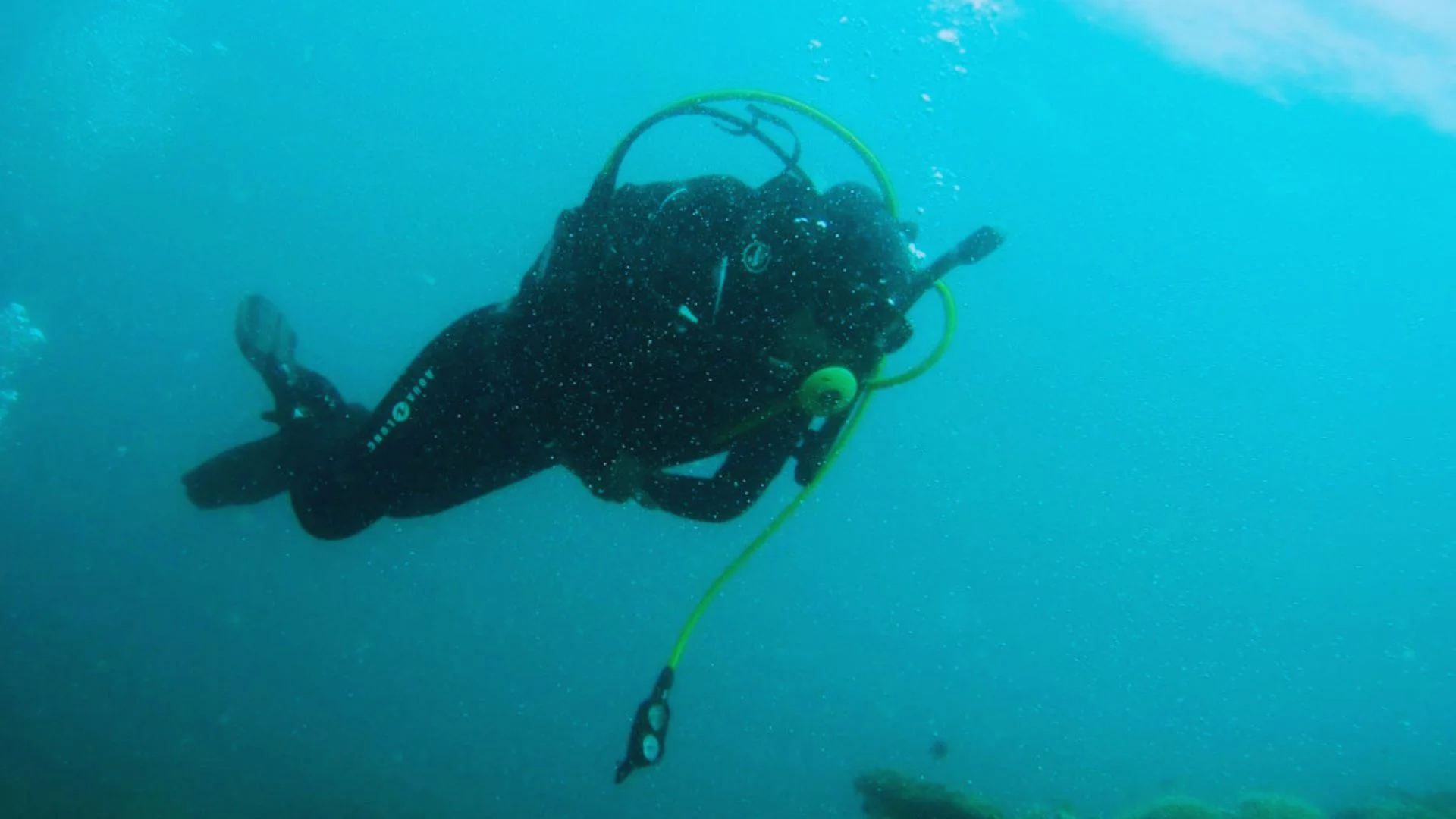
A team of Chinese scientists has developed a robotic diving suit that makes underwater movement easier, safer, and more efficient.
Early tests show that the system can reduce a diver’s oxygen use by nearly 40 percent. The suit works by closely following the diver’s natural movements and assisting them in real time.
The innovation comes from researchers at the Shenzhen Institute of Advanced Technology, Chinese Academy of Sciences.
Their findings were published in the peer-reviewed journal IEEE/ASME Transactions on Mechatronics in January.
READ ALSO: Tritone Joins Fleet, Signaling Italy’s Shift to Seabed Operations
The suit is designed as a flexible exoskeleton. It supports the diver’s legs and helps them move through water with less effort. This reduces fatigue and allows divers to stay underwater longer while using less oxygen.
Underwater work often requires constant changes in movement. Divers need to adjust their speed and direction quickly in the presence of currents and limited visibility. These frequent changes increase physical strain and raise the risk of accidents.
To solve this problem, the research team developed an algorithm that can match the diver’s movements in real time. “The exoskeleton assists the diver the moment the kicking direction changes,” the researchers explained. “Whether the leg moves forward or back, the boost is immediate and nearly imperceptible.”
This system allows the diver to move more naturally. It does not interfere with their rhythm or balance. Instead, it strengthens their own motion, similar to how land-based exoskeletons help workers lift heavy loads.
WATCH ALSO: Skid AI to boost development of its robotic intelligence platform, raises USD 1.4 billion
Designing such a system for underwater use is not simple. On land, human walking patterns are easier to predict. But underwater, buoyancy reduces body weight, making movements faster and less stable. A diver can switch from slow kicks to rapid ones in a single moment.
Traditional systems struggle in these conditions. Time-based estimators fail when the pace changes suddenly. Adaptive oscillators take too long to adjust. Advanced AI models also have limits because they need training for each individual user.
The new algorithm, called Ultra-Robust Adaptive Oscillator (URAO), avoids these issues. It does not need prior training. It works instantly for different users and adapts to their unique movement style.
URAO can handle both major swimming techniques used by divers. These include the flutter kick, which is common in freestyle swimming, and the frog kick, used in breaststroke. The system quickly detects changes in speed and adjusts without delay.
In March 2025, the team introduced a working prototype of the suit, named ‘Peaked.’ The system includes three main parts. A buoyancy vest provides flotation support. A waist-mounted unit contains waterproof components that control cable-driven motion. Leg cuffs deliver assistive force while also collecting movement data through sensors.
READ ALSO: US Army Selects Vector AI Drone to Sharpen ISR Reach and Precision
To test the system, researchers conducted trials in both indoor and outdoor pools. Divers were asked to switch between slow and fast kicking patterns, similar to those used in real underwater operations.
The results showed clear improvements. The algorithm reduced prediction errors by 49.5 percent for flutter kicks and 44.8 percent for frog kicks. This means the system can match the diver’s movement more accurately and respond faster than existing methods.
Lower oxygen consumption is one of the biggest advantages. With less physical effort needed, divers can conserve energy and extend their time underwater. This is especially important for tasks like seabed surveys, pipeline inspections, and rescue operations.
The technology also has potential for military use. Covert missions often require long-duration dives with minimal movement noise. A system that reduces effort and improves control can offer a strong advantage.
WATCH ALSO: Top research robot integrated with new intelligence platform
Beyond this project, the Shenzhen research team is working on other advanced robotics. These include medical microrobots, industrial automation systems, and multi-sensor platforms for reconnaissance.
The diving exoskeleton demonstrates how robotics can enhance human performance in challenging environments. By combining smart algorithms with wearable systems, researchers are opening new possibilities for underwater exploration and operations.