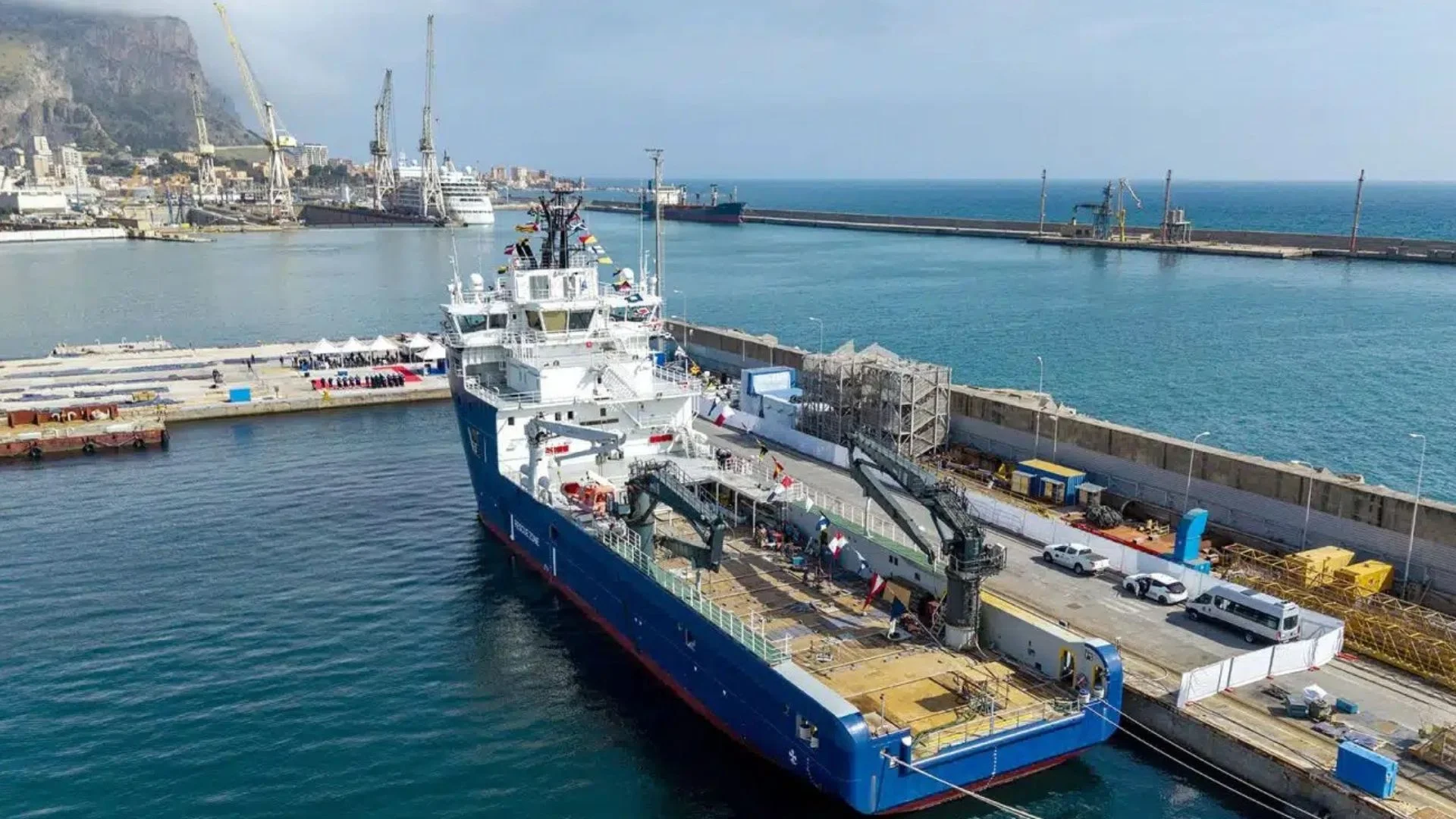
The Italian Navy has officially brought a new vessel into service, but this is not just another addition to its fleet.
The commissioning of Tritone (A 5341) marks a bigger change in how the Navy builds and acquires its capabilities, especially in the underwater domain.
Rather than designing a warship from scratch, Italy has chosen a different path. It has taken a commercially built offshore vessel and adapted it for military use. This approach is faster, more flexible, and allows the Navy to respond quickly to emerging threats, especially those beneath the sea.
READ ALSO: HotSat-2 Is Launching: This Satellite Can Expose What Happens Behind Closed Doors
This shift reflects a growing global concern: protecting critical underwater infrastructure. These include submarine communication cables, gas pipelines, and offshore energy systems. Such assets are vital for national security and economic stability.
The vessel was delivered by Fincantieri to the Italian Navy on April 14 at its Palermo shipyard. The ceremony was attended by senior officials, including Chief Inspector Admiral Cristiano Nervi, who recently took command of the Naval Armaments Directorate (NAVARM), and Vice Admiral Vincenzo Montanaro, head of the Italian Navy Logistic Command.
Rear Admiral Cristo Salvatore Traetta, who leads the Fifth Naval Division and Mine Countermeasures Command, was also present. The ship will operate under this division, highlighting its role in underwater and seabed-focused missions.
A New Way to Build Naval Power
The Tritone program shows a new strategy in naval procurement. Instead of long development cycles, the Navy directly explored the global market for existing solutions.
WATCH ALSO: China commissions world’s largest open-sea offshore solar photovoltaic project
This approach began in mid-July 2025, when the Italian Navy issued a request to acquire a second-hand Offshore Support Vessel (OSV). The aim was to convert it into a Multi-purpose vessel for underwater dimension surveillance, also known as UPSDS.
Officials described this as a new approach to capability acquisition. They focused on using existing platforms, upgrading them quickly, and putting them into operation without delay.
They also allowed options such as leasing or chartering vessels. This flexibility ensures faster deployment and constant technological updates.
From Civilian Vessel to Naval Asset
Tritone was not originally built for military use. It was constructed by VARD Vung Tau shipyard in Vietnam as a Platform Supply Vessel (PSV). Later, it was acquired by NCT Offshore in 2022 and named MV Coco.
The vessel was then used by Magellan for deep-water operations. It supported underwater vehicles and advanced equipment in commercial offshore projects.
READ ALSO: Virgin Galactic Targets Suborbital Q4 Return, But Can It Overcome Mounting Losses?
The Italian Navy saw potential in this design. It acquired the vessel and began upgrading it at the Palermo shipyard in December 2025.
The modernization process focused on enhancing operational capabilities and integrating the vessel into the Navy’s command systems. The upgrades were completed quickly, and sea trials were conducted in the Gulf of Palermo.
The project, funded at €53.5 million, moved from concept to delivery in less than a year. This speed reflects the efficiency of the new acquisition model. One of Tritone’s key strengths is its modular design. The ship can be reconfigured based on mission requirements.
It can carry and support a wide range of systems, including unmanned aerial vehicles (UAVs), unmanned surface vehicles (USVs), and autonomous underwater vehicles (AUVs). It can also operate as a mothership for remotely operated vehicles (ROVs), which are essential for deep-sea exploration and operations.
The ship has enough space to accommodate containerized payloads. This means new technologies can be added or replaced without modifying the entire vessel.
Officials say this flexibility is critical for the future. It allows the Navy to keep pace with rapidly evolving underwater technologies.
WATCH ALSO: India’s DRDO successfully completes user evaluation trials of Akash-NG Missile System
Tritone’s Core Missions: Surveillance and Protection
Tritone’s main role is to monitor and protect underwater infrastructure. These include submarine communication cables, which carry global internet traffic. They also include pipelines and offshore energy platforms.
Any disruption to these systems can have serious economic and security consequences. The vessel will conduct surveillance operations to detect potential threats. It will also serve as a deterrent by maintaining a visible presence in sensitive areas.
Tritone is not limited to military tasks. It also plays an important role in maritime safety. The vessel can support submarine rescue missions. It is compatible with the Italian Navy’s new SAVER system, which is designed to rescue crews from distressed submarines.
It can also support NATO rescue operations, making it a valuable asset for international cooperation. In addition, Tritone serves as a platform for scientific research and experimentation. It allows testing of new underwater technologies in real conditions.
These experiments will help define the design of future naval vessels, particularly the next-generation UPSDS ships expected to enter service from 2031.
READ ALSO: EDGE Group and Anduril Forge UAE-US Joint Venture to Launch Omen Autonomous Aircraft
Technical Features and Capabilities
Tritone measures 81.7 meters in length and has a beam of 18 meters. It has a full load displacement of 6,600 tonnes. The ship uses an integrated full electric propulsion system (IFEP). This system provides efficient power management and supports advanced onboard systems.
It is equipped with a Class II Dynamic Positioning System (DPS), which allows it to maintain its position with high precision. This is essential during underwater operations. The propulsion system includes multiple diesel generators and azimuth thrusters. These enable smooth maneuvering and stable operations.
The vessel can reach a maximum speed of 14 knots and has an endurance of 4,000 nautical miles at 10 knots. It can operate for up to 30 days without resupply. Tritone is equipped with modern navigation and communication systems. These include radar systems, electronic chart displays, and satellite communication tools.
It also features hydro-acoustic positioning systems that help track underwater equipment with high accuracy. The ship’s bridge offers a 360-degree view, improving situational awareness.
Accommodation is provided for up to 60 personnel, including a core crew of 40. Facilities include living areas, a gym, and workspaces. The vessel has a large working deck of around 620 square meters. This space can handle heavy equipment and containerized systems.
It includes cranes and lifting systems for deploying underwater vehicles. A larger offshore crane with advanced features is expected to be installed in the future. The deck is designed to support a wide range of missions, from rescue operations to technology testing.
The commissioning of Tritone marks the beginning of a new chapter for the Italian Navy. It shows a clear move towards flexibility, speed, and innovation. By leveraging existing platforms and adapting them quickly, the Navy can respond more quickly to new challenges.
Tritone will also play a key role in shaping future naval designs. The lessons learned from its operations will guide the development of next-generation vessels.
As underwater threats continue to grow, assets like Tritone will become increasingly important. This is not just a ship. It is a step towards a more agile and forward-looking naval strategy.