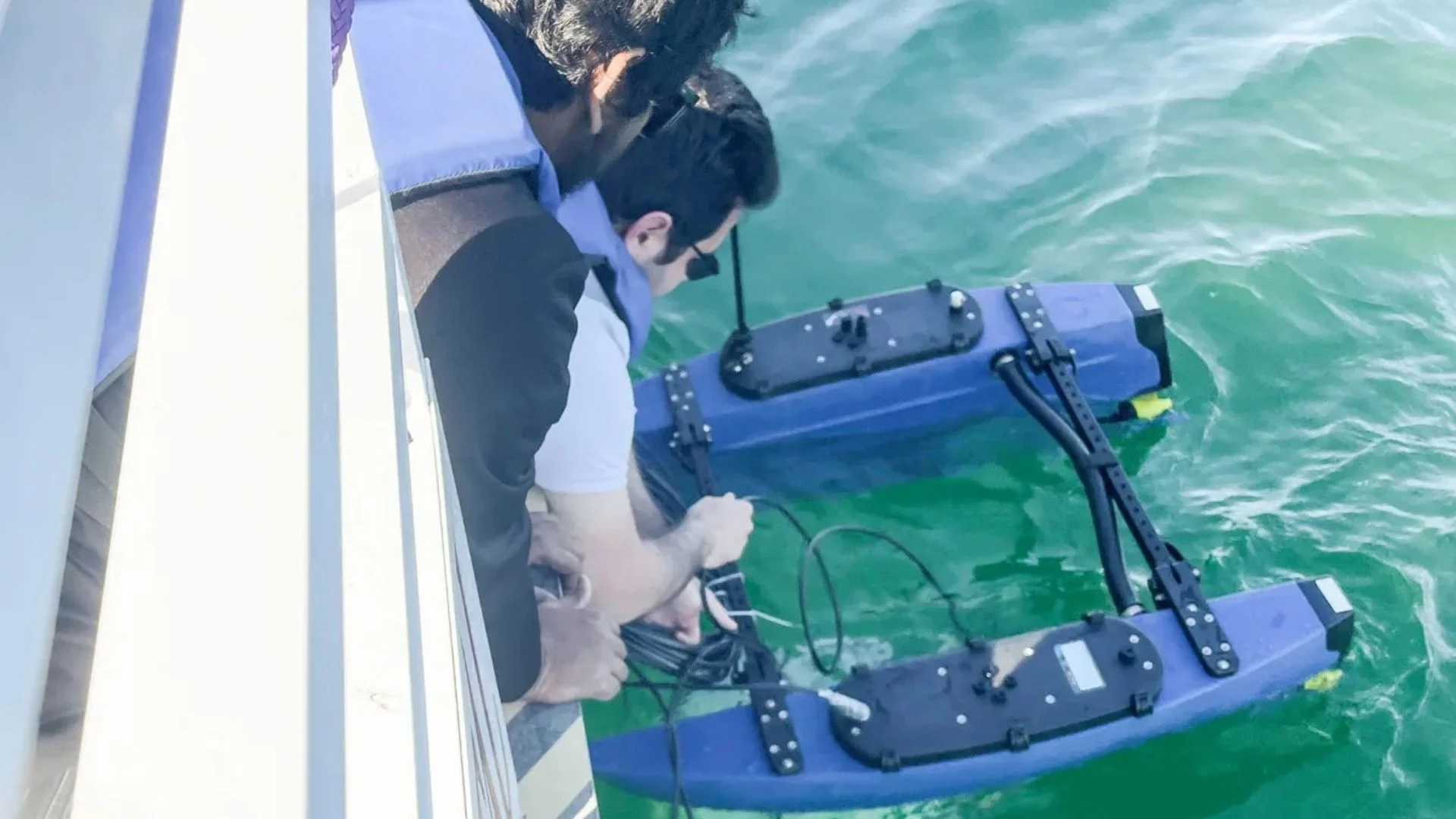
Researchers at the University of Florida have developed a compact underwater communication system designed to help autonomous robots share information more effectively beneath the surface.
The new technology, known as BlueME, allows underwater robots to communicate across long distances while using very little power. The advancement could support a wide range of applications, including naval missions, environmental research, and offshore infrastructure inspections.
The project is led by Md Jahidul Islam and Adam Khalifa, assistant professors in the Department of Electrical and Computer Engineering at the University of Florida. Their work combines expertise in marine robotics, wireless communications, and advanced antenna design.
The research findings were published in the IEEE Journal of Oceanic Engineering in a paper titled “BlueME: Robust Underwater Robot-to-Robot Communication Using Compact Magnetoelectric Antennas.”
BlueME Different Approach for Communication
Communication underwater remains a major challenge because radio signals, which work well in air, struggle to travel through water.
READ ALSO: Montreal’s Hidden Climate Culprit: The Surprising Source Choking Our Air
Many underwater systems rely on acoustic signals, but they can face limitations in speed, reliability, and in harsh environmental conditions. As a result, underwater robots often exchange only limited information or must surface to transmit larger amounts of data.
BlueME takes a different approach by using a compact magnetoelectric antenna. This antenna operates at its natural resonance frequency to transmit and receive very low-frequency and low-frequency electromagnetic signals underwater. The design enables communication while keeping the equipment small and energy-efficient.
The researchers focused heavily on reducing power consumption during development. According to the team, the system operates at around 10 watts at maximum capacity. That level of energy use is lower than that of many common robotic sensing systems, helping robots conserve battery life during long missions.
Inspiration Came From Medical Device Research
The idea behind BlueME emerged from an unexpected connection between medical technology and marine robotics.
Adam Khalifa has spent years studying miniature wireless medical implants that function inside the human body. Those devices must operate efficiently in highly conductive environments, a challenge that is similar to underwater communication.
Khalifa realized that many physical conditions found inside the body are comparable to those found underwater. Human tissue contains large amounts of lightly salted water, creating communication challenges similar to those encountered in oceans and lakes. This observation helped inspire a new way of thinking about underwater wireless systems.
The collaboration brought together experts from different research fields. By combining medical device knowledge with underwater robotics expertise, the team developed a solution to improve communication between autonomous marine systems.
READ ALSO: Russia Tests Nuclear-Powered Burevestnik Missile Amid Ukraine War and Trump Peace Talks
Long-Range Communication for Autonomous Robots
One of the biggest obstacles in underwater robotics is coordination among multiple robots. Limited communication range often prevents vehicles from sharing detailed information in real time. This restriction can reduce efficiency during exploration, mapping, inspection, and monitoring tasks.
BlueME was designed to help address this problem. During ocean testing, the system demonstrated communication ranges exceeding 700 meters while maintaining a compact design. Such distances can allow robots to remain connected without needing large antennas or excessive power consumption.
The technology enables robots to send mission updates while remaining underwater. Operators can receive status reports and make decisions based on incoming information rather than waiting until the robots return to the surface. This capability supports more responsive and adaptable missions.
The potential applications extend across several industries. Naval organizations could use connected underwater robots for surveillance and operational support. Environmental researchers could deploy coordinated robotic fleets to study marine ecosystems, while energy companies could improve inspections of underwater pipelines, cables, and offshore structures.
The researchers describe BlueME as one of the first practical demonstrations of compact magnetoelectric antennas for underwater robotic communication. The team has already filed a provisional patent and is seeking additional support to expand testing and further refine the system.
WATCH ALSO: An American company has launched an autonomous delivery robot that’s one-tenth the size of a car
As underwater robotics continues to advance, communication technologies will play an important role. Systems such as BlueME could help fleets of autonomous marine robots work together more effectively, opening new possibilities for ocean exploration, scientific research, infrastructure monitoring, and maritime operations in the years ahead.