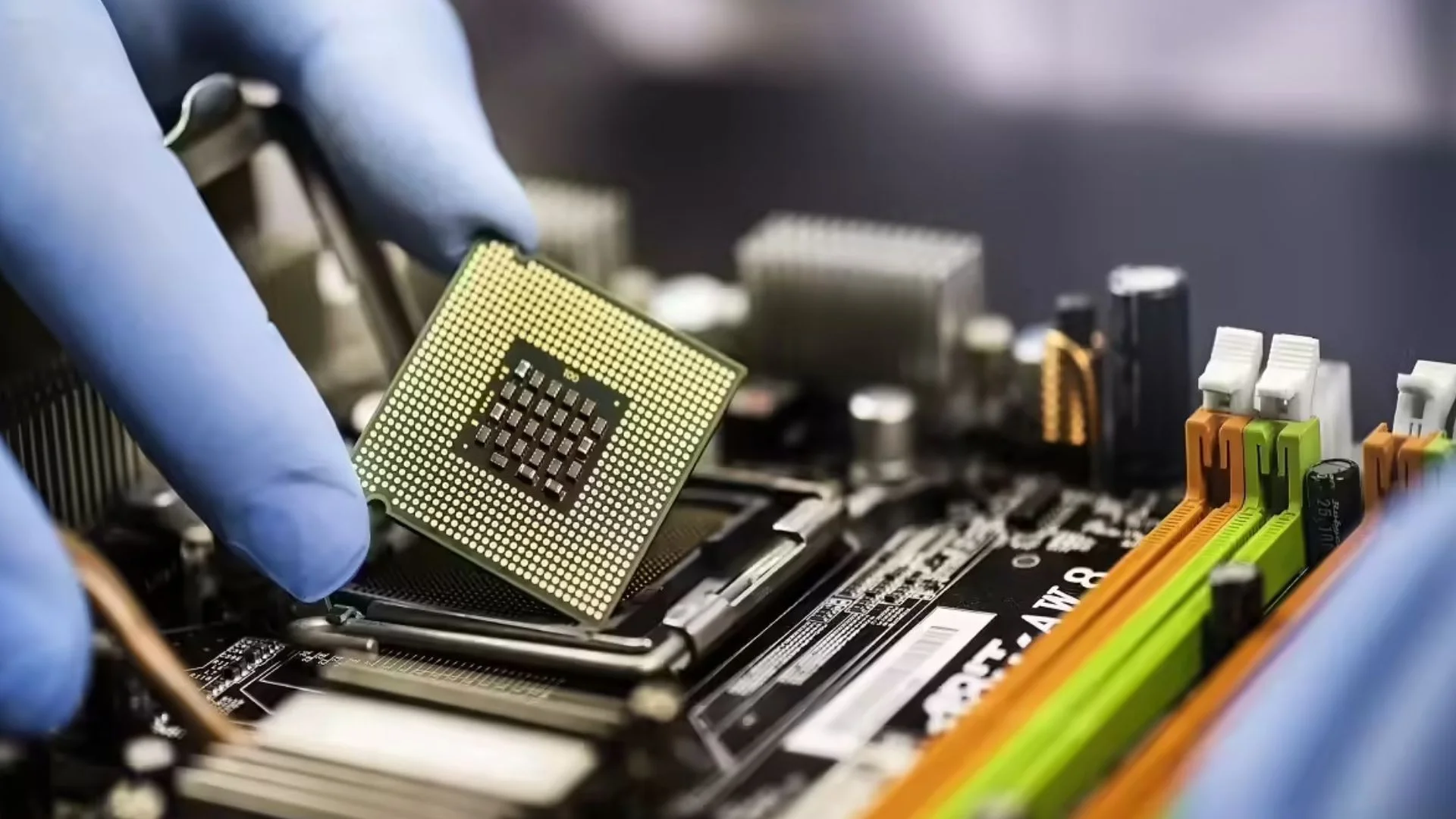
Applied Materials has introduced a new portfolio of chipmaking systems designed to support the next generation of artificial intelligence (AI) chips.
The new tools target both advanced DRAM memory production and advanced chip packaging, two areas that have become essential for meeting the growing performance needs of AI computing.
The company says the systems will help chipmakers improve production speed, increase manufacturing yields, and support more complex 3D chip designs.
As AI models grow larger, they require much faster memory access. This has created the memory wall, where memory performance struggles to keep up with the increasing processing power of AI chips.
To address this challenge, manufacturers are turning to technologies such as High Bandwidth Memory (HBM) and advanced 3D chip stacking.
HBM improves memory performance by stacking multiple DRAM chips on top of one another instead of placing them side by side. These stacked chips communicate through tiny vertical connections known as through-silicon vias(TSVs). This design provides much higher bandwidth while reducing power consumption, making it well suited for AI servers and data centers.
However, manufacturing these advanced memory systems is far more complicated than producing traditional semiconductor devices. Every layer must be aligned with extreme precision, and even very small defects can reduce production yields. Applied Materials has developed its latest equipment to solve these manufacturing challenges across multiple production stages.
READ ALSO: Scientists Turn Graphene Into Custom Nanodiamonds for Quantum and Medical Uses
DRAM Tech Brings Logic Manufacturing Techniques to Memory
One of the biggest announcements is the enhanced Centura Prime Epi system. The company has upgraded the platform with new capabilities that selectively grow silicon-germanium and silicon-phosphorus materials inside DRAM transistors. These materials improve transistor performance by combining advanced strain engineering with highly controlled doping.
In semiconductor manufacturing, doping means adding carefully selected atoms to improve the electrical performance of silicon. Strain engineering alters the material’s structure to enable electrical current to flow more efficiently. Together, these techniques increase transistor speed while reducing power consumption.
These manufacturing methods have already been widely used in advanced logic processors. Applied Materials is now bringing these technologies to next-generation DRAM production. This reflects a growing trend in which the manufacturing processes used for processors and memory chips are becoming more similar.
AI-Driven Chipmaking Revolution
The updated Centura Prime Epi system also has a footprint that is around 20 percent smaller than earlier versions. This allows chip manufacturers to install more systems inside the same factory space. Higher equipment density helps memory manufacturers expand production capacity more efficiently.
Dr. Prabu Raja, President of Applied Materials’ Semiconductor Products Group, said the technologies that improved leading-edge logic chips are now becoming essential for DRAM manufacturing. He said the company is well positioned to support this transition due to its extensive experience with advanced epitaxy systems.
Three New Systems Focus on Advanced AI Chip Packaging
Applied Materials also introduced three new manufacturing systems built specifically for advanced packaging. Advanced packaging has become one of the most important technologies in AI computing because modern processors increasingly combine multiple chips into a single package rather than relying on a single large chip.
One of the new systems is the Opta Quad chemical-mechanical planarization (CMP) platform. CMP is a polishing process that creates extremely flat wafer surfaces before additional manufacturing steps. Flat surfaces are especially important for hybrid bonding, where two chips are joined directly together using copper connections and surrounding insulating materials.
READ ALSO: UCF’s VERA Platform Tackles Cybersickness With First Large-Scale Remote Virtual Reality Study
The Opta Quad platform continuously monitors the wafer during polishing. It automatically adjusts the polishing process in real time to improve thickness consistency across the wafer. Better surface uniformity helps manufacturers reduce defects and improve yields during advanced packaging.
The second system is the Nokota VMax 2 electrochemical deposition platform. This equipment deposits copper inside through-silicon vias and creates tiny copper connections known as microbumps. These structures provide the electrical links between stacked memory chips.
The new system introduces a feature called Adaptive Pattern Tuning. This technology dynamically adjusts the electric field during copper plating to compensate for differences in chip layouts. The result is more uniform copper deposition across the entire wafer, helping improve the reliability of stacked chip connections.
Applied Materials also introduced the Producer Avila 2 plasma-enhanced chemical vapor deposition system. This equipment deposits thin dielectric films that strengthen very thin DRAM wafers during manufacturing. Modern HBM memory chips are often reduced to about one twenty-fifth the thickness of a standard semiconductor wafer before stacking.
Ultra-thin wafers are prone to bending or warping during manufacturing. Warpage becomes even more challenging as more memory layers are added into taller HBM stacks. The Producer Avila 2 system deposits carefully balanced dielectric layers around TSV structures to improve mechanical stability and reduce bonding failures.
The company says the system supports current 12-layer HBM products while also preparing manufacturers for future 16-layer and even higher-layer memory designs. In addition to HBM, the equipment can support several advanced memory and logic packaging technologies.
According to Raja, advanced packaging has become just as important as shrinking transistor sizes inside individual chips. He said customers now require greater manufacturing precision across every production step to successfully build increasingly complex 3D chip architectures.
New eBeam Inspection Systems Improve Packaging Quality
Applied Materials also expanded its process control portfolio with two new electron beam(eBeam), inspection systems designed specifically for advanced packaging factories. Process control has become important because modern packaging features are now too small for many traditional optical inspection systems.
The first new product is the VeritySEM 7AP critical dimension metrology system. It measures extremely small features on thick, sometimes warped semiconductor substrates commonly used in HBM and chiplet packaging. The system automatically adapts to different substrate materials and sizes while providing measurement sensitivity below 10 nanometers.
READ ALSO: IBM Unveils World’s First Nanostack Sub-1nm Chip Technology With 100 Billion Transistors
The second system is the SEMVision G7AP defect analysis platform. It performs high-resolution inspection of packaging defects across silicon, organic, and glass substrates. The equipment also uses automated defect classification to help manufacturers quickly identify serious production issues while filtering out harmless signals.
Applied Materials says the SEMVision G7AP system is already being used in high-volume manufacturing by leading memory and logic chip producers. Faster defect detection allows manufacturers to improve production yields while reducing the cost of advanced packaging.
Keith Wells, Group Vice President and General Manager of Applied Materials’ Imaging and Process Control Group, said advanced packaging factories now face many of the same inspection challenges as leading-edge wafer fabrication plants. He said the new inspection systems bring proven wafer manufacturing expertise into advanced packaging production.
The semiconductor industry is investing heavily in advanced memory and packaging technologies because AI workloads continue to demand faster data movement and higher computing efficiency. As chipmakers move toward increasingly complex 3D architectures, manufacturing precision becomes even more important across every stage of production.
Applied Materials‘ latest product portfolio reflects this industry shift by combining DRAM manufacturing, advanced packaging, and process control into a broader materials engineering strategy. These new systems are expected to help semiconductor manufacturers produce future AI processors with higher performance, better yields, and faster production as demand for AI computing continues to expand.