

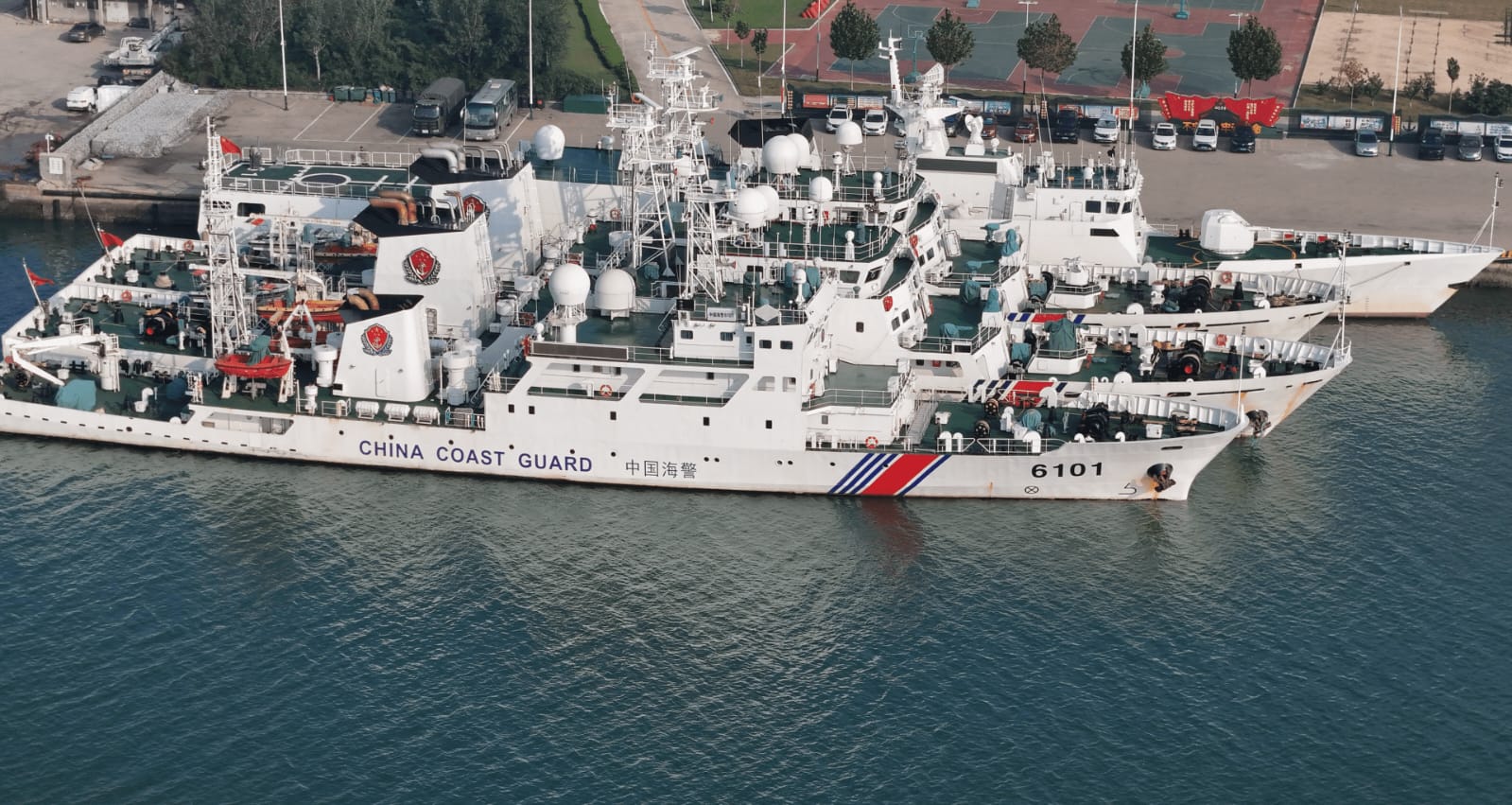
A Chinese research team has developed an artificial intelligence system designed to help coastguard crews assess the intentions of unknown vessels during tense maritime encounters.
In computer-based war games, the system improved the accuracy of vessel-intent assessments and prevented weapons-use violations in the simulations. The study also found that a conventional rule-based command system used lethal weapons in 0.3 per cent of simulated encounters.
AI Tracks Vessel Intentions
The research was led by Sun Shengzhi, a professor at the China Coast Guard Academy, and was published on August 10 in the Chinese journal Command Control & Simulation.
The academy trains officers for the People’s Armed Police Force and studies operational issues relevant to China’s coastguard. The researchers focused on situations where vessels behave in ways that are difficult to classify as either routine activity or deliberate interference.
READ ALSO: https://modernmechanics24.com/post/china-gj-21-drone-flying-again/
The war game centred on a scenario described as foreign interference during fishing protection. One Chinese coastguard vessel was assigned to protect fishing boats while four to six simulated foreign vessels conducted low-level harassment and reconnaissance.
The setup was intended to reflect the uncertainty often found in maritime grey-zone encounters, where potentially hostile actions can resemble normal fishing or navigation.
The simulated vessels followed several operational restrictions. These included a minimum separation of 0.5 nautical miles, or about 0.9 kilometres, as well as strict rules governing the use of weapons. The coastguard vessel therefore had to determine the likely intentions of approaching boats before deciding how to respond.
Conventional Rules Show Limits
Under the existing rule-based command system, the simulated coastguard used lethal weapons in 0.3 per cent of the encounters.
Although the figure was small, the researchers viewed any weapons-use violation as a significant concern in situations involving disputed waters. The same system identified vessel intentions correctly in 68.5 per cent of the tests.
The researchers then introduced an AI framework that combines information from radar and other sensors with a causal model.
In simple terms, the system tries to understand why a vessel is moving in a particular way instead of judging its behaviour only against fixed rules. This allows it to continuously update the probability of different intentions as new movements are detected.
In one simulation, the system initially gave a nearby vessel a 72 per cent probability of being harmless. The assessment changed after three vessels formed a wedge and approached from different directions, with the probability of successive probing rising to 68 per cent. The AI responded by ordering the use of a water cannon, allowing the coastguard vessel to deter the approaching boats without using lethal force.
WATCH ALSO: https://modernmechanics24.com/post/china-c919-first-international-flight/
AI Improves Maritime Decisions
Across dozens of simulated encounters, the AI-controlled system did not trigger a weapons-use violation. It also reduced the overall rate of rule breaches, including unsafe approaches, from 1.2 per cent under the conventional system to 0.8 per cent. Its vessel-intent recognition accuracy reached 89.6 per cent, compared with 68.5 per cent for the rule-based approach.
The system was also tested against simulated deception. In one scenario, several fishing boats appeared to retreat in an attempt to draw the coastguard vessel away from its position. Other vessels then accelerated from another direction in a manoeuvre that appeared to simulate a possible collision attempt.
The AI linked the two actions and identified the retreat as part of a possible coordinated tactic. It therefore maintained its position instead of reacting only to the first group of vessels. Sun said the method generated more rational and flexible opposing behaviour and helped reveal weaknesses in existing operational plans.
Broader Role For AI
The researchers said the framework is intended to improve both decision support and the realism of military and coastguard exercises.
It combines three elements: recognising vessel intentions, making decisions within operational limits and generating adaptive behaviour from opposing forces. Together, these features allow simulated encounters to better reflect the uncertainty faced by commanders at sea.
The research has particular relevance to disputed maritime areas, including the South China Sea, where coastguard ships, fishing fleets and other vessels can operate in close proximity. In such environments, determining whether an unusual manoeuvre is accidental, routine or deliberate can influence how a patrol responds. A system that improves this assessment may help commanders choose proportionate responses while remaining within established rules.
The researchers did not propose removing human commanders from the decision-making process. Sun noted that further research is needed to ensure AI decisions remain consistent with higher-level strategic objectives and ethical standards. The team plans to test the framework in more complex scenarios involving several operational domains and examine how humans and AI can work together when making decisions.
READ ALSO: https://modernmechanics24.com/post/l3harris-arx-robotics-robot-sensors/
The study points to a growing role for AI in maritime decision support, particularly where commanders must interpret large amounts of sensor information while following strict rules. Its results remain limited to computer simulations, so further testing would be needed to determine how the system performs in real-world conditions.
However, the research provides a model for using AI to recognise vessel behaviour more accurately while keeping human oversight at the centre of sensitive coastguard decisions.










One Response