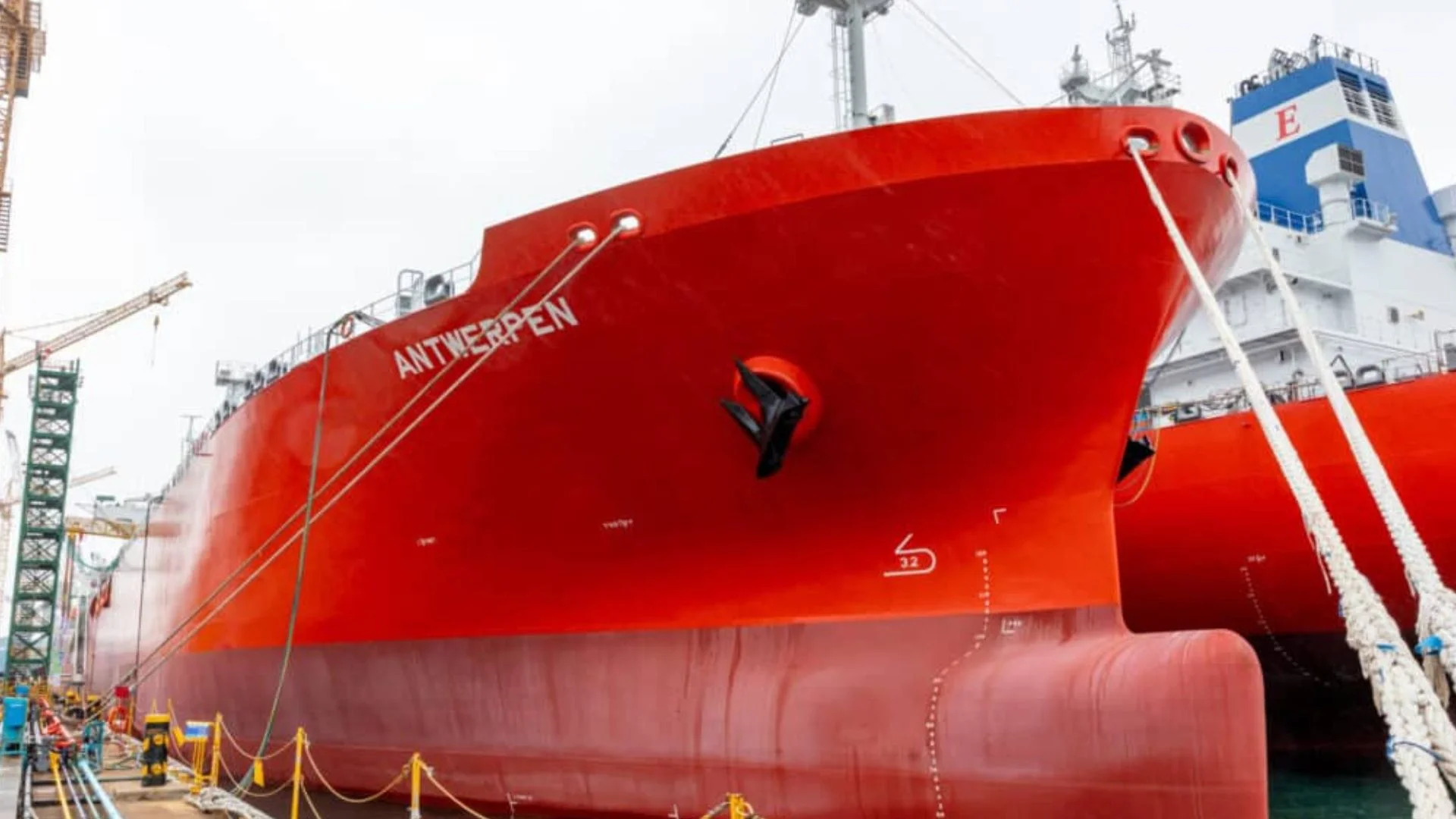
Exmar has officially received the world’s first newly built dual-fuel ammonia-powered gas carrier, marking a major milestone for the global shipping industry.
The vessel, named Antwerpen, entered service on June 10 and is the first large commercial ship designed to transport ammonia while also using the same fuel for propulsion.
The delivery signals a new phase in the shipping sector’s efforts to reduce emissions and adopt alternative marine fuels.
The ship is the first of four ammonia dual-fuel vessels being built for Exmar. Three vessels are scheduled for delivery during 2026, while the fourth is expected to join the fleet in early 2027. Together, these ships are expected to provide valuable operational experience for the emerging ammonia-fueled shipping sector.
Antwerpen has a cargo capacity of 46,000 cubic meters and is designed to transport ammonia and other liquefied gases. What makes the vessel unique is its ability to use ammonia both as cargo and as fuel. This combination has never before been implemented on a newly built commercial gas carrier of this scale.
The project is the result of several years of collaboration between shipbuilders, engine manufacturers, classification societies, and regulators.
READ ALSO: Inch by Inch, This Robot Is Powering a More Energy-Efficient Future for Soft Robotics
Exmar worked closely with Belgian authorities and Lloyd’s Register to help establish the regulatory framework needed for ammonia-fueled operations. Existing rules allowed LNG and LPG to be used as marine fuels, but they did not permit toxic cargoes such as ammonia to power gas carriers.
Ammonia presents different challenges compared with other alternative fuels. LNG and LPG are mainly associated with flammability risks. Ammonia, however, is highly toxic and can also cause corrosion if not handled correctly.
To address these concerns, the project partners developed new safety systems and operational procedures. Exmar relied on its decades of experience transporting ammonia cargoes worldwide. That knowledge helped shape the vessel’s design and safety measures.
The development program officially began in 2022. Exmar partnered with Hyundai Mipo, engine developer WinGD, Nord Gas Solutions, and Lloyd’s Register to bring the concept into reality. Each company contributed technology and expertise to make ammonia-fueled shipping commercially viable.
Inside the Ammonia-Powered Engine
A key component of the vessel is its ammonia-capable main engine. WinGD developed a large two-stroke engine that uses high-pressure ammonia injection technology. The engine was manufactured by HD Hyundai Heavy Industries and installed in 2025.
The system uses ammonia as its primary fuel source, requiring only a small amount of pilot fuel for ignition. At full operating load, pilot fuel accounts for about five percent of total fuel consumption. According to the developers, the engine delivers performance comparable to that of conventional diesel-powered marine engines.
The first two vessels in the series have been named Antwerpen and Arlon, after Belgian cities. Each vessel measures 190 meters in length and has a deadweight capacity of approximately 27,000 tons. They were specifically designed for transporting liquefied gases, including ammonia and LPG.
READ ALSO: eCopter Takes Off: A New Chapter for FlyNow Aviation
Engineers modified the original vessel design to increase carrying capacity. The ships were lengthened by approximately 10 meters and slightly widened. These adjustments allow the vessels to transport more cargo than vessels of the same category in standard designs.
The ships feature three large cargo tanks located below deck. Together, these tanks provide around 45,000 cubic meters of storage capacity. Two additional deck tanks, each capable of holding 500 cubic meters, support fuel operations and cargo management.
Ammonia is attracting growing interest as a future marine fuel because of its potential environmental benefits. Unlike conventional marine fuels, ammonia contains no carbon. As a result, its use can significantly reduce carbon dioxide emissions during vessel operations.
HD Hyundai estimates that ammonia-fueled operations can reduce emissions by up to 90 percent compared with traditional ships. The fuel is also viewed as an efficient carrier of hydrogen, which is expected to play an important role in future industrial energy systems. This makes ammonia attractive not only for shipping but also for broader energy transition strategies.
Another advantage is storage and transportation. Liquid ammonia can be stored at around minus 33 degrees Celsius or under a moderate pressure of approximately 8 bar. This is considerably easier than handling liquid hydrogen, which requires temperatures near minus 253 degrees Celsius.
Ammonia also offers higher energy storage density than liquid hydrogen. According to HD Hyundai, liquid ammonia can store roughly 1.7 times more hydrogen by volume. This makes it better suited for long-distance transportation and large-scale energy distribution networks.
The delivery of Antwerpen comes amid growing worldwide interest in ammonia-fueled shipping. Data from DNV’s Alternative Fuels Insights database shows that only a handful of vessels currently operate with ammonia fuel capability. Most existing examples are small converted vessels, including tugs and offshore support ships.
WATCH ALSO: World’s first motorbike backflip between two moving trucks successfully completed
However, a larger order pipeline is now emerging. DNV reports that 47 ammonia-capable vessels are currently on order and scheduled for delivery before 2030. Several shipping companies are preparing to introduce ammonia-powered bulk carriers, tankers, and other vessel types over the coming years.
Following delivery, Antwerpen departed from Ulsan in South Korea and began its voyage to Zhoushan, China. Its sister vessel, Arlon, is expected to enter service in the coming months. A third vessel in the series is scheduled for delivery before the end of the year.
For Exmar and its partners, the vessel represents more than a single ship. It serves as a real-world test platform for technology, regulations, and operational practices that could shape the future of cleaner maritime transport. The experience gained from these vessels is expected to support wider adoption of ammonia fuel across the global shipping industry in the years ahead.