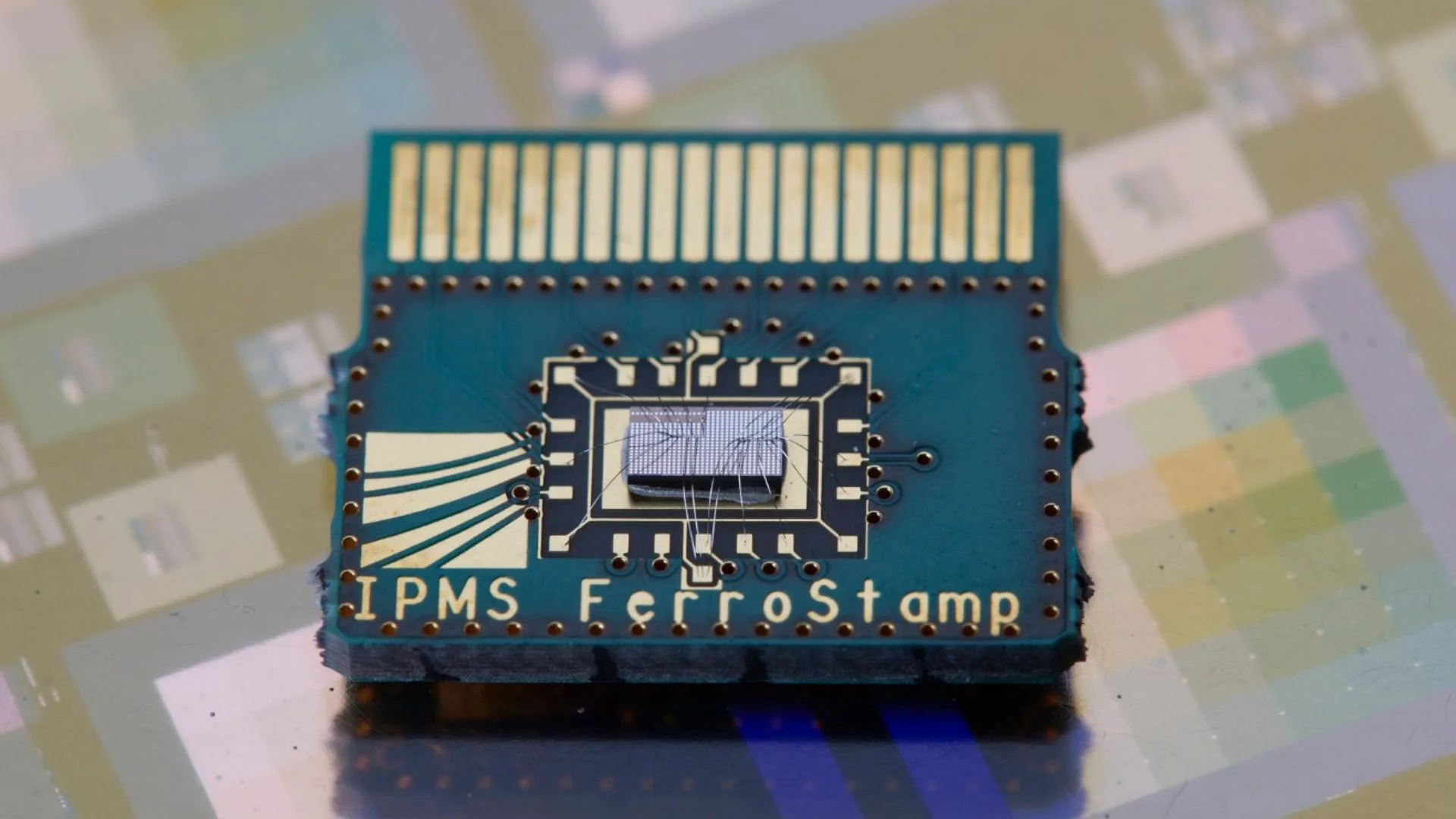
Researchers from the Fraunhofer Institute for Photonic Microsystems (Fraunhofer IPMS) and semiconductor manufacturer GlobalFoundries have developed a new memory technology designed to improve the performance and energy efficiency of future electronic devices.
The joint project has successfully integrated ferroelectric random-access memory (FRAM) into an existing industrial chip manufacturing process. The achievement has earned the team the Stifterverband Science Prize Forschung im Verbund, which recognizes successful collaboration between industry and research.
Modern electronic systems require memory that is fast, reliable, energy efficient, and capable of storing data even when power is removed. As devices become more connected and intelligent, these requirements continue to grow. Existing memory technologies are struggling to meet all these demands simultaneously.
The new solution is based on ferroelectric memory technology. Unlike conventional memory systems, which often require continuous power to retain information, FRAM can retain stored data even when a device is switched off. This feature makes it attractive for battery-powered and energy-sensitive applications.
At the heart of the technology is ferroelectric hafnium oxide. In this material, tiny charged particles, known as ions, move within the crystal structure when an electrical signal is applied. These movements change the material’s electrical polarization, allowing digital information to be stored and retrieved.
One of the major advantages of ferroelectric memory is its speed. The memory cells can switch states within nanoseconds, allowing data to be written and accessed very quickly. At the same time, the stored information remains available without requiring a continuous power supply.
Another important benefit is durability. The memory can handle a large number of write and clear cycles while maintaining reliable operation. This long operational life is critical for industrial systems and other applications that frequently process data.
READ ALSO: Improved Method Sets New Standard for Multi-Photon State Creation
A major milestone of the project was integrating the memory into GlobalFoundries’ 22FDX manufacturing platform. This semiconductor process is specifically designed for ultra-low-power chips. By embedding the new FRAM cells into this production environment, researchers demonstrated that the technology can be manufactured using established industrial methods.
The memory cells operate at voltages below one volt. Lower operating voltages reduce overall energy consumption and help extend battery life within portable devices. This is important as connected devices continue to expand across industries.
FRAM Powers Edge AI
The technology is especially relevant for edge artificial intelligence. Edge AI refers to data processing that occurs directly on a device rather than relying on remote cloud servers. Processing information locally reduces delays, lowers communication costs, and improves privacy in many applications.
Examples include smart sensors, industrial monitoring equipment, autonomous systems, and medical devices. These products often operate with limited power resources and require fast access to stored information. The new memory technology addresses both needs simultaneously.
The development also supports the growing demand for efficient computing systems. Traditional computing systems regularly separate memory and processing, creating delays and increasing energy consumption. Advanced non-volatile memory technologies, such as FRAM, can help reduce these inefficiencies and support new approaches to data processing.
The project reflects years of cooperation between Fraunhofer IPMS and GlobalFoundries in Dresden, Germany. Researchers worked together on materials, manufacturing processes, and device integration, leveraging the broader Silicon Saxony innovation ecosystem. This close collaboration helped move the technology from laboratory research toward practical industrial use.
WATCH ALSO: China sets world record, maglev train reaches 700km/h speed in 2 seconds
For Germany and Europe, the achievement also has strategic significance. The global semiconductor industry is highly competitive, and advanced memory technologies are becoming increasingly important for future electronics. Strengthening domestic expertise in semiconductor production supports long-term technological competitiveness.
As demand for AI-enabled devices, smart sensors, and energy-efficient electronics continues to grow, memory technologies that combine speed, durability, and low power consumption will play an increasingly important role in future chip designs.
The successful industrial integration of ferroelectric FRAM marks an important step toward next-generation electronic systems that are faster, more efficient, and better suited for emerging AI applications.