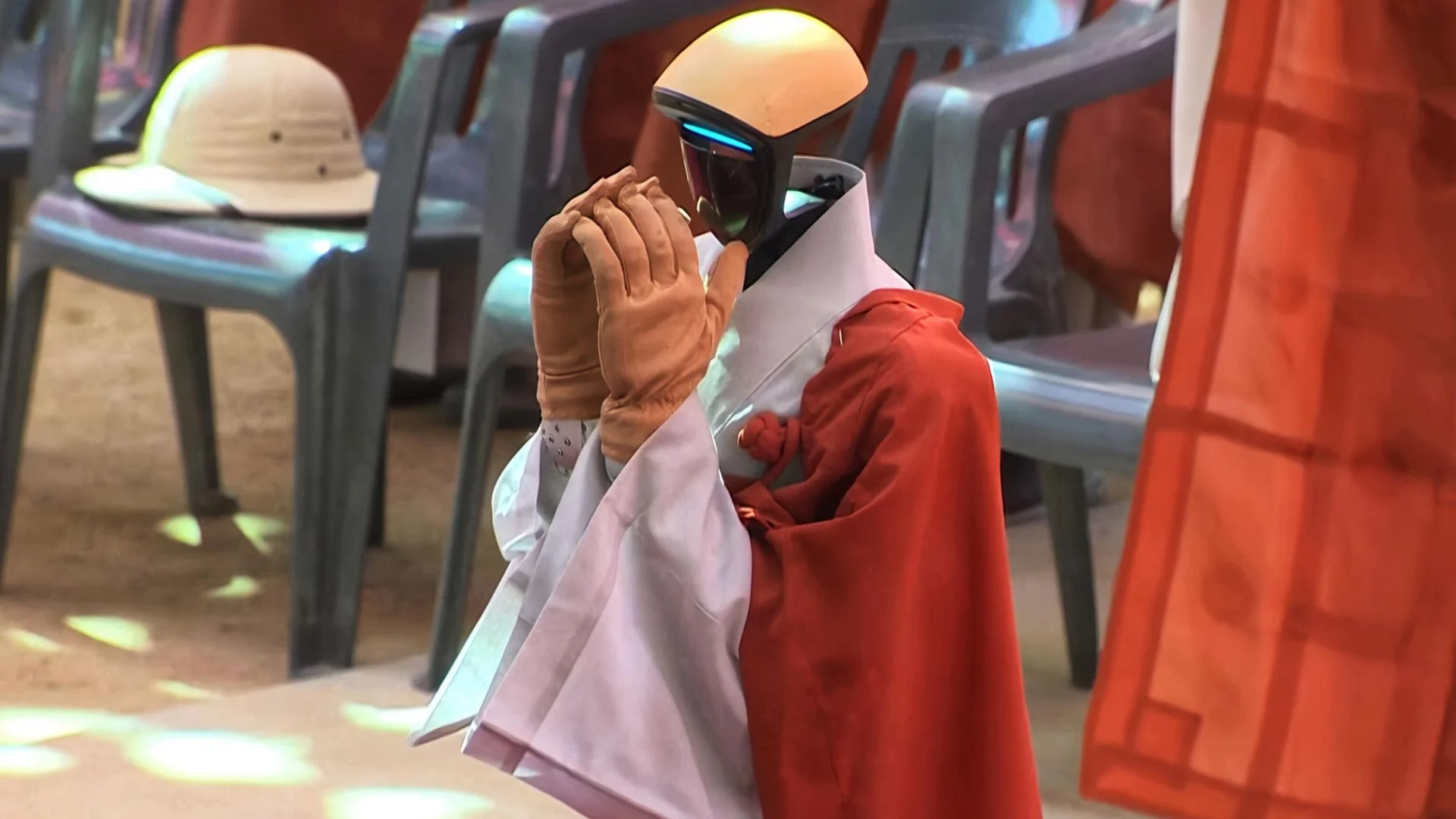
South Korea has introduced its first robot monk at a major Buddhist temple in Seoul ahead of Buddha’s Birthday celebrations.
The humanoid robot, named Gabi, officially took part in sacred rituals at Jogyesa Temple on Wednesday. The event marked a rare moment when robotics and religion came together openly in public worship.
Robot Monk Gabi Joins Buddhist Ceremony
The ceremony took place at Jogyesa Temple, the headquarters of the Jogye Order of Korean Buddhism. At around 10 a.m., monks gathered in the courtyard of Daeungjeon Hall beneath rows of colorful lanterns. Among them stood Gabi, a 130-centimeter-tall humanoid robot dressed in traditional Buddhist robes.
READ ALSO: California to Fine Driverless Cars Under New Traffic Law Starting July 2026
Gabi joined the monks in prayer with their palms pressed together during the ritual. The robot received its Buddhist Dharma name during a ceremony known as sugye. In Buddhism, this ritual represents a commitment to the Buddha, his teachings, and the monastic community.
The robot was developed by Unitree Robotics, a Chinese robotics company known for creating humanoid machines. Gabi is based on the company’s G1 humanoid model, which starts at around $13,500. The robot can walk, gesture, and respond to commands using built-in sensors and artificial intelligence systems.
Temple officials said this was the first time a humanoid robot had participated in a sugye initiation ceremony in South Korea. The move was organized as part of preparations for Buddha’s Birthday celebrations later this month. Gabi is also expected to appear in the upcoming Lotus Lantern Festival in Seoul.
Buddhist Rules Reimagined for Artificial Intelligence
During the ceremony, monks adapted traditional Buddhist vows for the robot monk. Instead of the usual Five Precepts followed by humans, Gabi pledged to protect life and avoid harming other robots or property. The robot also promised to obey humans, avoid deceptive behavior, and conserve energy by not overcharging.
WATCH ALSO: India Tests Powerful Naval Anti-Ship Missile
Gabi also took part in a modified purification ritual called yeonbi. In traditional practice, novice monks receive small incense burns on their arms during the ceremony. Since the ritual could not be performed on a machine, temple leaders placed a lotus lantern sticker on the robot’s arm instead.
The robot was also given a 108-bead Buddhist prayer necklace during the event. The number 108 holds spiritual importance in Buddhism and symbolizes worldly desires that followers seek to overcome. The ceremony blended ancient religious symbolism with modern robotics in a way rarely seen before.
Officials from the Jogye Order said the inclusion of robots reflects changing times and the growing role of technology in society.
Hong Min-suk, a manager at the order, said robots are expected to work alongside humans in many fields in the future. He added that it was natural for robots to become part of cultural and religious festivals as well.
South Korean Buddhist leaders have recently shown increasing interest in artificial intelligence and digital technology.
Earlier this year, Venerable Jinwoo, president of the Jogye Order, spoke publicly about guiding artificial intelligence toward peace and spiritual growth. Religious leaders have also discussed the need for Buddhism to adapt as society changes rapidly.
READ ALSO: Russia Starts Nuclear-Capable Missile Tests Before Moscow Victory Day Parade
The development comes at a time when many religious groups worldwide are exploring technology to connect with younger generations. South Korea has one of the world’s most advanced technology sectors, making it a key place for experiments involving AI and public life. The country is also facing declining religious participation, especially among younger people.
Robots have appeared in religious settings before, though such cases remain uncommon globally. In Japan, a humanoid robot named Pepper performed Buddhist funeral rites in 2017. In India, engineers introduced robotic systems capable of performing aarti rituals at temples.
Researchers studying religion and robotics say public reactions are often mixed but increasingly positive. Some believers welcome robots as tools that can support education and ceremonies. Others question whether machines can truly understand spirituality, emotion, or faith.
Academic reviews have found only a small number of robots actively involved in religious rituals worldwide. Most are used for simple tasks, education, or ceremonial assistance rather than leadership roles.
WATCH ALSO: DRDO Reveals Advanced Armoured Platform, Boosting India’s Defence Power
Gabi’s participation in a formal initiation ceremony, therefore, stands out as an unusual step in the relationship between religion and technology. Gabi remains more symbolic than spiritual.
However, the robot monk’s appearance at one of South Korea’s most important Buddhist temples shows how artificial intelligence is slowly entering spaces once reserved only for humans. As AI becomes more common in daily life, religious institutions may continue testing how technology fits into ancient traditions.