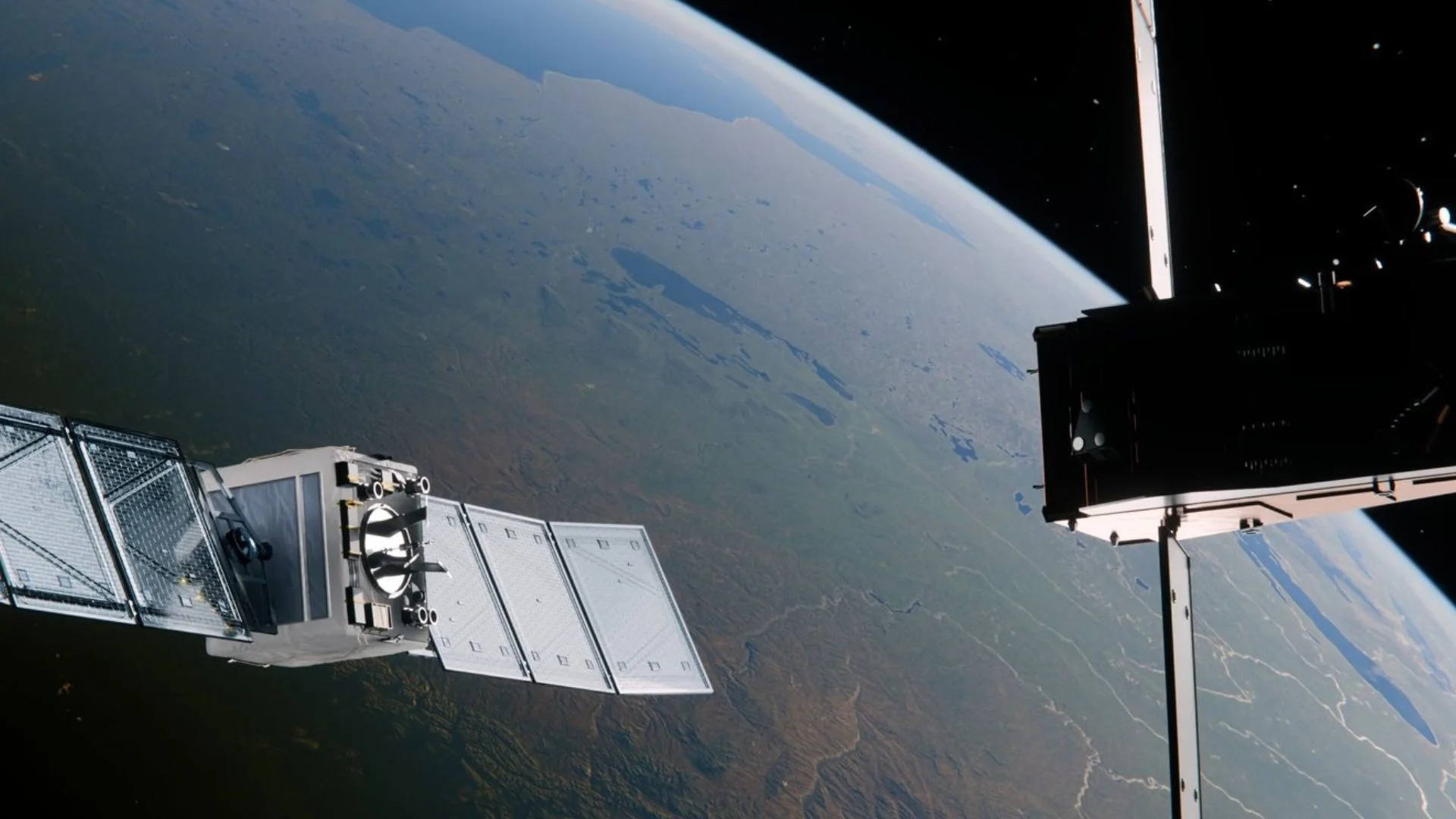
Flexcompute and Northrop Grumman have introduced a new AI-based system that changes how space missions are prepared.
The system uses advanced computing powered by NVIDIA to automate complex simulations. It focuses on predicting how spacecraft thrusters behave during docking operations.
This new method uses what experts call AI Physics models. These models can simulate real-world physics while learning from data. The goal is to make accurate predictions much faster than traditional systems.
One of the biggest challenges in space missions is understanding plume impingement. This happens when exhaust gases from a spacecraft thruster hit nearby surfaces. These interactions can generate strong forces and heat, affecting spacecraft stability.
READ ALSO: Forterra’s MESA Targets the Last Tactical Mile with Battlefield Autonomy
In space, gases expand rapidly due to the vacuum. This makes plume behavior hard to predict and even harder to test on Earth. Engineers have long relied on heavy simulations to study these effects.
Traditional methods require months of preparation before a mission. Engineers must run millions of simulations to gather enough data. This process is slow and demands massive computing resources.
The new AI Physics approach completely changes this. Instead of running endless simulations, the model learns from physics-based patterns. It can then make accurate predictions in just seconds.
This means mission preparation time can be reduced by up to 100 times. Engineers can move from planning to execution much faster. It also allows quicker adjustments during mission design.
WATCH ALSO: United Launch Alliance launches launches third batch of Amazon’s Project Kuiper satellites
The system is built using NVIDIA’s PhysicsNeMo framework. This open-source platform supports AI models designed for physics problems. Flexcompute enhanced it with custom designs and training methods.
These improvements help the model better understand complex plume interactions. The system also includes uncertainty estimation. This feature tells engineers how reliable each prediction is.
Reliable predictions are important for mission-critical decisions. Engineers need to trust the data when controlling spacecraft. The added layer of uncertainty makes the system more reliable.
Fahad Khan from Northrop Grumman says the company is pushing the limits of space technology. He says they are using physics AI to solve difficult simulation problems and speed up design. He adds that the partnership is helping deliver advanced space capabilities faster.
READ ALSO: Squire WIG Drone’s Low-Altitude 40-Knot Flight Signals New Way To Move And Fight
Vera Yang from Flexcompute highlights the strength of their approach. She says the company combines accurate physics with powerful AI models. She explains that this allows engineers to solve complex problems quickly and with confidence.
Tim Costa from NVIDIA points out the growing need for speed in space missions. He says traditional engineering cycles are no longer enough for modern demands. He explains that AI Physics turns long simulations into quick insights.
The benefits go beyond faster preparation. Better plume modeling leads to improved spacecraft control. It also allows for lighter designs and more efficient fuel use.
These improvements can extend mission lifetimes. They also support more sustainable space operations. Every efficiency gain matters on long-duration missions.
The new system also supports space robotics and docking tasks. These operations require precise control and fast decision-making. AI Physics makes both possible in real time.
WATCH ALSO: An unmanned boat has completed a long 1,100-nautical-mile voyage
This work shows how AI is changing engineering itself. Simulation is no longer just a support tool. It is becoming a central part of decision-making.
Flexcompute is positioning itself as a key player in this shift. The company focuses on solving complex physics problems using AI. Its tools aim to go beyond traditional simulation limits.
By combining physics, AI, and engineering, this approach sets a new direction for the industry. It opens the door to faster innovation and smarter designs. The future of space missions may depend on how quickly systems like this are adopted.