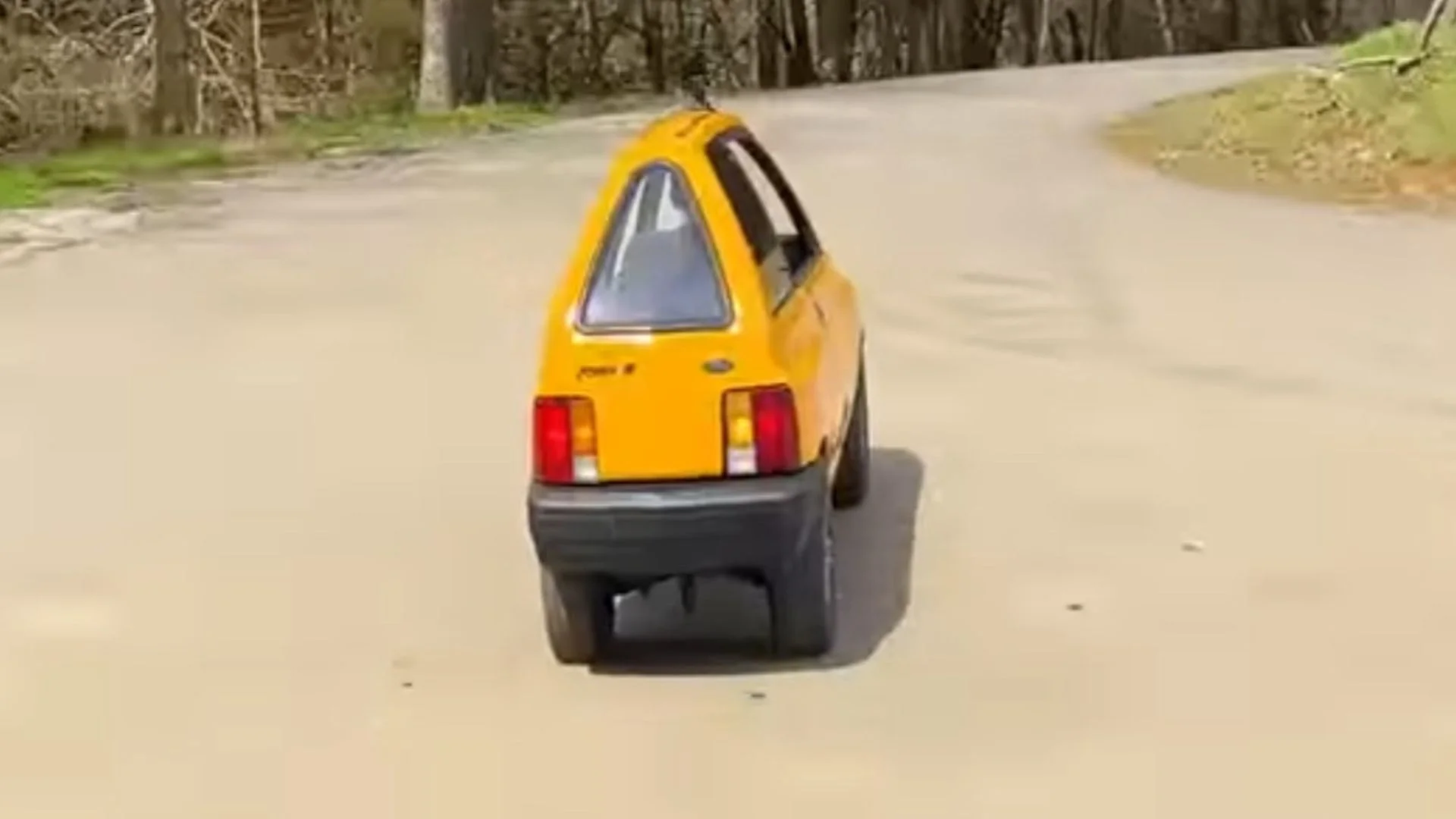
A YouTuber in Tennessee has built an extremely narrow car that looks almost unreal, turning a small hatchback into a machine barely wider than a shopping cart.
Even more surprisingly, the car actually runs on public roads.
The builder, Tyler Fever, is known for bold mechanical experiments on his YouTube channel. This time, he chose a tiny base vehicle and pushed its limits even further. The result is a strange but functional car that has captured wide attention.
The modified vehicle started as a Ford Festiva, already one of the smallest mass-produced cars. Fever’s goal was to make it even smaller and more unusual. He described the idea clearly, saying, “We are going to make it even smaller and more pathetic looking.”
READ ALSO: Sun and Water Alone? This Startup’s Hydrogen Idea Changes the Rules
The project began by removing everything inside the car. Fever stripped out the entire interior until only the outer shell remained. This created a blank base for extreme modification.
To make the process easier, he used liquid nitrogen. The freezing method made stubborn parts brittle, allowing them to be removed quickly. This step helped speed up the teardown process.
Next came the most interesting step. Fever used industrial lasers and CNC tools to cut the car straight down the middle. The equipment was so powerful that it sliced through metal and even marked the ground beneath.
Once the car was split, the challenge shifted to rebuilding it in a much narrower form. The original engine was too large to fit inside the reduced frame. This forced a complete rethink of the power system.
WATCH ALSO: This Microsoft AI Could Change Cancer Treatment Forever
Fever replaced the stock engine with a compact electric dirt bike motor. This motor provided enough power while taking up far less space. It also introduced a rechargeable battery system, improving efficiency.
The redesign created new mechanical challenges. The reduced width made it difficult to position basic controls. Every component had to be adjusted to fit within the tight structure.
One major issue involved the steering wheel. In the new layout, it blocked access to the brake pedal. Fever solved this by cutting the steering wheel in half.
The modified wheel created more space for movement. However, it also required the driver to adjust their posture while driving. Fever had to duck slightly and shift his body to steer properly.
The dashboard also needed changes to meet road requirements. Fever designed custom parts using 3D printing. These included mounts for lights, mirrors, and other safety features.
READ ALSO: Safran and MBDA Eye 2029 Delivery for France’s Next-Gen Thundart Rocket Artillery
The car runs a simple but effective electrical setup. A 12-volt battery powers essential systems like headlights and the horn. It also supports small features such as phone charging ports.
Despite its size, the car includes basic road equipment. Mirrors, lighting, and signaling systems are all present. This helps the vehicle meet street-use requirements.
The compact design does not eliminate comfort entirely. Fever managed to include two seats in the narrow body. The second passenger sits in a small space behind the driver.
After rebuilding the structure, the two halves of the car were joined together. The final shape was extremely thin but still stable enough to drive. A bright yellow paint job gave it a bold look.
Fever then tested the car on public roads in Nashville. The vehicle quickly drew attention due to its unusual size and shape. People stopped to watch as it moved through traffic.
The car handled city driving better than expected. It could turn, park, and move through tight spaces with ease. Its narrow body made it especially useful in crowded areas.
The car proved capable of handling basic driving conditions. Fever drove it across a major bridge and through busy streets. It showed surprising stability for such a modified build.
WATCH ALSO: From Ice to Innovation: US Coast Guard Deploys Drones in Antarctic Mission
Parking was one of its strongest advantages. The car could fit into extremely small spaces between larger vehicles. This highlighted a practical benefit of its unusual design.
Despite its limitations, the car functioned as a real vehicle. Fever emphasized this success, saying, “I am blown away by how well it drives on the street.” His statement reflects the unexpected performance of the build.
The project was completed in just a few weeks. It combined creativity, engineering, and unconventional tools. The result is a vehicle that challenges traditional design ideas.
While it may not be practical for everyday use, it demonstrates what is possible with innovation. The use of lasers, compact motors, and custom parts shows a new way of thinking. It also highlights the role of digital tools in modern vehicle modification.
Fever’s ultra-thin car stands as a unique experiment. It blends humor with serious engineering effort. Most importantly, it proves that even the strangest ideas can work when executed carefully.