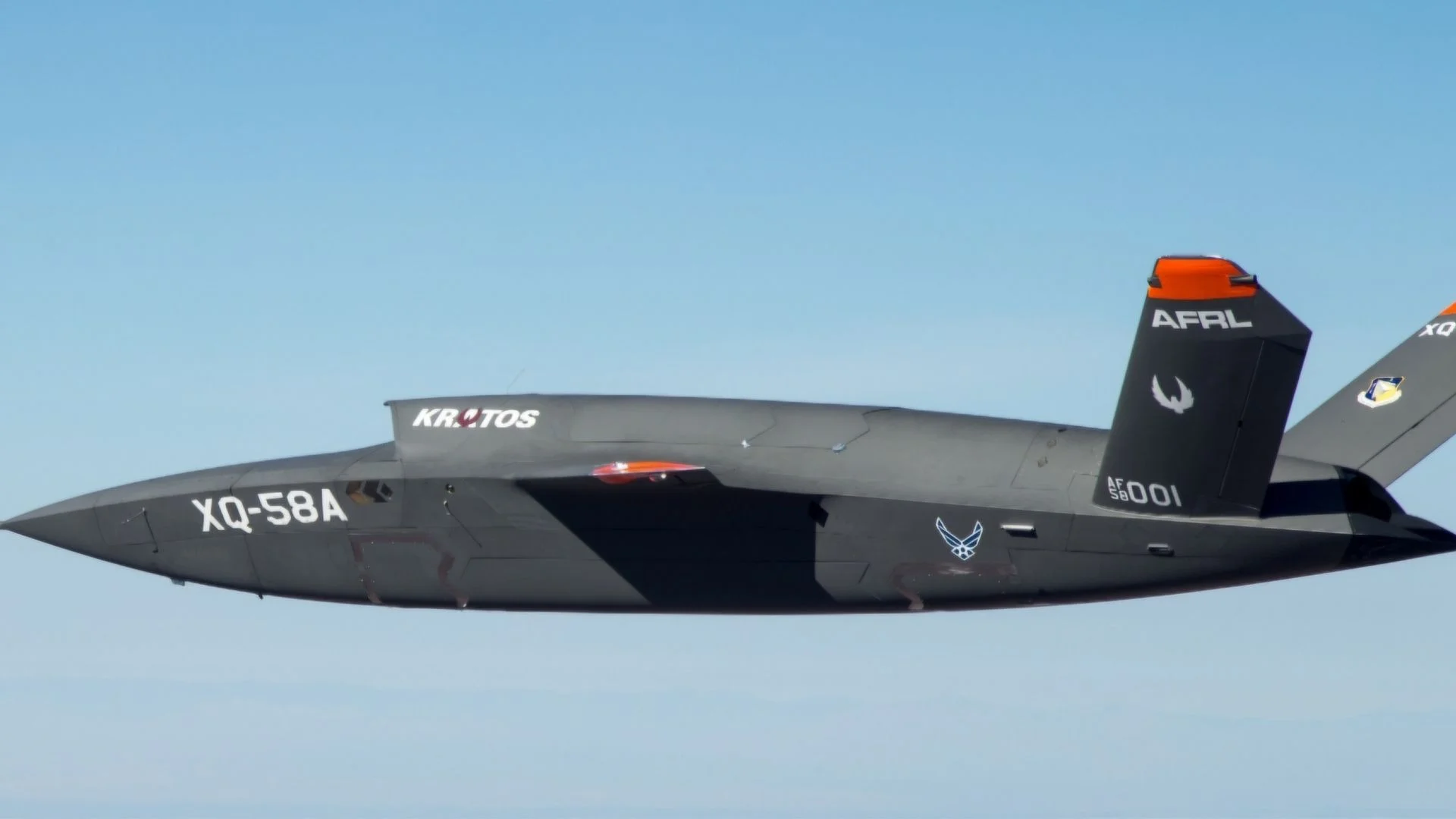
The US Marine Corps aims to field its first MQ-58 Valkyrie drones by 2029, featuring conventional landing gear for standard takeoff and landing operations.
This marks a major shift from earlier versions that relied on rocket-assisted launches.
The MQ-58 is part of the Marine Corps’ Collaborative Combat Aircraft program. These drones are designed to fly alongside crewed fighters and expand their combat power. The goal is to create a flexible and more lethal air combat system.
The program falls under the Marine Air-Ground Task Force Uncrewed Expeditionary Tactical Aircraft effort. This initiative focuses on integrating drones into Marine Corps operations. It aims to improve both air and ground mission effectiveness.
READ ALSO: Textron’s $9.5M Deal to Test F-15 EPAWSS Sensors Signals a New Electronic Warfare Era
Colonel Scott Shadforth explained that the goal is to increase the power of current and future aircraft. He said the program focuses on making aircraft more effective in high-threat environments. The MQ-58 plays a key role in achieving that vision.
The MQ-58 is based on the XQ-58 Valkyrie developed by Kratos. Earlier versions used rocket-assisted takeoff and lacked landing gear. The new version adds wheels, making it easier to reuse and operate more frequently.
Shadforth said the Marines want to turn the existing airframe into a conventional aircraft. He emphasized the need for higher sortie rates and better reusability. This change is expected to improve operational flexibility.
The Marine Corps has already tested earlier versions of the Valkyrie. These tests included multiple flights under a Pentagon-backed program. The results helped shape the current MQ-58 development path.
WATCH ALSO: Chinese company’s humanoid robot has mastered Webster flip, defies physics
Recent tests also included payload integration flights at China Lake. These tests focused on how the drone carries and uses different mission systems. They are important steps toward operational readiness.
The first flight of the conventional takeoff version is expected soon. Officials are targeting mid- to late summer for this milestone. This will mark a key transition in the program.
The ultimate goal is to deliver working prototypes by 2029. These drones will be sent to Marine Operational Test and Evaluation Squadron One. There, they will be tested in real tactical scenarios.
This unit will study how the MQ-58 fits into combat operations. It will also develop tactics and procedures for using these drones. This phase is critical for future deployment.
The MQ-58 is designed to work closely with F-35 fighter jets. It will act as a support platform, extending the reach and capability of manned aircraft. This teaming approach is central to modern air combat strategies.
The drone can carry a variety of payloads. These include electronic warfare systems, weapons, and sensors. This makes it highly adaptable for different mission types.
READ ALSO: Ursa Major’s Hadley Engine: 10 Flights That Put Hypersonic Tech on the Map
Initial focus is on electronic warfare missions. The Marine Corps sees this as a key role for the MQ-58. It can disrupt enemy systems and support friendly forces.
The drone also has space for internal and external weapons. It can carry small bombs, missiles, and other payloads. This gives it both defensive and offensive capabilities.
One of its strengths is its ability to launch other drones. These ‘launched effects’ can perform additional tasks during missions. This adds another layer of capability to the system.
Kratos is also working on a small cruise missile for the Valkyrie. This weapon can be carried inside the drone or under its wings. It further enhances the MQ-58’s strike potential.
The Marine Corps is also exploring other drone options. It is working with multiple companies to study future designs. These could include drones with short- or vertical-takeoff capabilities.
Shadforth said the Marines are interested in runway-independent systems. He explained that shorter takeoff distances open more operational options. This is especially important in remote or contested areas.
WATCH ALSO: A South Korean humanoid robot has performed Michael Jackson’s Moonwalk, leaving all viewers stunned
Even the new MQ-58 will retain some flexibility. It can still use rocket-assisted takeoff if needed. This allows it to operate in different environments.
However, it will still need a runway for landing. This is a trade-off for improved reusability and efficiency. The Marines believe this balance is worth it.
Future versions may remove the need for landing gear entirely. Some concepts include vertical takeoff and landing drones. These would offer even greater flexibility.
The Marine Corps is still studying how best to use these systems. Shadforth said there is no fixed solution yet. Much will depend on testing and real-world experience.
The MQ-58 will also work with other aircraft types. These include F-35 variants and older fighter jets. This ensures it fits into the broader military system.
The program is still in the prototype phase. The Marine Corps has not yet started full-scale production planning. But progress is steady and focused.
MUX TACAIR represents a major step forward for the Marines. It shows a clear commitment to integrating drones into combat roles. The MQ-58 is at the center of this effort.
READ ALSO: Solid state nuclear battery to offer 100-year longevity with low power consumption
By 2029, the Marine Corps hopes to have a working fleet of these drones. They will play a key role in future missions. Their impact on air combat could be significant.
The MQ-58 is more than just a drone. It is a platform that brings together speed, flexibility, and advanced technology. It represents the future of coordinated air warfare.
As testing continues, the Marine Corps will refine its approach. Each step brings it closer to operational deployment. The journey toward next-generation air combat is well underway.