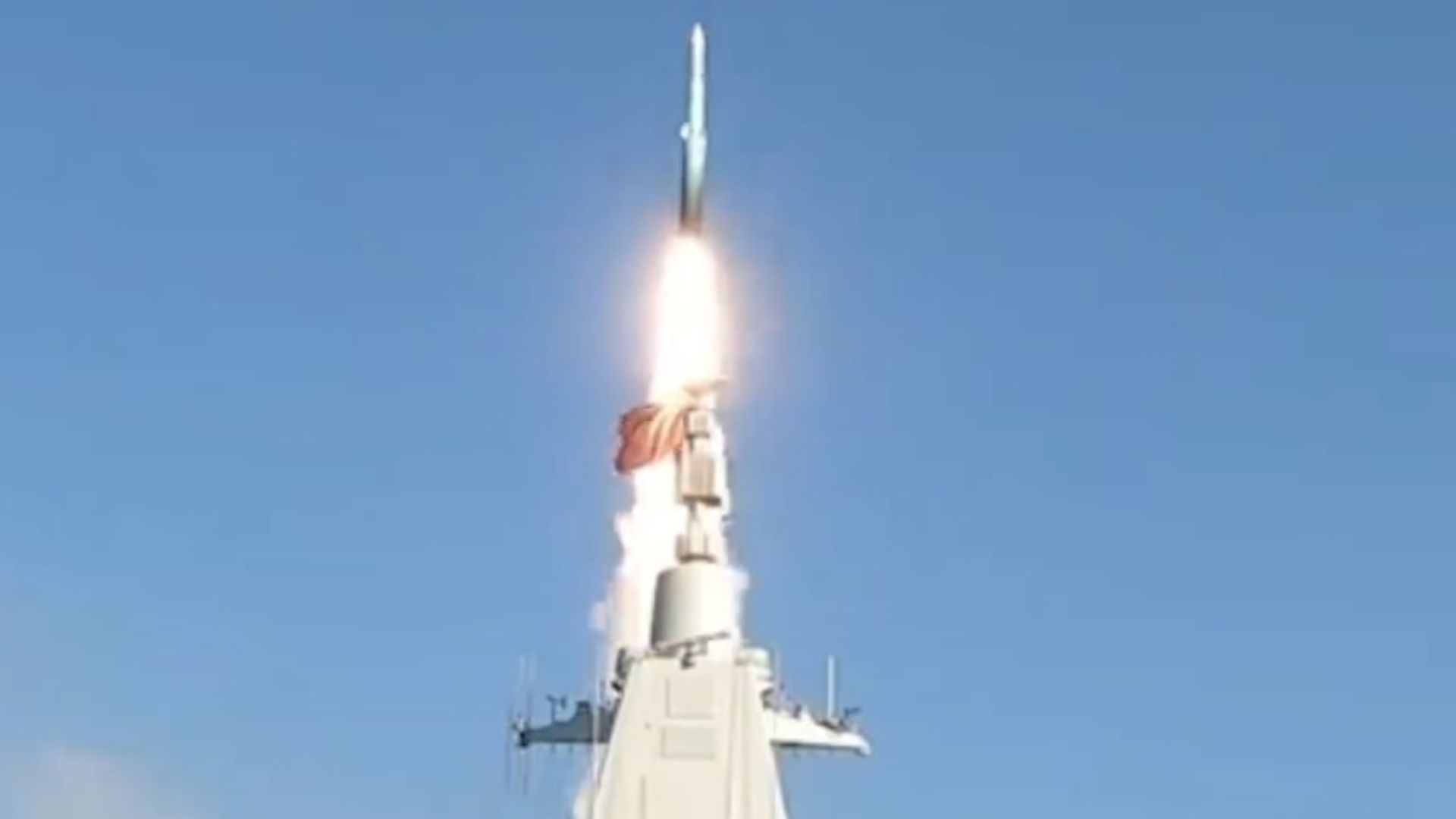
China has released new footage of its advanced hypersonic anti-ship missile, the YJ-20, amid rising military activity in the South China Sea.
The video appeared just as large-scale joint exercises led by the US, the Philippines, and Japan entered a critical phase near waters linked to Taiwan.
The footage was shared by a People’s Liberation Army-affiliated social media account, China Military Bugle. It showed multiple launches of the YJ-20 missile from naval platforms. The post did not confirm when or where the tests took place, but the timing has drawn attention.
The release came only two days after China confirmed that a naval group, led by the Type 055 destroyer Zunyi, had conducted live-fire drills and joint air-sea exercises east of Luzon. Luzon is a major island in the Philippines, located close to Taiwan, and a key strategic area.
READ ALSO: MIT Unveils Robotically Assembled Building Blocks Reshape Sustainable Construction Methods
Some visuals in the latest video appeared similar to earlier footage released in December, when another Type 055 destroyer, Wuxi, carried out YJ-20 test launches. However, the new clip also included fresh angles and sequences that had not been seen before.
China’s PLA Southern Theatre Command said the exercises were a direct response to the current regional situation. It stated that such operations were necessary given the growing military presence of foreign forces near China’s maritime boundaries.
At the same time, the annual Balikatan exercises began on April 20. This year’s drills are larger and more complex than before. They are scheduled to run for 19 days and involve forces operating in areas facing both the South China Sea and Taiwan.
For the first time, Japan has joined the drills in an operational role, rather than as an observer. This marks a major shift in regional military cooperation.
The Philippine military confirmed that the exercises include live-fire scenarios. One of these involves sinking a decommissioned vessel using anti-ship missile systems. Japan has deployed its Type 88 anti-ship missile system for this purpose.
WATCH ALSO: Researchers from German have developed a diving robot that can easily collect underwater waste
The Type 88 missile has a range of around 100 kilometers. According to Philippine Marine spokesman Colonel Dennis Hernandez, the missile will be used in a maritime strike exercise near sensitive waters close to Taiwan and the South China Sea.
China reacted strongly to Japan’s increased involvement. Earlier in April, the Japanese destroyer Ikazuchi sailed through the Taiwan Strait on its way to the drills. Beijing called this move a deliberate provocation.
Chinese analyst Yang Xiyu, from the China Institute of International Studies, said the PLA’s military exercises were justified. He told CCTV that China’s actions were a reasonable response to highly targeted foreign drills in the region.
Tensions remain high over Taiwan, which China considers part of its territory. Beijing has not ruled out the use of force to reunify the island. However, countries like the US, Japan, and the Philippines oppose any attempt to change the situation by force.
The South China Sea is another major flashpoint. China and the Philippines have had repeated maritime confrontations in recent years. Both countries claim parts of the disputed waters.
WATCH ALSO: World’s largest nuclear fusion research project ITER has reached a new milestone
The Type 055 destroyer, used in the recent Chinese drills, is one of the most advanced warships in China’s navy. It weighs more than 10,000 tonnes and is designed for long-range combat missions.
The YJ-20 missile is a key part of its strike capability. Also known as Eagle Strike-20, the missile was officially introduced during a military parade in Beijing marking the 80th anniversary of the end of World War II.
Experts believe the YJ-20 can hit targets at a range of 1,000 to 1,500 kilometers. It travels at hypersonic speeds, reaching around Mach 6 during cruise and up to Mach 10 in its final attack phase. This makes it extremely difficult to intercept.
Chinese military commentator Yue Gang described the missile as a mature and powerful system. He compared it with Japan’s Type 88 missile and highlighted the difference in speed.
READ ALSO: China’s Predator Micromotor Tracks Ocean Uranium Using Light for Nuclear Fuel
He said the Type 88 has basic anti-ship capabilities but only operates at subsonic speeds. In contrast, the YJ-20 moves several times faster, giving it a major advantage in modern naval warfare.
As military drills continue and new weapons are displayed, the situation in the region remains tense. The overlap of exercises, missile tests, and strategic messaging shows how quickly competition in these waters is intensifying.