Russia’s S-71K Kovyor missile highlights a new strategy that blends stealth design with low-cost production for modern aerial warfare.
New details about the missile have been released by the Ukrainian Ministry of Defense through its intelligence arm, the Main Directorate of Intelligence (GUR). The agency has shared new technical insights, including an interactive 3D model that offers a closer look at how the missile is built and operates.
According to the GUR, the S-71K has already been used in combat since late last year. Its deployment signals Russia’s growing need for weapons that are cheaper and easier to produce in large numbers, especially as the war in Ukraine continues to strain existing stockpiles.
The missile is believed to have been developed for the Sukhoi Su-57, Russia’s most advanced stealth fighter. The GUR says the project also marks a new step for United Aircraft Corporation, which is traditionally known for building aircraft rather than missiles.
READ ALSO: NASA MoonFall Drones Aim To Cover 30 Miles Each At Lunar South Pole By 2028
At the core of the S-71K is a design that blends old and new ideas. One of its most striking features is its warhead. Instead of creating a completely new system, engineers adapted the OFAB-250-270, a Cold War-era high-explosive fragmentation bomb. This bomb weighs approximately 551 pounds and is integrated directly into the missile’s structure.
This reuse of older technology helps reduce cost and speeds up production. It also shows how Russia is combining existing resources with modern design techniques to meet current battlefield demands.
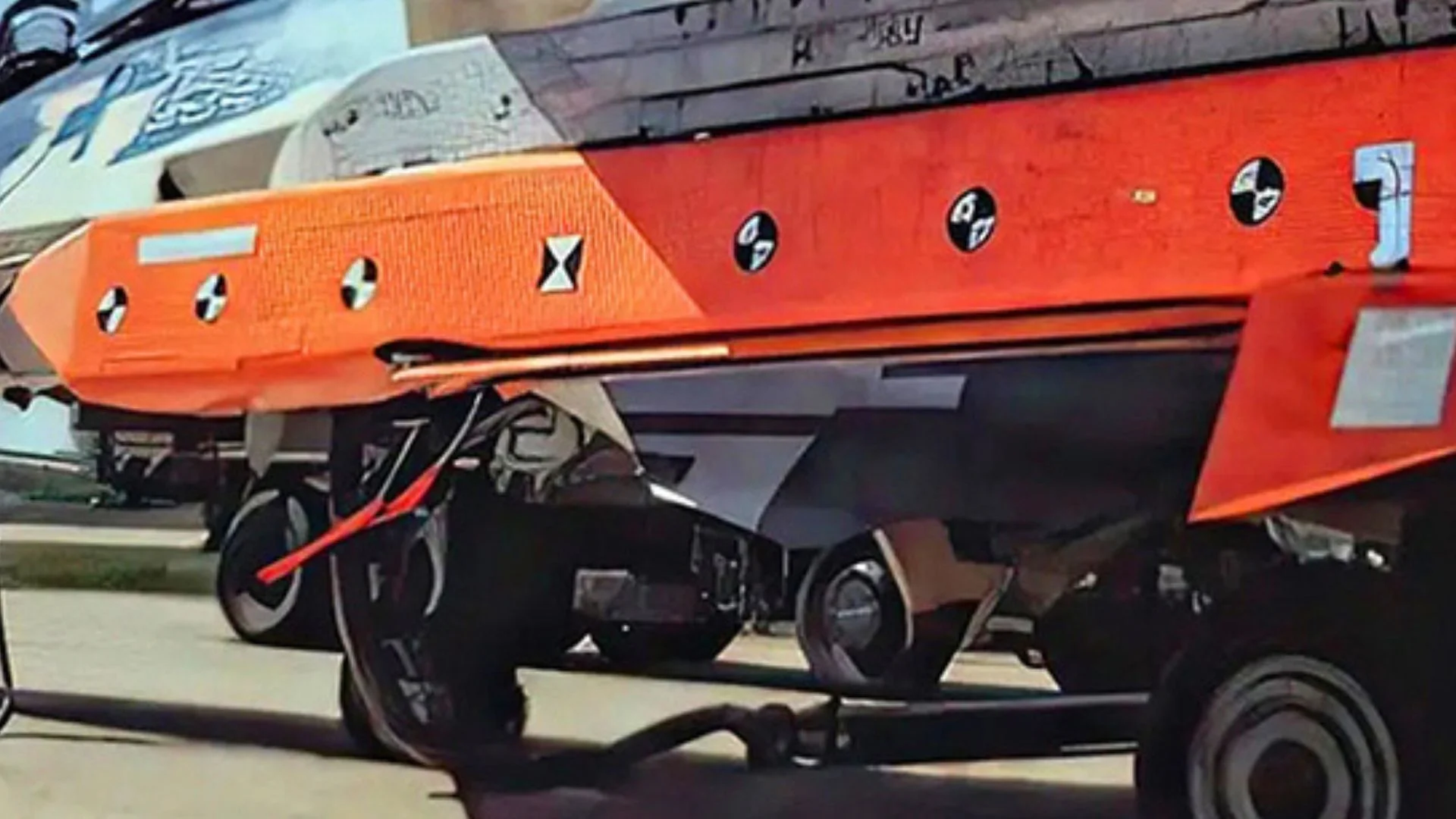
The missile’s outer body is designed to reduce its radar visibility. It uses a multi-layer fiberglass structure, strengthened with aluminum parts. Its shape is carefully designed to deflect radar signals. The airframe has a trapezoidal cross-section, a sharply angled nose, and swept wings that deploy during flight. It also features an inverted V-shaped tail.
Images of wreckage have revealed more details. The missile includes a top-mounted engine intake that blends into the body. The intake feeds air into a compact duct, helping maintain a low profile. However, experts note that the missile does not appear to use advanced radar-absorbing coatings. This again points to a design that balances stealth with affordability.
WATCH ALSO: Drum-shaped antenna reflector on NASA-ISRO NISAR satellite deployed
Powering the S-71K is a small R500 turbojet engine, also produced by United Aircraft Corporation. This engine allows the missile to cruise at around Mach 0.6. It can fly up to 27,000 feet, giving it flexibility across different combat scenarios.
The missile carries fuel in three internal tanks. Based on Ukrainian assessments, it has a range of up to 186 miles. While this is shorter than some long-range cruise missiles, it is enough for tactical missions when launched from aircraft closer to the target.
Navigation is handled by an inertial navigation system based on basic sensors. This system likely works in conjunction with satellite navigation to guide the missile to its target. While not highly advanced, this approach keeps costs low and allows for mass production.
One of the key concerns raised by Ukrainian officials is the missile’s reliance on foreign components. Most of the electronic components in the S-71K are sourced from outside Russia. These include components made in countries such as China, Germany, Ireland, Japan, Switzerland, Taiwan, and the US.
The agency states, “Continued access to foreign technologies and components allows the aggressor state to develop new weapons and scale their use in the war against Ukraine.” This highlights ongoing challenges in restricting the flow of dual-use technologies.
READ ALSO: Unitree Unveils a Skating, Flipping Robot That Moves Like It Has a Mind
The S-71K is not the only Russian weapon found to include foreign parts. Similar findings were reported in systems like the Shahed-136 drone and the Sukhoi S-70 Okhotnik-B unmanned combat air vehicle.
Reports suggest that the S-71 program has undergone major changes since its conception. In 2024, the Russian Ministry of Defense approved production after design updates. These changes were based on lessons learned from the war in Ukraine. They included improving range and reducing radar visibility to increase survivability.
Although the S-71K is closely linked to the Su-57, it is likely to be used on other aircraft as well. This would be necessary if Russia wants to deploy the missile in large numbers. Tests have already been conducted, including captive-carry trials in April 2024 at the Zhukovsky Flight Research Center.
There are also plans to integrate the missile with unmanned systems. The S-70 Okhotnik-B drone is expected to carry versions of the S-71 in the future. This would expand the missile’s role in both crewed and uncrewed operations.
Alongside the S-71K, a more advanced variant is under development. Known as the S-71M ‘Monokhrom,’ this version is described as a guided weapon with human-in-the-loop capability. This means an operator can adjust its path during flight, allowing it to hit moving targets.
The S-71M is expected to include electro-optical sensors for both day and night use. It may also carry different types of warheads, including high-explosive and shaped-charge options. Unlike the S-71K, it may be stored inside the internal weapons bays of stealth aircraft.
There have been unconfirmed reports that the S-71M was used in an attack on a Ukrainian HIMARS launcher earlier this year. However, Russian sources claimed that a different weapon carried out that strike.
Another related development is the Izdeliye 30 missile. This system has a much longer range of over 930 miles, but does not focus on stealth. It is designed as a lower-cost alternative to larger cruise missiles, such as the Kh-101 and Kh-555, which are used by heavy bombers.
WATCH ALSO: NASA rover discovered ancient microbial life signature on Mars
These weapons show a clear trend. Russia is building a mix of missiles that trade some advanced features for lower cost and faster production. This approach allows for larger stockpiles and sustained operations over time.
The S-71K fits into this strategy as a tactical weapon. Its moderate range is balanced by its stealth features and compatibility with advanced aircraft. It also offers a more affordable option compared to missiles like the Kh-69.
For Ukraine, the arrival of the S-71 series adds another layer of difficulty. Its air defense systems are already under pressure, and the introduction of new, harder-to-detect missiles increases the challenge.
As the conflict continues, the focus on scalable, cost-effective weapons is becoming increasingly important. The S-71K is a clear example of this shift, combining simple systems, reused components, and stealth shaping into a weapon designed for modern warfare.