A new study from the Massachusetts Institute of Technology (MIT) suggests that robotically assembled building blocks may transform how structures are built, making construction faster, more efficient, and far more sustainable.
Researchers explored a new method that uses small modular units, known as voxels, to construct buildings.
These voxel-based systems rely on robotic assembly rather than traditional construction techniques. The study shows that this approach can significantly reduce carbon emissions while maintaining strength and durability.
The research team carried out a detailed feasibility study. They tested whether a simple building made from these interlocking subunits could perform well in real-world conditions. Their findings indicate that the system is not only practical but also environmentally beneficial.
READ ALSO: Doughnut Airship Redefines Flight With Silent, Precise Design Twist
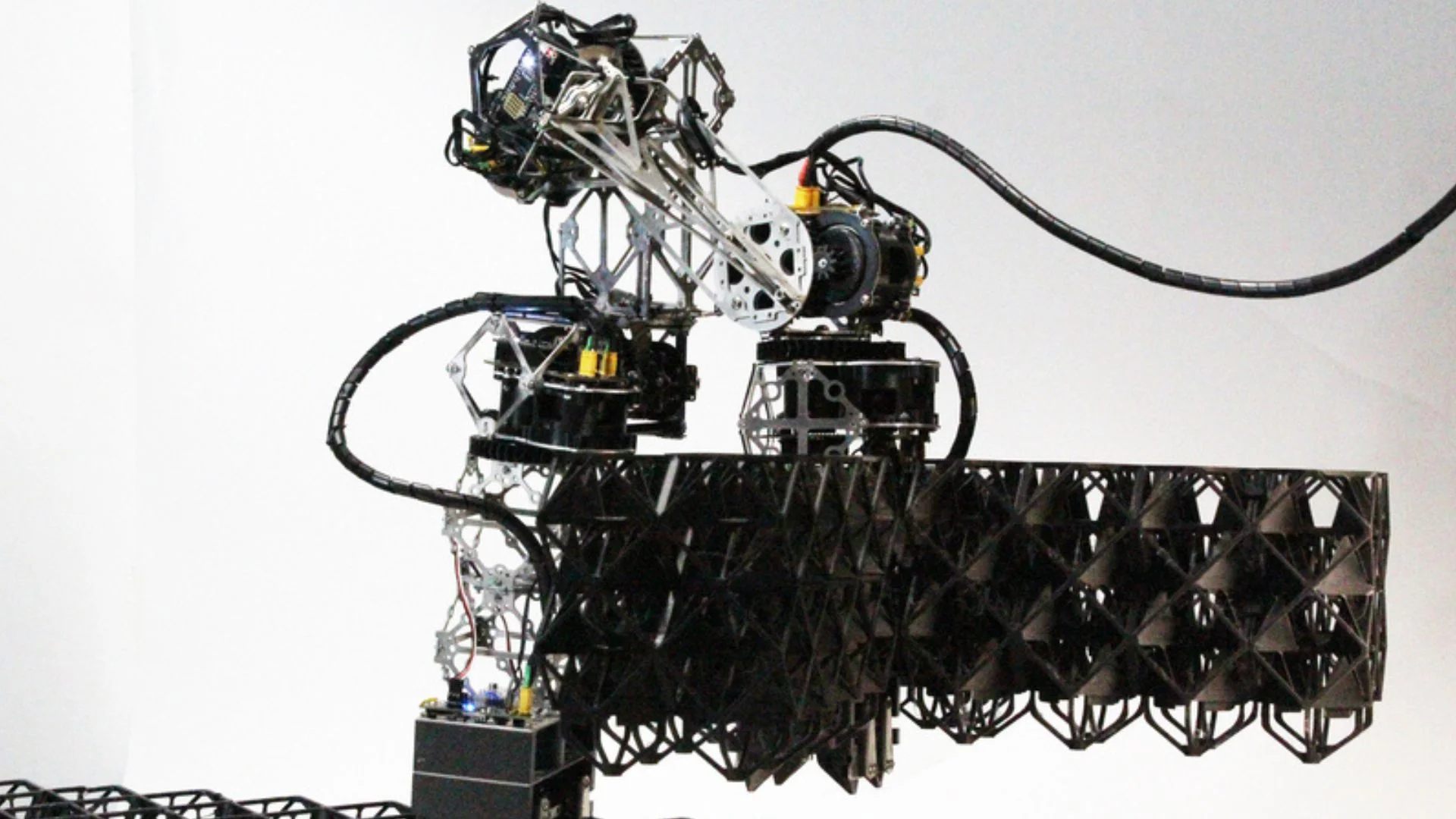
At the core of this approach are voxels, three-dimensional building blocks that fit together to form strong lattice structures. These units can be combined to create complex shapes, much like assembling a puzzle.
The researchers evaluated eight existing voxel designs. These included shapes like cuboctahedrons made from glass-reinforced nylon and Kelvin lattice structures made from steel. After studying their performance, the team created three new voxel designs.
These new designs use an octet lattice geometry. This structure offers high strength and stiffness while allowing the blocks to align themselves during assembly. The interlocking feature eliminates the need for many connectors, speeding up the building process.
Miana Smith, a graduate student at MIT and the lead author of the study, highlighted the system’s advantages. She said, “I am particularly excited about how robotic assembly can help us build more efficiently and sustainably.”
The research was conducted at MIT’s Center for Bits and Atoms, where scientists have been working on voxel-based construction for several years. Their earlier work involved industries such as aerospace, collaborating with companies including NASA, Airbus, and Boeing.
WATCH ALSO: Researchers from German have developed a diving robot that can easily collect underwater waste
Senior researcher Neil Gershenfeld explained the inspiration behind the project. He said, “We are applying aerospace principles to buildings. We should aim to construct buildings as efficiently as we build airplanes.”
To bring this idea to life, the team also developed a robotic system. These robots, called Modular Inchworm Lattice Assemblers (MILAbots), move across structures by anchoring and extending their bodies, much like an inchworm.
Each robot uses grippers to pick up voxel blocks and place them accurately. The system allows the robots to snap the pieces into place and ensure proper alignment. Smith explained, “The robots can drop the blocks into position and step on them to lock them together.”
The team also created a user-friendly software interface. This system allows users to design a structure digitally or input a layout. The software then calculates the robots’ movement paths and sends assembly instructions.
One of the most important findings of the study relates to sustainability. The researchers measured the embodied carbon of the voxel system. Embodied carbon includes all emissions generated during the production and use of building materials.
READ ALSO: Pentagon Eyes Foreign Warship Design Plan As US Navy Production Strains Deepen
The results showed major environmental benefits. The system can reduce embodied carbon by up to 82 percent compared to common methods such as 3D concrete printing, precast concrete, and steel framing.
Material choice plays a key role. The researchers tested voxels made from plastic, plywood, and steel. Plastic performed poorly on sustainability. However, steel and wood-based voxels showed strong environmental performance.
Steel voxels required only 36 percent of the carbon emissions of 3D concrete printing and 52 percent of precast concrete. Plywood performed even better, requiring just 17 percent and 24 percent, respectively.
Smith noted that plastic-based options may still work in the future. She said researchers need to choose materials and designs more carefully to improve sustainability.
The system also offers time-saving advantages. The team estimated that constructing a one-story building with voxel assembly would take around 99 hours. Traditional methods, in comparison, average about 155 hours.
Speed improves when multiple robots work together. A single robot is slower than conventional methods. But a group of 20 robots working simultaneously can match or exceed current construction speeds while keeping costs lower.
Another advantage is flexibility. Builders can expand structures easily by adding more voxels. They can also take apart and reuse the blocks if needed. Gershenfeld said, “You can start building and keep adding to it. If needs change, you can disassemble and rebuild.”
WATCH ALSO: World’s largest nuclear fusion research project ITER has reached a new milestone
The researchers also emphasized that several challenges remain. They need to study long-term durability, fire resistance, and how these structures perform under different conditions, such as strong winds or earthquakes.
The next phase of the project will test the system at a larger scale. The team plans to use a facility in Bhutan, where a super fab lab has been set up to produce and test the robots for building a sustainable city.
Thomas Heatherwick, founder of Heatherwick Studio, praised the idea. He said, “This work shows how buildings might one day assemble themselves with small robots.”
The research, published in the journal Automation in Construction, highlights a promising direction for the future of construction. By combining robotics, smart design, and modular systems, robotically assembled building blocks may redefine how cities are built.