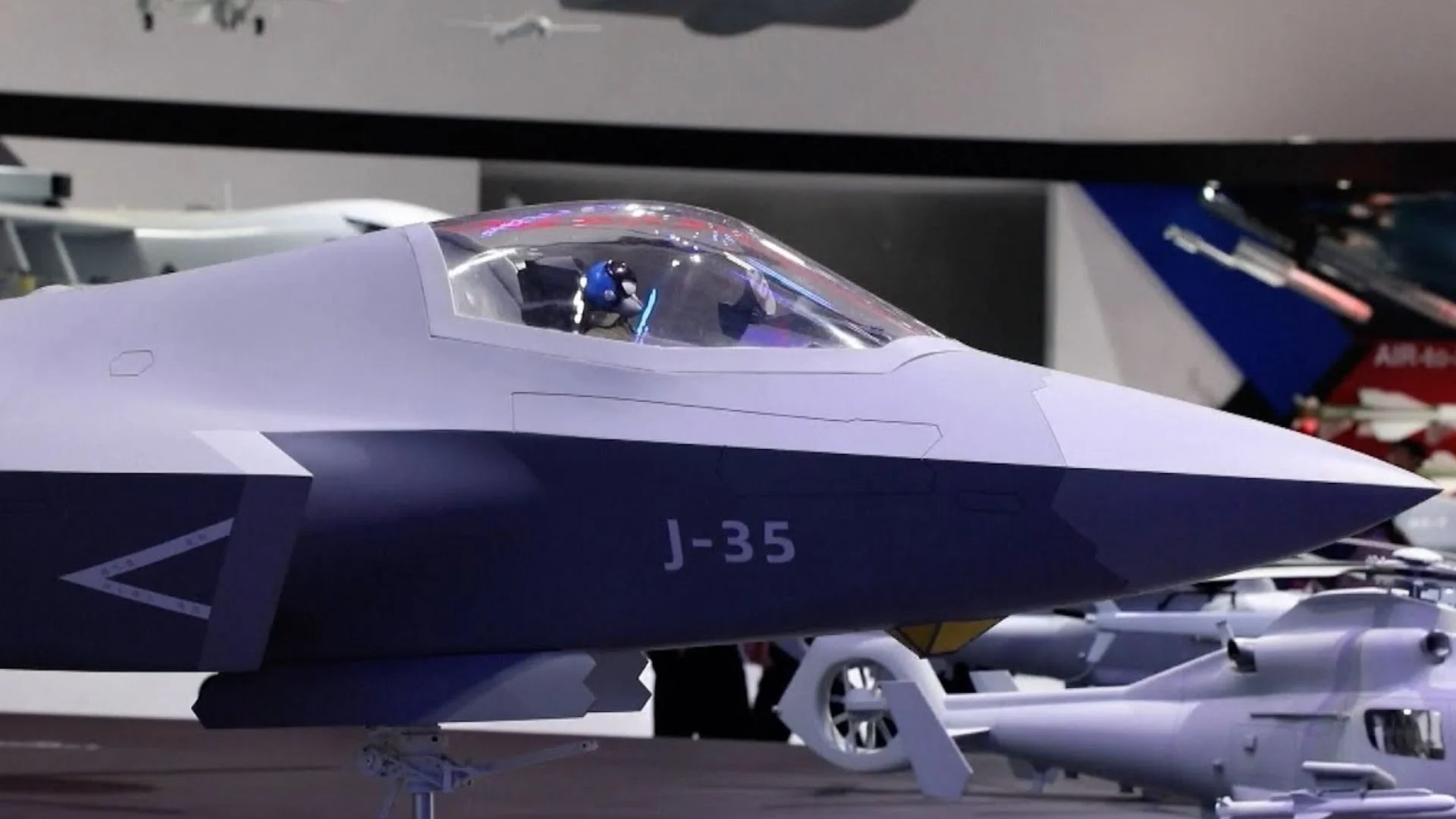
China has officially named its carrier-based J-35 stealth fighter Blue Shark, signaling the jet’s transition toward operational deployment in naval service.
This move signals that the jet is no longer just in development. It is steadily moving toward real operational use within China’s naval air force.
The aircraft is designed to operate from aircraft carriers. It brings stealth capability to China’s expanding naval fleet. By naming it publicly, China is showing confidence in the program’s progress. It also highlights a wider effort to strengthen air power at sea.
The J-35 program reflects a clear goal. China wants a modern fighter that can survive in contested airspace. It also wants a jet that can extend strike range from its carriers. The ‘Blue Shark’ is expected to play a key role in that plan.
READ ALSO: Unitree Unveils a Skating, Flipping Robot That Moves Like It Has a Mind
The nickname follows a pattern within the PLA Navy. Carrier-based aircraft often carry shark names. The older J-15 is called the Flying Shark, while the electronic warfare version, J-15D, is known as the Electric Shark. The new J-35 fits neatly into this naming tradition.
The name Blue Shark did not appear suddenly. It had been seen earlier on a patch at the Zhuhai Airshow in 2024. References to the name had also circulated informally since 2022. This shows that the designation had already been in use internally for years.
The aircraft itself has been slowly stepping into the public eye. Photos have shown jets with naval markings. However, these aircraft do not yet carry full operational squadron numbers. That detail suggests they are still in testing or in early deployment.
By mid-2025, multiple J-35 airframes were seen in production and flight testing. This marked a shift from prototype work to early manufacturing. The program appears to have entered a low-rate production phase. This stage usually supports training, testing, and system integration.
WATCH ALSO: US firm successfully demonstrates ship-based Sea Launcher for autonomous underwater vehicle ops
The origins of the J-35 go back more than a decade. It evolved from the FC-31 prototype, which first flew in 2012. A second prototype followed in 2016 with improved design features. These included a redesigned structure and more powerful engines.
The naval version of the J-35 made its first flight in October 2021. This version includes key changes for carrier use. These include folding wings, a reinforced landing gear, and a catapult launch bar. Each feature is essential for operating from a carrier deck.
A land-based version, known as J-35A, appeared later. It first flew in September 2023. This version is lighter and lacks carrier-specific hardware. It was publicly shown at the Zhuhai Airshow in 2024.
Both variants were displayed during a major military parade in Beijing in 2025. This marked their formal entry into China’s military inventory. However, full operational deployment is still in progress. The aircraft is not yet widely assigned to combat units.
The J-35 is a medium-weight stealth fighter. It uses a twin-engine design and a single-seat cockpit. Its shape and structure are built to reduce radar visibility. This helps it operate in high-risk environments.
READ ALSO: Handle With Care: This Robot Gripper Picks Ripe Fruit by Touch Alone
The aircraft includes internal weapons bays. These allow it to carry weapons without increasing the radar signature. It also uses diverterless supersonic intakes and hidden engine ducts. These features further reduce detectability.
Carrier-specific modifications set the naval version apart. Folding wings help save space on crowded decks. A twin-wheel nose landing gear supports catapult launches. An arrestor hook allows safe recovery after landing.
The jet is designed to work with modern carrier systems. It can operate from the Type 003 aircraft carrier Fujian, which uses electromagnetic catapults. It may also operate from older carriers, such as Liaoning and Shandong. This flexibility increases its value to the fleet.
In terms of performance, the J-35 has a reported maximum takeoff weight of about 30,000 kg. Its combat radius is around 1,200 kilometers on internal fuel. These figures place it in the same general class as the F-35C.
WATCH ALSO: Top research robot integrated with new intelligence platform
The aircraft’s weapons system is designed for both air combat and strike missions. Internally, it can carry air-to-air missiles such as the PL-10 and PL-15. These cover short-range and beyond-visual-range engagements. A longer-range missile, PL-21, is also expected to be integrated.
For strike roles, the J-35 can carry precision-guided bombs. It can also handle penetration munitions for hardened targets. Anti-ship and anti-radiation weapons may be used in limited internal configurations.
Externally, the aircraft has six additional pylons. These allow it to carry more weapons when stealth is less critical. In total, it can handle a payload of around 8,000 kg. However, external loads increase radar visibility.
Engine development remains a key challenge. Early prototypes used Russian RD-93 engines. These were later replaced by Chinese WS-13E engines. These provide improved efficiency and around 87 kN of thrust.
More advanced versions of the engine have been tested. These include variants producing around 93 kN of thrust. The final goal is the WS-19 engine. It is expected to deliver thrust between 110 and 116 kN.
As of late 2025, the WS-19 has not been fully deployed on production aircraft. Different engine types may still be in use across test units. This suggests that engine development is still ongoing. It also affects overall readiness.
READ ALSO: Pentagon’s Seals $276M AUKUS Submarine Deal: One Condition Changes Everything
Carrier operations place high demands on engines. They must handle repeated stress during launch and recovery. This makes reliability a critical factor. It is likely that newer engines will first be proven on land-based versions.
Production activity shows steady progress. Aircraft with serial numbers have been linked to test units. Assembly lines in Shenyang have produced multiple airframes. These signs point to an active manufacturing phase.
Despite this progress, production remains limited. The program is still in a low-rate stage. This means output is controlled and focused on evaluation. Full-scale production has not yet begun.
Estimates suggest that over 57 units had been produced by late 2025. This is a modest number compared to mature programs. For example, the F-35 Lightning II has delivered over 1,200 units globally. The gap highlights differences in scale and experience.
The J-35’s real strength will depend on integration. A stealth fighter alone does not guarantee effectiveness. It must work with radar systems, data links, and surveillance assets. Carrier strike group coordination is also essential.
China appears to be following a parallel development strategy. Both naval and land-based versions are developed together. This approach helps reduce risk. It also speeds up overall progress.
WATCH ALSO: Skid AI to boost development of its robotic intelligence platform, raises USD 1.4 billion
The land-based J-35A is likely a test platform. It allows systems to be refined without the complexity of carrier operations. Lessons learned can then be applied to the naval version. This improves efficiency.
Looking ahead, the J-35 Blue Shark is advancing toward initial operational capability. It is not yet fully deployed, but it is no longer just a prototype. The aircraft represents a major step in China’s naval aviation ambitions.
As production grows and systems mature, its role will expand. The J-35 is expected to become a core part of China’s carrier air wings. Its development reflects a broader push to project power across maritime regions.
The Blue Shark may still be in its early phase, but its direction is clear. It is built for stealth, reach, and flexibility. And with each step forward, it is becoming a more visible part of China’s evolving military strategy.