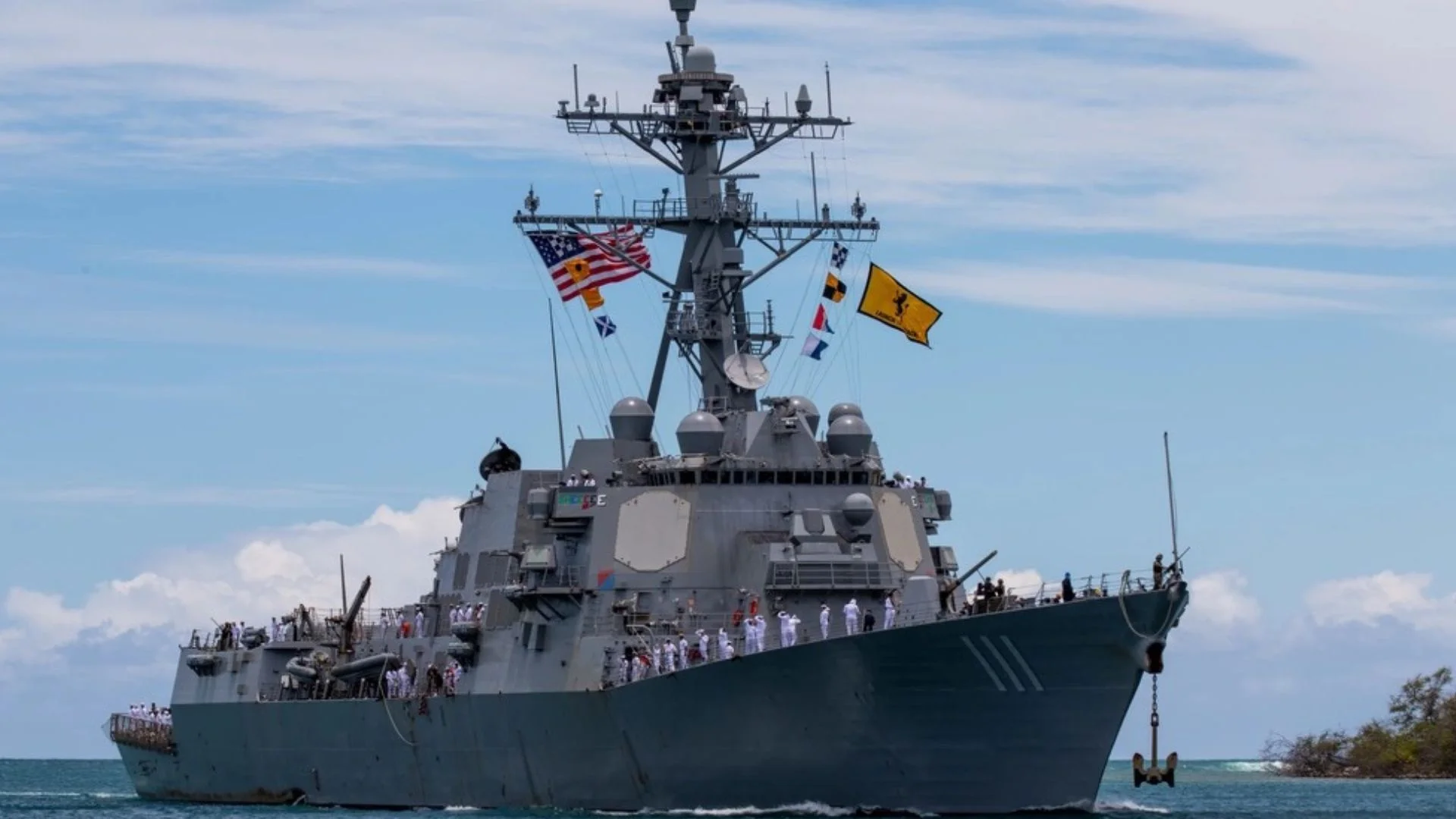
For the first time in nearly four decades, the US Navy used a main deck gun against another vessel when, on Saturday, the guided missile destroyer USS Spruance fired on the Iranian cargo ship Touska.
Such actions are extremely uncommon in modern naval warfare. The last confirmed case occurred on April 18, 1988. That day, US forces engaged Iranian naval units during Operation Praying Mantis in the Persian Gulf.
According to a US Navy official, that earlier event remains the most recent clear example before this new incident. In 1988, American warships exchanged fire with Iranian vessels in a direct and intense confrontation.
During Operation Praying Mantis, three US Navy ships took part in a coordinated attack. These included the guided missile cruiser USS Wainwright, the destroyer escort USS Bagley, and the frigate USS Simpson. Together, they formed a Surface Action Group, SAG Charlie.
READ ALSO: Hidden Threat In Soil: How Microplastics Are Affecting Your Everyday Food Crops
The target was the Iranian fast attack craft IRIS Joshan. The Iranian vessel ignored multiple warnings. It then launched a Harpoon missile toward the American ships. The missile missed its target.
The US response was swift and powerful. American ships fired both missiles and deck guns. Wainwright and Bagley used their 5-inch guns. Simpson fired its 3-inch gun. Combined missile strikes and gunfire left the Joshan heavily damaged and burning. It was eventually sunk.
Operation Praying Mantis was part of a larger mission called Operation Ernest Will. This mission began in 1987 during the final phase of the Iran-Iraq War. At that time, both Iran and Iraq were attacking oil tankers in the Persian Gulf.
To protect shipping, the US reflagged Kuwaiti oil tankers under the American flag. This allowed US Navy ships to escort them safely through the region.
However, tensions escalated quickly. In July 1987, during one of these escort missions, a ship struck a naval mine. The situation worsened months later when the USS Samuel B. Roberts hit an Iranian mine.
WATCH ALSO: United States is considering to conduct air strikes against drug cartels in Venezuela
The explosion caused severe damage. The blast tore a massive hole in the ship’s hull. Ten sailors were badly injured. Some suffered serious burns. The ship’s commander, Paul X. Rinn, was also hurt.
Despite the damage, the crew managed to save the ship. Their efforts became a powerful example of discipline and training under pressure. The ship did not sink.
The US responded forcefully. Operation Praying Mantis became the largest US Navy surface battle since World War II. It was also the only time the US Navy exchanged anti-ship missile fire directly with an enemy.
During the one-day operation, US forces destroyed two Iranian surveillance platforms. They sank two Iranian ships and severely damaged another. The outcome had a strong impact.
Military analysts later noted that Iran reduced its attacks on merchant vessels after this operation. The show of force appeared to change the course of events in the region.
Now, nearly 38 years later, the USS Spruance incident has drawn attention for its similarities and differences. Unlike the 1988 battle, the Touska was not a warship. It was an unarmed cargo vessel. Reports say the ship attempted to evade a US Navy blockade on Iranian ports.
READ ALSO: Sewage Sludge Treatment Secret Turns Waste Into Gas, Cuts Costs, Boosts Output 200%
The USS Spruance used its 5-inch MK 45 deck gun during the encounter. The gunfire struck the ship’s engine room. The damage forced the vessel to stop.
However, the Touska did not sink. US forces boarded the ship and took control of it. The crew was also detained.
This situation stands in sharp contrast to the events of 1988. Back then, the US Navy was facing armed opponents in open combat. Today’s incident involved a civilian vessel during a tense standoff.
Another key difference lies in the broader military situation. In 1988, Iran still had several large naval assets. Now, much of its navy has been weakened in ongoing conflicts.
Recent operations have reportedly destroyed many of Iran’s larger ships. What remains is mostly a collection of smaller, fast attack craft. These vessels do not pose the same level of threat as frigates like the Joshan once did.
The political impact of the two events also differs. Operation Praying Mantis led to a decrease in Iranian aggression at sea. It helped stabilize shipping routes in the Persian Gulf. The Touska incident, however, has not had the same effect. Instead, it has increased tensions.
Iran has strongly condemned the action. Officials have called it an act of piracy. They have demanded the immediate return of the ship and its crew. Iran has also issued warnings of possible retaliation. So far, no direct response has taken place.
The situation is further complicated by ongoing diplomatic efforts. US President Donald Trump has extended a deadline for a ceasefire. However, Iran has not agreed to return to negotiations.
WATCH ALSO: This robotic system to pick strawberries automates tough tasks
Some observers believe the incident could harden positions within Iran. It may make future talks more difficult.
Despite these uncertainties, one fact stands out clearly. The use of a deck gun by a US Navy ship against another vessel is extremely rare in modern times.
The USS Spruance’s action marks the end of a long gap. It brings back memories of a very different era of naval warfare.
While the scale and context differ, the historical connection is striking. Both incidents took place in the same region. Both involved Iran. And both highlight how quickly tensions at sea can escalate.
As the situation continues to develop, the world is watching closely. The rare use of such force has raised new questions about strategy, rules of engagement, and the future of naval operations in contested waters.