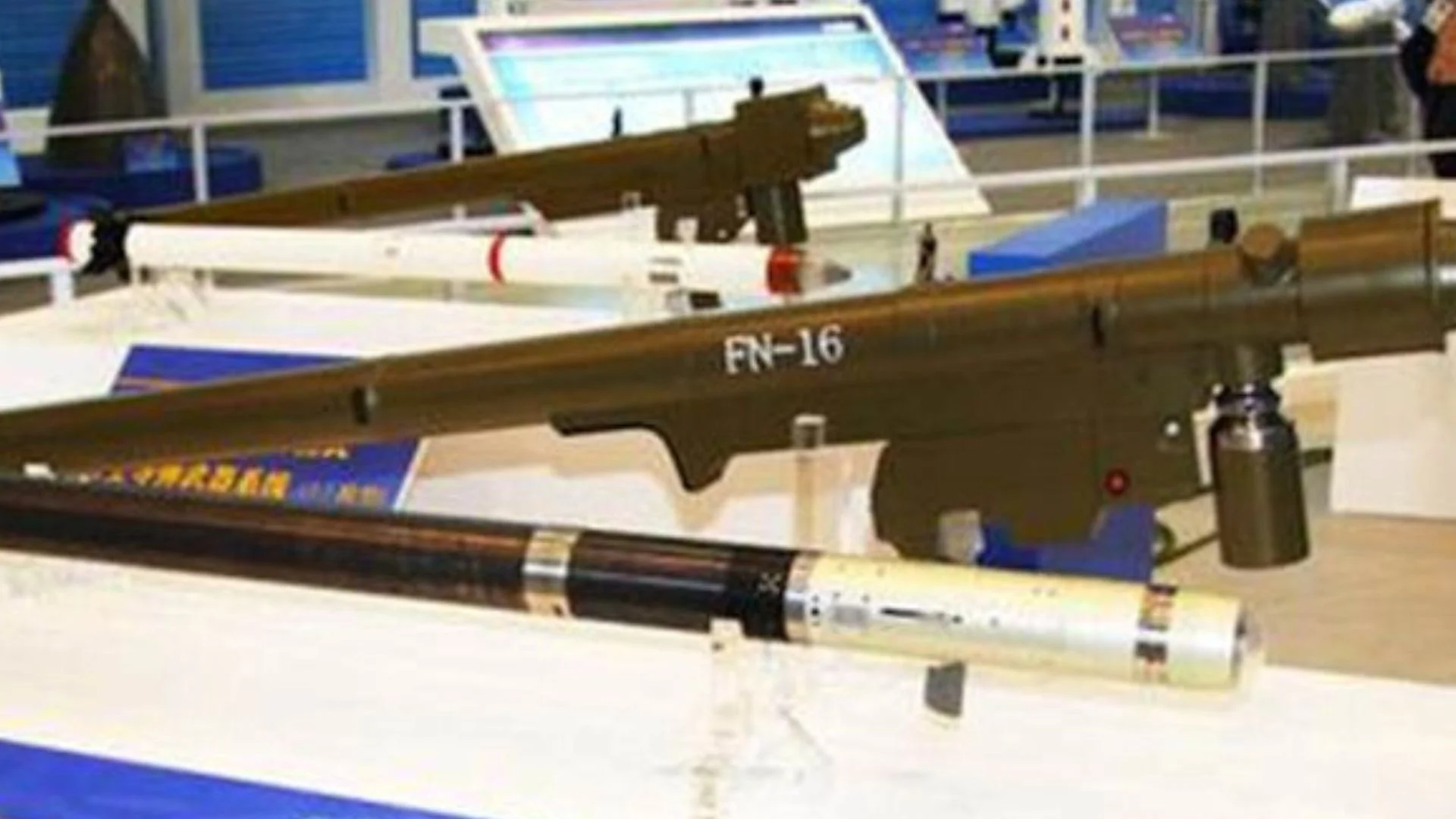
China has unveiled a dual-launcher version of its FN-16 missile, marking a shift toward faster and more effective short-range air defense on modern battlefields.
The FN-16 is designed to counter low-flying threats such as drones, helicopters, and cruise missiles. By adding a second ready-to-fire missile on the same launcher, the system now offers greater firepower at the moment of engagement. This matters in situations where threats appear quickly and in large numbers.
The dual-launcher setup improves reaction time. Instead of firing one missile and pausing to reload, operators can engage multiple targets in quick succession. This is especially important against drone swarms or fast-moving aircraft that give defenders only seconds to respond.
The FN-16 was first introduced as an upgrade to the earlier FN-6 system. It was publicly revealed at the Zhuhai Airshow in 2008. Since then, it has been promoted as a more capable low-altitude interception weapon.
READ ALSO: F-35s Turn Quarterbacks as Drone Swarms Redefine Marine Corps Air Combat
Chinese sources describe the missile as using a dual-color infrared and ultraviolet seeker. This helps it track targets more accurately and resist common countermeasures, such as flares. The system also includes a laser proximity fuze and an impact fuze, increasing the likelihood of destroying a target even if the missile misses it.
The FN-16 operates on a ‘fire-and-forget’ principle. Once launched, it self-guides to the target without further operator input. This allows soldiers to move or take cover immediately after firing.
Performance figures suggest the missile can engage targets at distances between 0.5 and 6 kilometers. It can operate at altitudes ranging from 10 meters up to 4,000 meters. The reaction time is around five seconds, which is critical in close-range air defense.
The missile itself is compact. It measures about 72 millimeters in diameter and up to 1.6 meters in length. It weighs no more than 11.5 kilograms, while the full combat system weighs around 18 kilograms. This makes it portable and suitable for frontline use.
WATCH ALSO: This robotic system to pick strawberries automates tough tasks
Speed and maneuverability are also key strengths. The FN-16 can travel at speeds of at least 600 meters per second and handle maneuvers of up to 18 g. These features enable it to intercept fast, agile targets.
What makes the new dual-launcher version stand out is its design. It follows a similar concept to the larger four-missile FN-16J system, which includes remote control, infrared tracking, and automated firing features. The twin launcher seen at a defense exhibition in Kuala Lumpur appears to be a lighter and more flexible version.
This design reduces the time needed to reload. It also gives operators a more stable firing platform. These advantages are useful when dealing with sudden threats, such as helicopters popping up from behind terrain or drones flying at low altitude.
The FN-16 is not meant to work alone. It fits into a layered air defense network. In such a system, different weapons cover different ranges and altitudes. The FN-16 fills the gap between gun systems and medium-range surface-to-air missiles.
READ ALSO: Blue Origin Reuses New Glenn: Lands Booster at Sea, But Satellite Hits Wrong Orbit
Armies can deploy these launchers around key locations. These include airbases, bridges, command centers, and supply depots. They can also be used with mobile units to protect troops on the move. Light radar systems or electro-optical sensors can help detect and track incoming threats.
The missile is also part of larger vehicle-based systems, such as the FB-6C. This shows that it is designed as a modular weapon that can be integrated into different platforms.
While China has not released a full list of users, reports indicate that several countries operate the FN-16. Pakistan is believed to have received over a thousand units between 2018 and 2021. Bangladesh also uses the system and has explored local production. Cambodia has reportedly acquired similar Chinese air defense weapons, though details remain unclear.
Competition-wise, the FN-16 is often compared to systems like the Stinger. It offers similar mobility and ease of use. However, its range and altitude are lower than those of some Western systems, such as the Mistral 3 and the RBS 70 NG.
Even so, the FN-16 has its own strengths. It is generally seen as more affordable and adaptable. Its compatibility with various platforms makes it attractive to countries looking to build layered air defense at a lower cost.
WATCH ALSO: United States is considering to conduct air strikes against drug cartels in Venezuela
The introduction of the dual-launcher version highlights a broader trend. Modern conflicts are increasingly shaped by drones and low-flying threats. These targets are hard to detect and even harder to intercept.
By improving ready-to-fire capacity and reducing response time, the FN-16 dual launcher offers a practical solution. It strengthens point defense and adds depth to existing air defense systems.
In today’s battlefield, the focus is not just on range or power. It is about speed, flexibility, and the ability to handle multiple threats at once. China’s latest move reflects that reality.