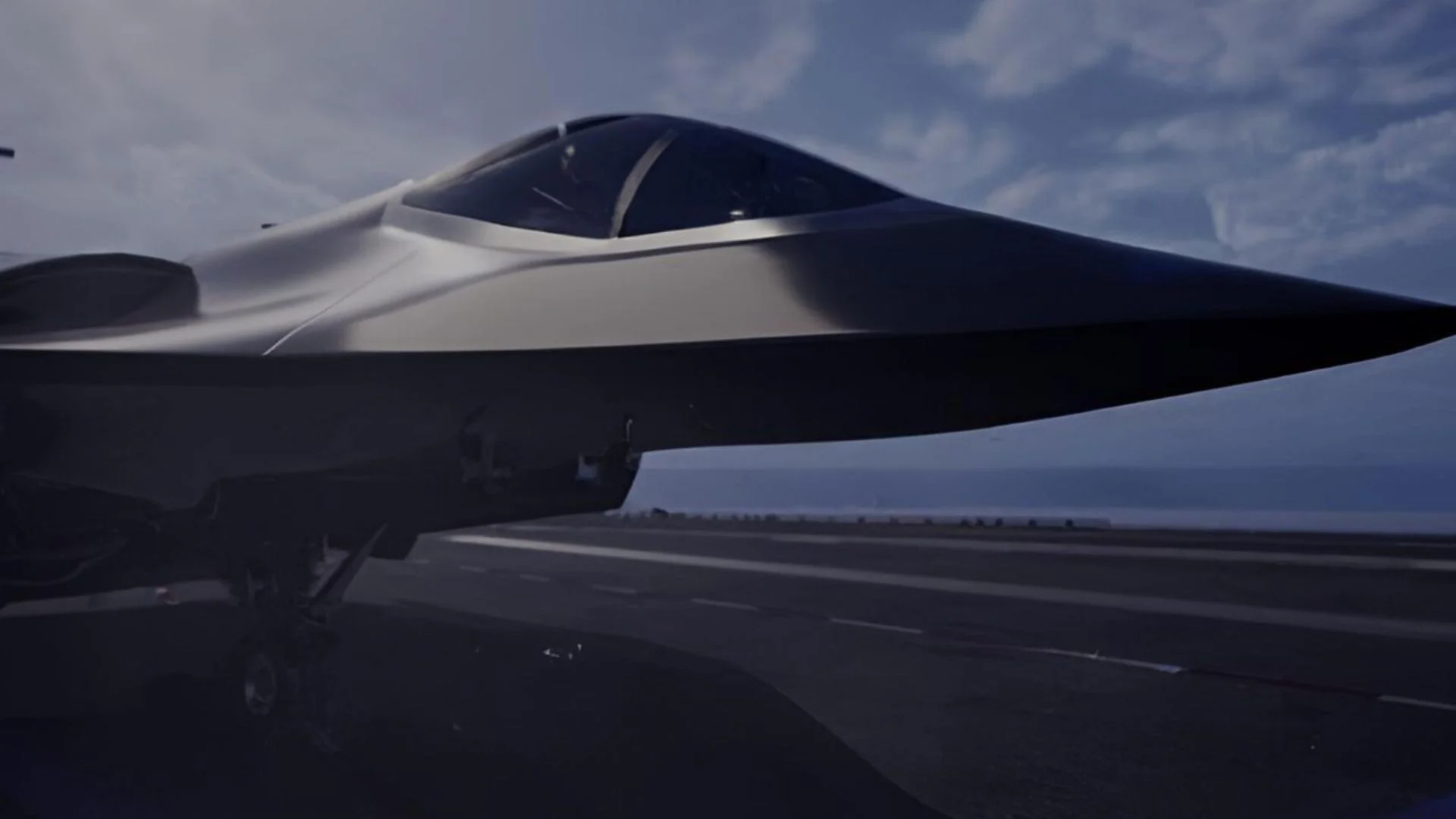
After years of delays, the US Navy is set to advance its next-generation carrier-based stealth fighter program, F/A-XX, with a key contracting decision expected by August, according to a top naval Admiral.
Chief of Naval Operations Daryl Caudle shared the update while speaking at the Sea-Air-Space 2026 exposition near Washington, D.C. He made it clear that the Navy is ready to move ahead, even after the program spent months stuck in what many described as procurement limbo.
The F/A-XX is a sixth-generation fighter jet designed to operate from aircraft carriers. It is expected to replace or work alongside current aircraft, such as the F/A-18 Super Hornet, and to complement the capabilities of the F-35 Lightning II.
For a long time, the program faced uncertainty. The Pentagon had effectively paused progress in its Fiscal Year 2026 budget request. At that time, the Navy asked for only $74 million, a relatively small amount for such a large and important project.
READ ALSO: Unitree Robotics H1 vs Usain Bolt: 10 m/s Sprint Puts Humans on Edge
However, the US Congress stepped in and changed the direction. Lawmakers approved $1.69 billion in funding through a mix of spending bills and legislative support. This move ensured that the F/A-XX program would continue rather than fade away.
Adm. Caudle explained why the Navy never lost sight of the need for this aircraft. He said, “We are seeing our competitors improve their air defense systems. At the same time, advanced weapons are becoming cheaper and more available.”
He added, “This is not just about facing a peer adversary. It is about having an aircraft that can operate in uncertainty with acceptable risk.”
The Navy believes the future battlefield will be more complex. More countries, and even smaller players, now have access to advanced weapons. This makes stealth, range, and adaptability more important than ever.
Why F/A-XX Matters for Future Air Power
The F/A-XX is not just another fighter jet. It is a key part of how the Navy plans to fight and survive in the future. One of its biggest roles will be to extend the reach of carrier air wings. Modern threats are forcing aircraft carriers to operate farther away from danger zones. This means fighter jets must fly farther while remaining stealthy and effective.
WATCH ALSO: World’s largest nuclear fusion research project ITER has reached a new milestone
Adm. Caudle highlighted how the F/A-XX will work closely with the MQ-25 Stingray, a carrier-based refueling drone built by Boeing. The MQ-25 is expected to enter initial service soon and will allow fighter jets to stay in the air longer.
“It ties to our MQ-25 for stealth refueling,” Caudle said. “It ties to our reach. It ties to building a carrier air wing that remains effective in the future.”
This combination of stealth fighter and refueling drone is expected to significantly increase the operational range of Navy aircraft. It also helps reduce risks by keeping carriers farther from enemy defenses.
The program is also about maintaining technological superiority. The US military is watching how threats are evolving. According to Caudle, current aircraft may become vulnerable by the time new systems are fully deployed.
“We assess these threats very closely,” he said. “We look at whether our designs will still overmatch them. We believe they will, but we know time is a factor.”
READ ALSO: No Leader, No Plan: Ant-Inspired Robot Swarms Build and Break on Their Own
Speed is becoming crucial. Developing and fielding a new fighter takes years. If delays continue, existing aircraft may face greater risks in future conflicts.
The race to build the F/A-XX currently involves two major defense companies: Boeing and Northrop Grumman. Both firms have already revealed early concepts for the aircraft.
Northrop Grumman presented a design featuring a sleek shape and a focus on global reach, dubbed ‘Project Power Anywhere.’ Boeing’s concept drew comparisons to its work on the Air Force’s next-generation fighter program, often referred to as the F-47. An earlier round of selection reportedly removed Lockheed Martin from the competition in 2025.
Despite this progress, challenges remain. One of the biggest concerns has been the US defense industry’s ability to handle multiple advanced fighter programs simultaneously. The Air Force is already pushing forward with its own sixth-generation fighter, creating pressure on resources and production capacity.
Adm. Caudle acknowledged this issue openly. He said, “We have many aircraft programs running. The Air Force has demand. The Navy has demand. One contractor may not deliver on time.”
He described the situation as a careful balancing act. “We took a hard look before moving forward. It was a ‘check twice, cut once’ decision,” he explained.
Even with renewed momentum, the Navy’s program still lags behind the Air Force’s effort in terms of funding. The Air Force’s next-generation fighter has already received billions and may secure an additional $5 billion in the coming budget cycle.
In comparison, the Navy has requested about $140 million more for the F/A-XX in the next fiscal year, a modest increase given the project’s scale. Still, the planned contract decision in August signals real progress. It shows that the Navy is ready to move beyond planning and into execution.
WATCH ALSO: Researchers from German have developed a diving robot that can easily collect underwater waste
The F/A-XX program has seen several moments where progress seemed close, only to stall again. Reports in late 2025 suggested that the program had already received approval and that a contract announcement was near. However, no major steps were taken at that time.
Now, with clear backing from Congress and renewed urgency from Navy leadership, the situation appears different. The decision expected by August could mark a turning point. It will shape the future of naval aviation and determine how the Navy maintains its edge in an increasingly contested world.
The stakes are high. The F/A-XX is not just about replacing older jets. It is about redefining how air power works from the sea.
It will give the Navy a powerful tool to operate in complex environments, extend its reach, and stay ahead of emerging threats. For now, all eyes remain on the upcoming decision. After years of waiting, the next chapter in the F/A-XX story is finally about to begin.