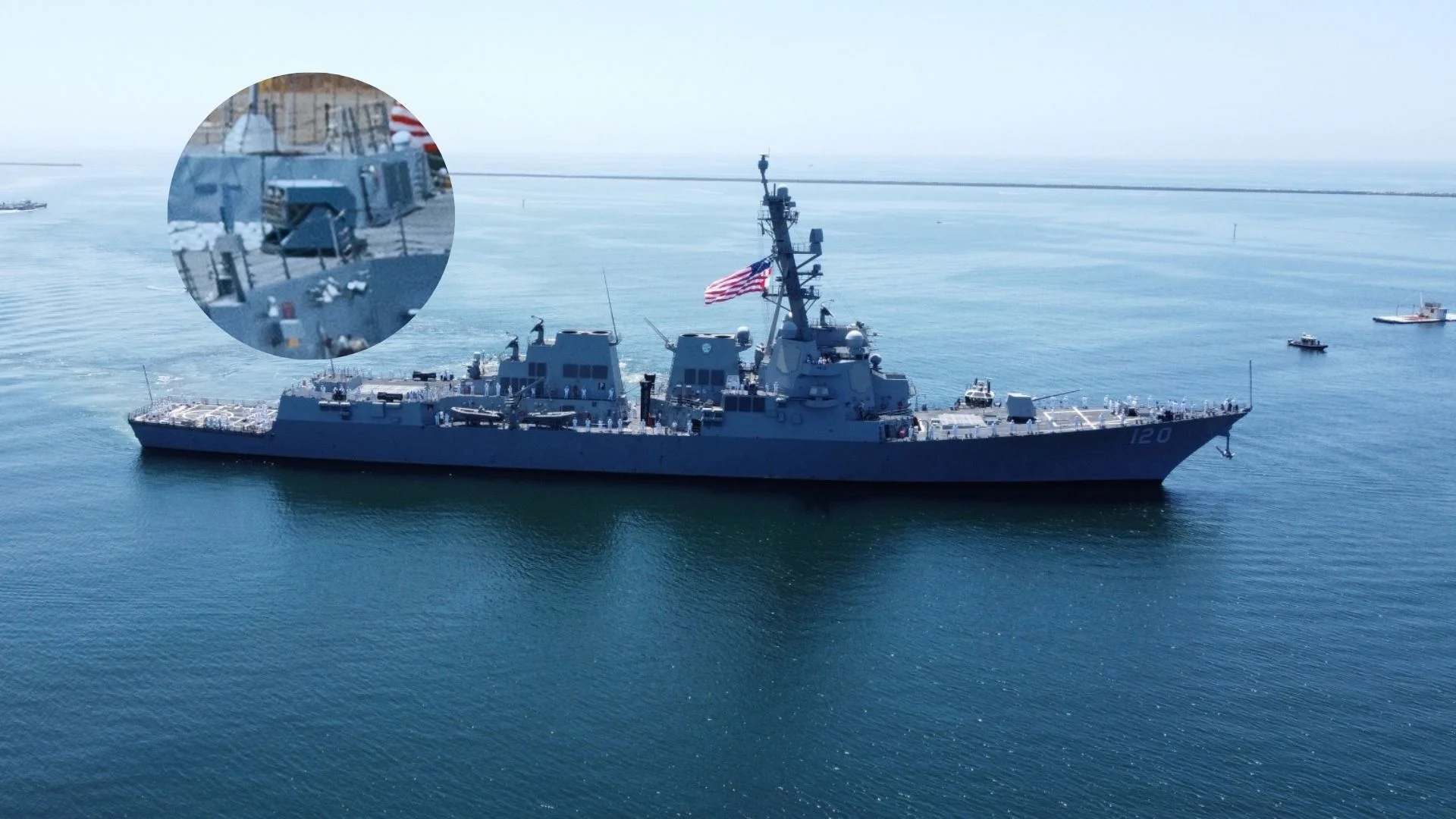
A new, unidentified launcher has been spotted aboard a US Navy destroyer, raising fresh questions about the future of naval warfare and evolving defense systems.
The warship in focus is the USS Carl M. Levin, an Arleigh Burke-class destroyer currently based in Pearl Harbor. The vessel has recently received a new installation on its aft upper deck, unlike anything previously seen on ships of its class.
The discovery was made through an image released by the US Marine Corps on April 8. The photograph, taken on March 29, captured the destroyer in the background. While the image was not meant to highlight the ship, it quickly caught the attention of observers.
A Japanese-language blog, OSINFO, was the first to identify the unusual launcher and share it on social media. Since then, defense analysts and enthusiasts have been closely examining the system, trying to understand its purpose.
READ ALSO: Butterfly-Inspired Lattice Resists Impact and Absorbs Energy for Aerospace, Earthquake Safety
The launcher is positioned at the aft end of the ship’s superstructure. It sits between the port-side torpedo tubes and the rear Mk 41 Vertical Launch System array. This location is already used on some destroyers for additional defensive systems, which makes the new installation even more interesting.
From the available visuals, the launcher appears to have multiple cells. Its design suggests it may be fixed in place rather than fully rotating. However, it likely tilts upward when firing. The base of the system seems circular, which supports the idea of limited movement rather than full rotation.
What the launcher actually fires remains unknown. There are several possibilities, and each one points to the changing nature of naval threats.
One of the strongest theories is that the launcher is designed for counter-drone operations. In recent years, drones have become a major threat to naval forces. Small, fast, and often deployed in swarms, they are difficult to detect and intercept.
WATCH ALSO: China’s military showcases modern battlefield capabilities in new exercise
The US Navy has already been testing solutions to deal with this growing challenge. Last year, launchers for Coyote counter-drone interceptor systems were installed on other destroyers, including the USS Bainbridge and the USS Winston S. Churchill. These launchers were placed in a similar location on the ships.
The similarity in placement suggests that the new launcher on the Levin may serve a related purpose.
Another possible candidate is the White Spike system. Developed by Zone 5 Technologies, White Spike is part of a broader initiative to develop low-cost counter-drone weapons.
This initiative, known as Counter Unmanned Aerial Systems – NEXT, is being led by the Defense Innovation Unit. Since 2024, the program has focused on finding new ways to defend against unmanned aerial threats, especially in naval environments.
The White Spike launcher shown earlier features four cells. While it does not exactly match the launcher seen on the Levin, there are noticeable similarities. The shape and overall structure suggest that the new system may be a modified or evolved version of the original.
READ ALSO: MIT’s Sandook Drives Data Center SSDs to Peak Performance Without New Hardware
Another system under evaluation is the Roadrunner-M, developed by Anduril Industries. However, the Roadrunner-M uses a vertical launch method and is designed for reuse. Its launcher design does not match what is seen on the Levin, making it a less likely candidate.
Still, the Navy has shown a strong interest in integrating both Roadrunner-M and Coyote systems across its fleet.
The urgency behind these efforts comes from real-world experiences. US Navy ships operating in and around the Red Sea have faced increasing drone threats in recent years. These encounters have highlighted gaps in existing defenses and the need for more flexible, cost-effective solutions.
Tensions involving Iran have further emphasized the importance of counter-drone capabilities. The scale and variety of unmanned threats continue to grow, forcing navies to adapt quickly. Beyond counter-drone roles, the new launcher may have other uses.
One possibility is that it is designed to fire small missiles, such as the AGM-179 Joint Air-to-Ground Missile. Developed by Lockheed Martin, this missile is an evolution of the AGM-114 Hellfire.
The JAGM uses advanced guidance systems, including millimeter-wave radar. This makes it effective not just against ground targets, but also against drones. In fact, earlier versions of the Hellfire missile have already been adapted for counter-drone roles.
WATCH ALSO: Buildroid AI expanding simulation-first robotic platform to multiple US sites
If the new launcher can fire such missiles, it would give the ship a powerful close-range defense option. It could also be used against small boats, including unmanned surface vessels.
Another possibility is that the launcher is meant for deploying drones. The Navy has been experimenting with drone systems that act as decoys. These decoys can mimic larger ships or create false targets, confusing incoming missiles. By doing so, they help protect real assets from attack.
In February, the Defense Innovation Unit called for designs of containerized drone launchers. These systems are intended to work both at sea and on land. The launcher seen on the Levin may be part of this effort.
Drone swarms offer several advantages. They can perform surveillance, electronic warfare, and even offensive missions. Having a dedicated launcher for such systems would greatly enhance a ship’s capabilities.
The launcher might also be used for shorter-range decoys or other countermeasures. These could include systems designed to disrupt enemy sensors or mislead incoming threats.
At this stage, the Navy has not confirmed any details about the system. Officials have not revealed its purpose, capabilities, or future plans. It is also unclear whether similar launchers will be installed on other ships.
However, the presence of this new system highlights an important trend. The Arleigh Burke-class destroyers have long been the backbone of the US Navy’s surface fleet. Over the years, they have been upgraded multiple times to keep pace with new threats.
READ ALSO: MIT Editing Tool Lets Chemists Shift Molecule Parts Without Rebuilding
In many cases, new technologies are first tested on a small number of ships. If successful, they are then expanded across the fleet or included in larger modernization programs.
The addition of this mysterious launcher fits that pattern. It shows that the Navy is actively exploring new ways to strengthen its defenses. It also reflects the growing importance of flexibility in modern warfare.
As threats evolve, so must the systems designed to counter them. Whether the launcher is meant for interceptors, missiles, drones, or decoys, one thing is clear. The USS Carl M. Levin is now at the center of a new chapter in naval innovation.
However, the system remains a mystery. But its presence signals that the future of naval combat is already taking shape, quietly, and just out of sight.