China has revealed a new generation of military robots that behave less like machines and more like coordinated wolf packs.
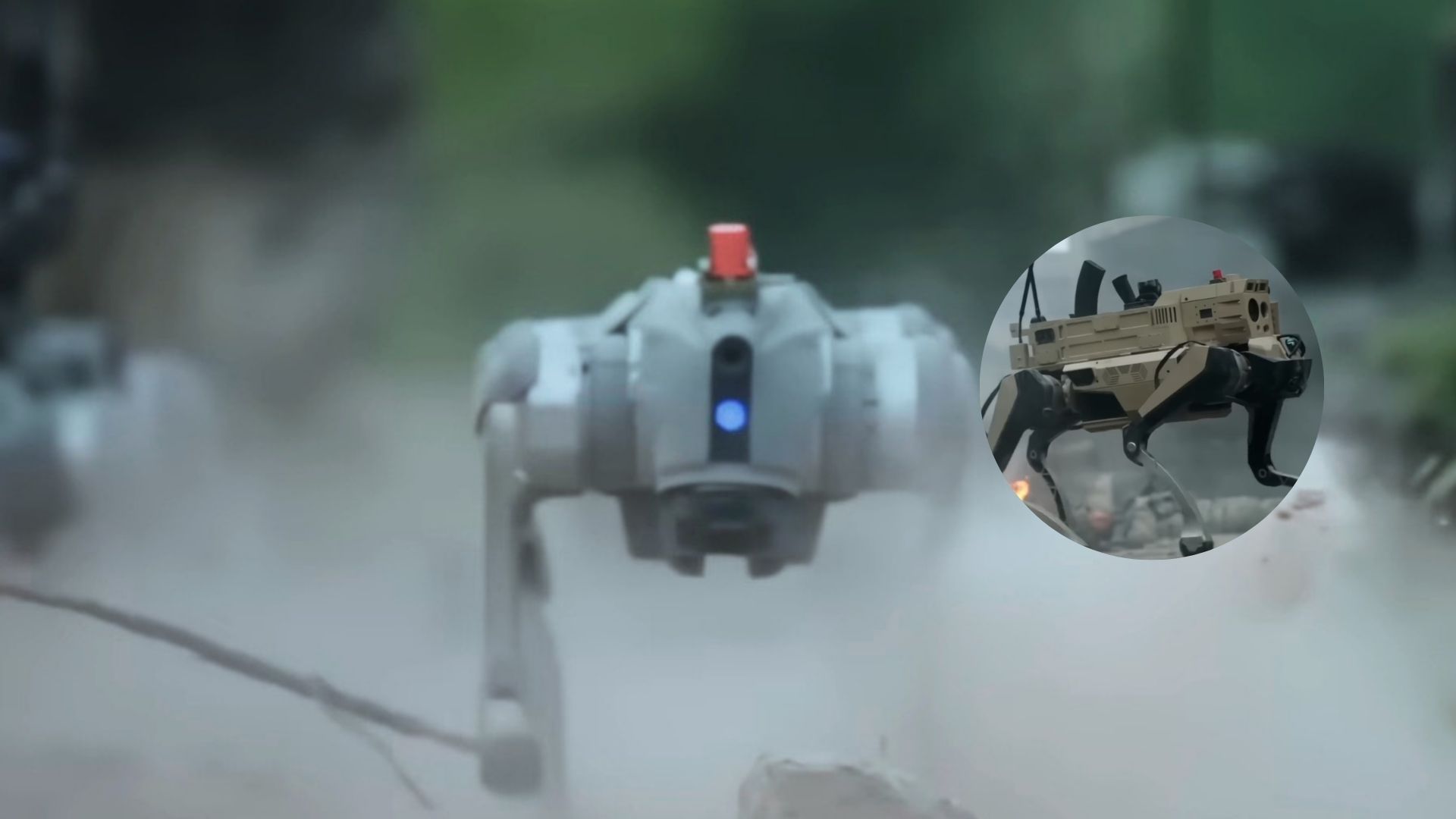
In a recent documentary aired by China Central Television, the country showcased advanced unmanned systems developed for the People’s Liberation Army. The highlight was a group of robotic dogs designed to operate together as an intelligent “wolf pack” in urban combat.
Unlike earlier versions that worked as single support units, these new robots act as a team. They share data, make coordinated decisions, and adapt to changing situations in real time.
The program, titled Unmanned Competition, offers a glimpse into how warfare could shift toward fully autonomous systems working in sync across land, air, and sea.
READ ALSO: US’s F-22 Secret Upgrade Emerges: Stealth Tanks and Pods Hint at New Air Combat Edge
Robot ‘Wolf Pack’: A Shared Brain, Specialized Roles
At the core of the “wolf pack” is a shared sensing network. This acts like a collective brain, allowing each robot to understand its surroundings while staying connected to the group.
During a simulated urban mission, the robots moved together, scanning areas, identifying targets, and adjusting their actions at every step without direct human control.
Each robot in the pack has a specific role.
The “Shadow” unit focuses on reconnaissance and real-time awareness. The “Bloody” variant is designed for combat and can carry weapons such as micro-missiles, grenade launchers, and automatic rifles. The “Polar” unit supports the team with logistics and backup functions.
These robots can move at up to 15 km/h and carry loads of up to 25 kg. They are built to operate in harsh environments and across different types of terrain.
WATCH ALSO: EHang’s next-gen autonomous eVTOL completes first public flight
Despite their advanced capabilities, human operators still make final decisions before any strike.
Researchers behind the project say the goal is to create systems that can collaborate smoothly. One scientist explained, “We are building machines that understand each other and act together as a single unit.”
Atlas: Drone Swarms and Smart Laser Defense
The documentary also revealed a powerful drone swarm system called Atlas. This system includes up to 96 drones, each performing a different task such as surveillance, electronic jamming, or targeted strikes. A single operator can control the entire swarm.
The drones communicate with each other in real time. They adjust their positions and actions constantly to stay coordinated during missions.
A researcher involved in the project said, “Each drone behaves as if it has its own brain, but they work together to complete the mission.”
The system is designed to function even when communication signals are blocked. Scientists are working toward what they call coordination without communication, where drones can predict each other’s actions and operate independently of external signals.
Alongside drones, China is also developing advanced laser weapons to counter aerial threats. Two systems were highlighted. The Guangjian 11-E uses low-power lasers to disable small drones by blinding their sensors. The more powerful Guangjian 21-A is designed to completely destroy targets.
READ ALSO: Canada’s University of Waterloo Engineers Bacteria That Eat Cancer Tumors
These systems use intelligent algorithms to identify and prioritize threats. They can target the most dangerous drones first before shifting focus to others.
Expanding Unmanned Operations Across Domains
China’s push for unmanned systems is not limited to land and air. The documentary also showed unmanned surface vessels used for maritime patrol. These boats can travel at high speeds and operate over long distances. They can plan routes, avoid obstacles, and identify targets using artificial intelligence.
In coordinated operations, these vessels can form tactical formations to surround or block targets. In some cases, they can even disable threats through direct action.
Experts say the broader goal is to build a network of autonomous systems that can operate together across different environments.
WATCH ALSO: China commissions world’s largest open-sea offshore solar photovoltaic project
A scientist involved in the program said, “We aim for large-scale autonomy where systems work together without constant human input.”
While these technologies are still evolving, they point to a future in which machines play a larger role in decision-making and combat. The rise of coordinated robotic systems from wolf-like ground units to intelligent drone swarms suggests that the nature of warfare is entering a new and highly automated phase.